Question 1
How many distinct arrangements can be made using all the letters of the word PARALLEL?
- A. $1680$
- B. $6720$
- C. $3360$
- D. $40\,320$
70 marks · an original Intuition practice paper realising the consensus predictions — every question links to the evidence behind it. Prefer the PDF?
This full-length practice paper was synthesised from a six-model AI consensus (Fable, Opus, GPT-5.6 Sol, Gemini 3.1 Pro, Grok, DeepSeek) over 152 question-level predictions for the 2026 HSC Mathematics Extension 1 examination. Every consensus cluster with agreement probability ≥ 0.55 is realised as a question below, with the remaining marks drawn from the panel's watch list; all questions are original Intuition Education compositions in NESA style — no question is reproduced from a past HSC paper. A prediction provenance table follows the marking notes.
General Instructions
Section I — 10 marks (Questions 1–10) Attempt Questions 1–10. Allow about 15 minutes for this section.
Section II — 60 marks (Questions 11–14) Attempt Questions 11–14. Allow about 1 hour and 45 minutes for this section.
10 marks — Attempt Questions 1–10 — Allow about 15 minutes for this section
Use the multiple-choice answer sheet for Questions 1–10.
How many distinct arrangements can be made using all the letters of the word PARALLEL?
The projection of $\underset{\sim}{u}$ onto $\underset{\sim}{v}$ is given by $\dfrac{\underset{\sim}{u} \cdot \underset{\sim}{v}}{|\underset{\sim}{v}|^2}\,\underset{\sim}{v}$.
What is the projection of $\underset{\sim}{u} = 3\underset{\sim}{i} - \underset{\sim}{j}$ onto $\underset{\sim}{v} = \underset{\sim}{i} + 2\underset{\sim}{j}$?
What is the value of $\cos^{-1}\left(\cos\dfrac{5\pi}{4}\right)$?
Using the substitution $t = \tan\dfrac{x}{2}$, the expression $\dfrac{1 - \cos x}{\sin x}$ simplifies to which of the following?
How many distinct solutions are there to the equation $\sin 2x = \sin x$ for $0 \le x \le 2\pi$?
Air is pumped into a spherical balloon so that its volume increases at a constant rate of $100 \text{ cm}^3\text{ s}^{-1}$.
What is the rate of increase of the radius, in $\text{cm s}^{-1}$, when the radius is $5$ cm?
A sample of $100$ voters is taken from a large population in which the proportion supporting a proposal is $p = 0.2$. Let $\hat{p}$ denote the sample proportion.
What is the standard deviation of $\hat{p}$?
What is the coefficient of $x^4$ in the expansion of $(x + 2)^7$?
Let $f(x) = x^3 + 3x + 1$. The function $f$ is increasing for all real $x$, so the inverse function $f^{-1}$ exists.
What is the value of $\left(f^{-1}\right)'(5)$?
What is the smallest number of people needed in a room to guarantee that at least $4$ of them were born on the same day of the week?
60 marks — Attempt Questions 11–14 — Allow about 1 hour and 45 minutes for this section
Answer each question in the appropriate writing booklet. Extra writing booklets are available. For questions in Section II, your responses should include relevant mathematical reasoning and/or calculations.
(a) Let $\underset{\sim}{a} = 2\underset{\sim}{i} + 3\underset{\sim}{j}$ and $\underset{\sim}{b} = -\underset{\sim}{i} + 4\underset{\sim}{j}$.
(i) Find $2\underset{\sim}{a} - \underset{\sim}{b}$. (1 mark)
(ii) Find $\underset{\sim}{a} \cdot \underset{\sim}{b}$. (1 mark)
(b) The polynomial $P(x) = 2x^3 + ax^2 + bx - 3$ has $(x - 1)$ as a factor. When $P(x)$ is divided by $(x + 2)$, the remainder is $-3$.
Find the values of $a$ and $b$. (3 marks)
(c) Solve $\dfrac{3}{x} \le x + 2$. (3 marks)
(d)
(i) Express $\sqrt{3}\sin x - \cos x$ in the form $R\sin(x - \alpha)$, where $R > 0$ and $0 < \alpha < \dfrac{\pi}{2}$. (2 marks)
(ii) Hence, or otherwise, solve $\sqrt{3}\sin x - \cos x = \sqrt{2}$ for $0 \le x \le 2\pi$. (2 marks)
(e) Use the substitution $u = x^2 + 9$ to evaluate
$$\int_0^4 x\sqrt{x^2 + 9}\; dx.$$
(3 marks)
(a) Use mathematical induction to prove that $5^n + 2 \times 11^n$ is divisible by $3$ for all integers $n \ge 1$. (3 marks)
(b) Solve the differential equation
$$\frac{dy}{dx} = \frac{x}{y},$$
given that $y = -4$ when $x = 3$. Give your answer with $y$ as the subject, justifying your choice of sign. (3 marks)
(c) The diagram shows the direction field for the differential equation
$$\frac{dy}{dx} = \frac{1}{2}\,y\,(2 - y).$$
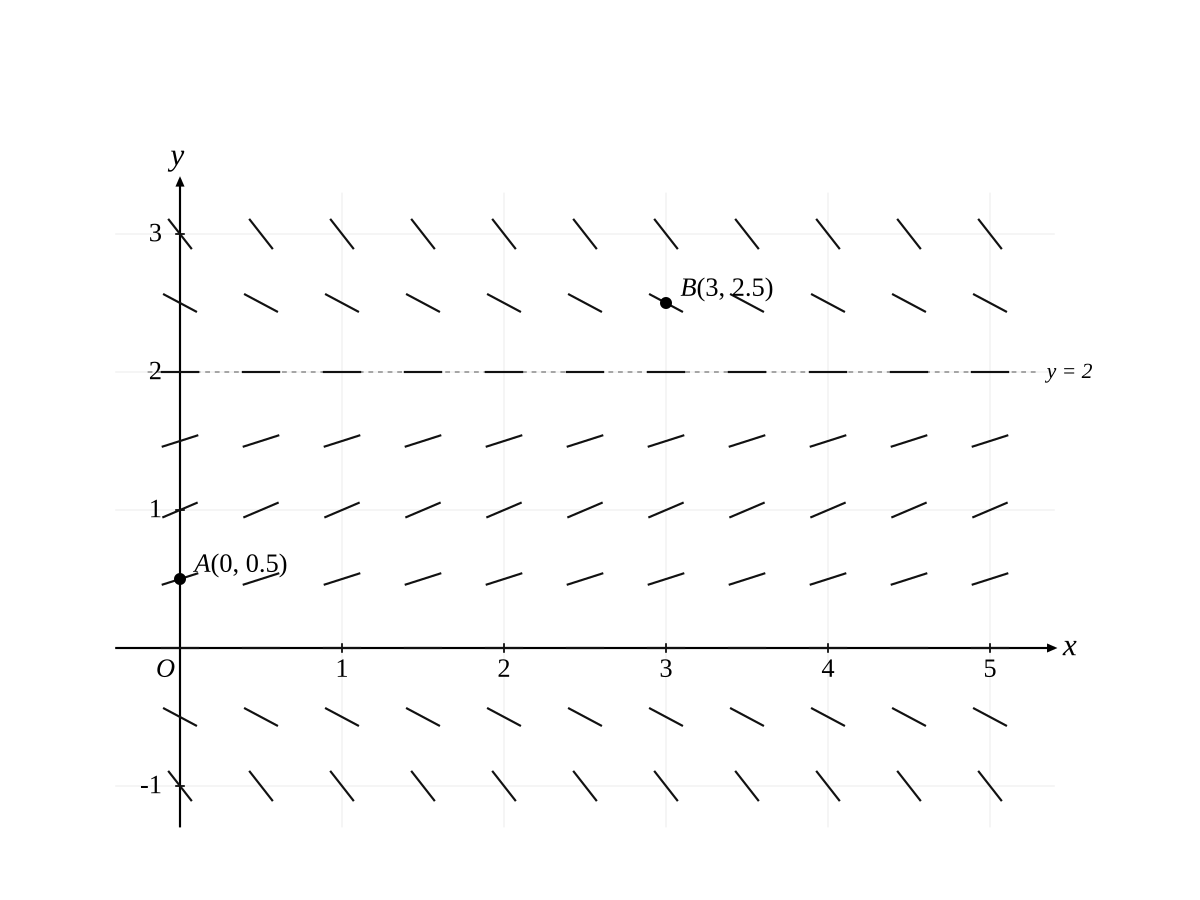
(i) On the diagram, sketch the graph of the particular solution that passes through the point $A(0, 0.5)$, showing its behaviour as $x$ increases. (2 marks)
(ii) Explain why the solution through $A$ can never pass through the point $B(3, 2.5)$. (1 mark)
(d) The region bounded by the curve $y = \dfrac{4}{x^2 + 1}$, the $y$-axis and the line $y = 1$ is rotated about the $y$-axis.
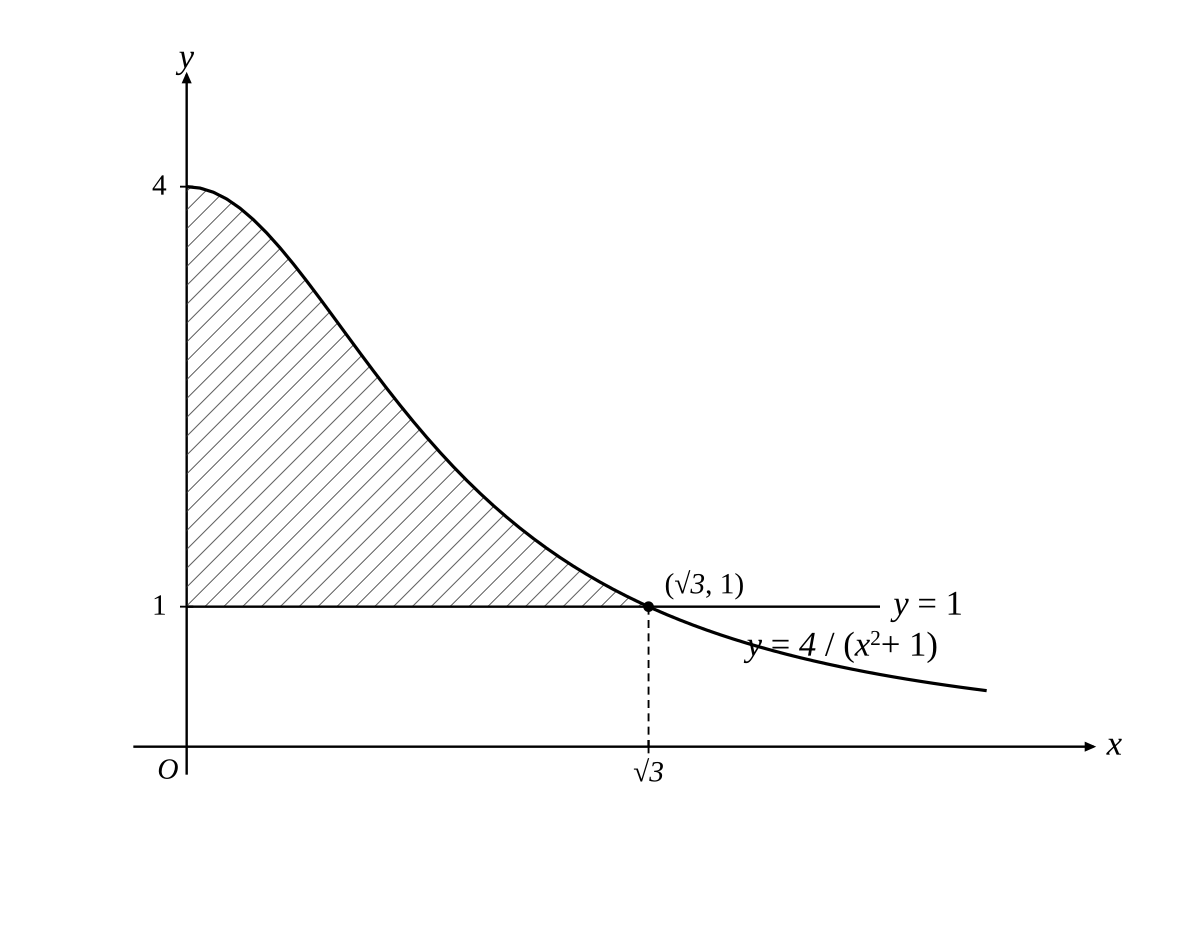
Find the exact volume of the solid formed. (3 marks)
(e) Solve $\cos 2x + \cos x + 1 = 0$ for $0 \le x \le 2\pi$. (3 marks)
(a) Sketch the graph of $y = 3\cos^{-1}\left(\dfrac{x}{2}\right)$, clearly labelling the coordinates of the endpoints of the graph. (2 marks)
(b) The points $A$ and $B$ lie at opposite ends of a diameter of a circle with centre $O$ and radius $r$, and $P$ is any other point on the circle. Relative to $O$, the points $A$, $B$ and $P$ have position vectors $\underset{\sim}{a}$, $-\underset{\sim}{a}$ and $\underset{\sim}{p}$ respectively.
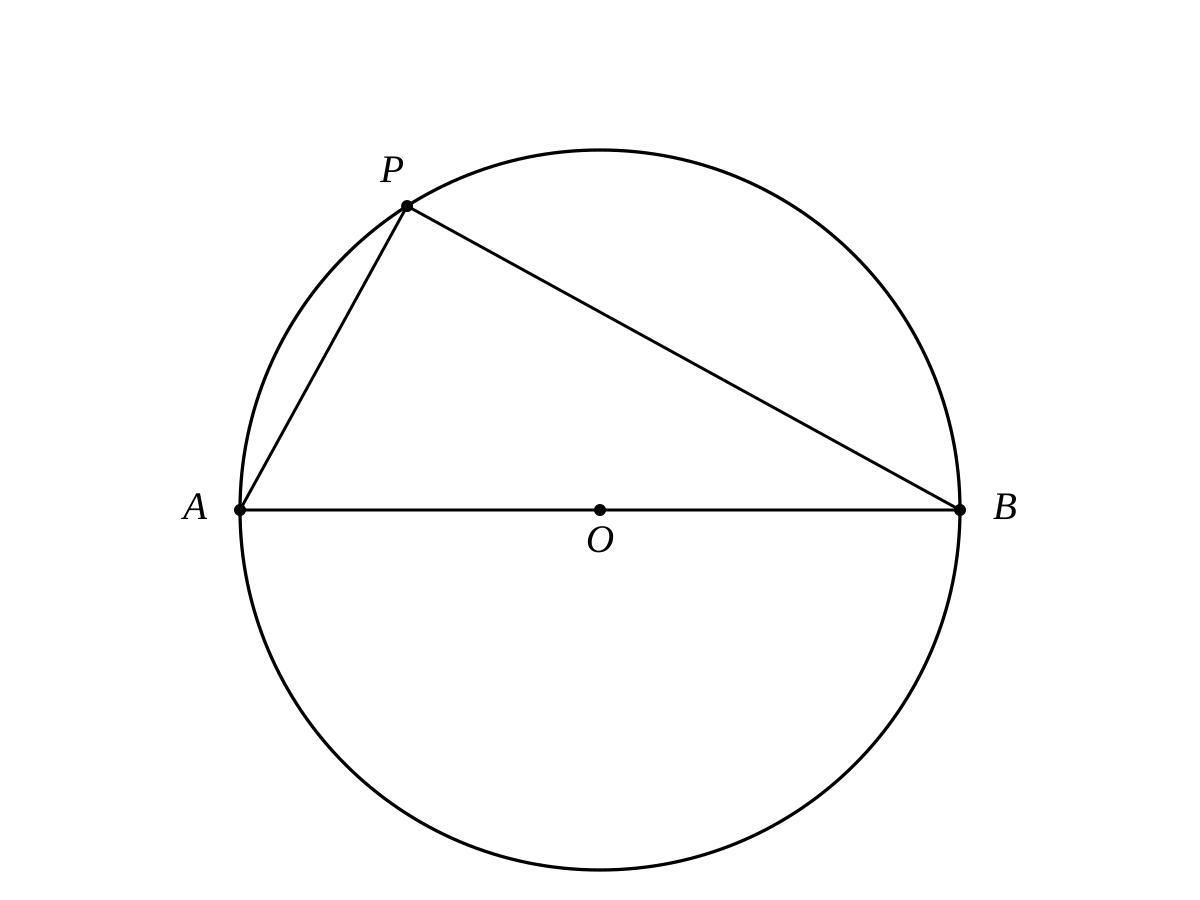
Using vectors, prove that $\angle APB = 90°$. (3 marks)
(c) A large nursery plants $400$ seeds. Each seed germinates with probability $0.9$, independently of all other seeds. The number $X$ of seeds that germinate is approximated by a normal distribution.
The table gives values of $P(Z \le z)$ for a standard normal variable $Z$.
| $z$ | $1.3$ | $1.4$ | $1.5$ | $1.6$ | $1.7$ |
|---|---|---|---|---|---|
| $P(Z \le z)$ | $0.9032$ | $0.9192$ | $0.9332$ | $0.9452$ | $0.9554$ |
(i) Find the mean and standard deviation of $X$. (1 mark)
(ii) The nursery's records show that the probability that fewer than $k$ seeds germinate is approximately $0.0668$. Using the normal approximation, find the value of $k$. (3 marks)
(d) Evaluate
$$\int_0^{\frac{\pi}{8}} \sin^2 (2x)\; dx,$$
giving your answer in exact form. (3 marks)
(e) The equation $x^3 + 2x^2 - 3x - 1 = 0$ has roots $\alpha$, $\beta$ and $\gamma$.
Find the value of $\alpha^2 + \beta^2 + \gamma^2$. (2 marks)
(a) By first completing the square in the denominator, show that
$$\int_{-1}^{1} \frac{dx}{x^2 + 2x + 5} = \frac{\pi}{8}.$$
(3 marks)
(b) Five points are placed inside or on the boundary of an equilateral triangle of side length $2$ cm.
By dividing the triangle into suitable regions, prove that at least two of the points must be no more than $1$ cm apart. (3 marks)
(c) You may use the identity $\tan 3\theta = \dfrac{3\tan\theta - \tan^3\theta}{1 - 3\tan^2\theta}$.
(i) Show that $t = \tan\dfrac{\pi}{12}$, $t = \tan\dfrac{5\pi}{12}$ and $t = \tan\dfrac{3\pi}{4}$ are the three roots of the equation
$$t^3 - 3t^2 - 3t + 1 = 0.$$
(2 marks)
(ii) Hence show that $\tan\dfrac{\pi}{12} + \tan\dfrac{5\pi}{12} = 4$. (1 mark)
(d) Two balls are launched from a point $O$ on horizontal ground. Take $g = 10 \text{ m s}^{-2}$ and ignore air resistance.
Ball $A$ is launched at time $t = 0$ with speed $V \text{ m s}^{-1}$ at an angle of $60°$ above the horizontal. Its position at time $t \ge 0$ seconds is given by
$${\underset{\sim}{r}}_A(t) = \frac{Vt}{2}\,\underset{\sim}{i} + \left(\frac{\sqrt{3}\,Vt}{2} - 5t^2\right)\underset{\sim}{j}. \qquad \text{(Do NOT prove this.)}$$
Ball $B$ is launched from $O$ at time $t = T$, where $T > 0$, with the same speed $V \text{ m s}^{-1}$ but at an angle of $30°$ above the horizontal. Its position at time $t \ge T$ seconds is given by
$${\underset{\sim}{r}}_B(t) = \frac{\sqrt{3}\,V(t - T)}{2}\,\underset{\sim}{i} + \left(\frac{V(t - T)}{2} - 5(t - T)^2\right)\underset{\sim}{j}. \qquad \text{(Do NOT prove this.)}$$
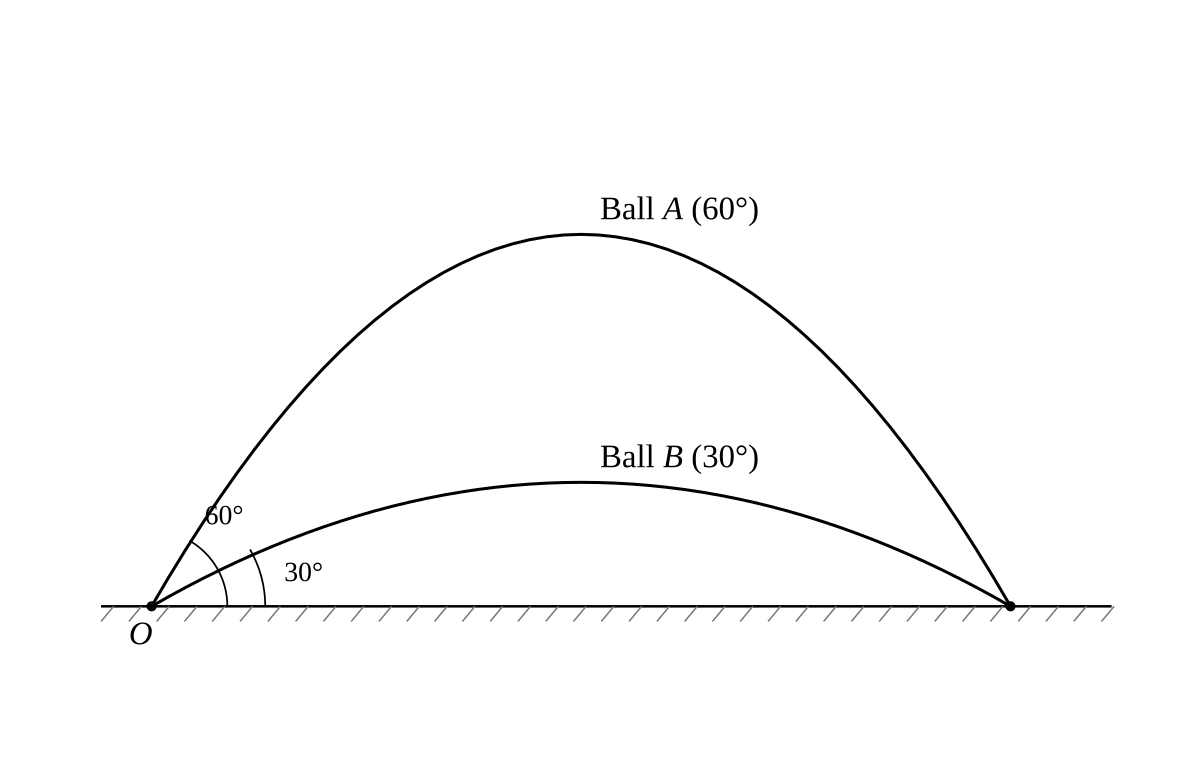
(i) Show that ball $A$ lands at time $t = \dfrac{\sqrt{3}\,V}{10}$, and that ball $B$ is in flight for $\dfrac{V}{10}$ seconds. Hence show that the two balls land at the same point. (3 marks)
(ii) The two balls land at the same instant. Show that $T = \dfrac{(\sqrt{3} - 1)V}{10}$, and hence find the exact value of $V$ for which $T = 2$. (2 marks)
(iii) Show that, at the moment the balls land, the acute angle between their velocity vectors is $\dfrac{\pi}{6}$. (2 marks)
(Intuition Education — not part of the examination paper.)
| Q | 1 | 2 | 3 | 4 | 5 | 6 | 7 | 8 | 9 | 10 |
|---|---|---|---|---|---|---|---|---|---|---|
| Answer | C | C | B | A | C | A | D | B | D | B |
Brief reasons:
(a)(i) $2\underset{\sim}{a} - \underset{\sim}{b} = (4+1)\underset{\sim}{i} + (6-4)\underset{\sim}{j} = 5\underset{\sim}{i} + 2\underset{\sim}{j}$. (a)(ii) $\underset{\sim}{a}\cdot\underset{\sim}{b} = -2 + 12 = 10$.
(b) $P(1) = 0$: $2 + a + b - 3 = 0 \Rightarrow a + b = 1$. $P(-2) = -3$: $-16 + 4a - 2b - 3 = -3 \Rightarrow 2a - b = 8$. Adding: $3a = 9$, so $a = 3$, $b = -2$. (1 mark each equation, 1 mark solving.)
(c) Multiply both sides by $x^2 > 0$ ($x \ne 0$): $3x \le x^3 + 2x^2$, i.e. $x(x+3)(x-1) \ge 0$. Sign analysis of the cubic gives $-3 \le x < 0$ or $x \ge 1$ ($x = 0$ excluded as it zeroes the denominator). (1 mark valid method, 1 mark three critical values $-3, 0, 1$, 1 mark correct union with $x=0$ excluded.)
(d)(i) $R = \sqrt{3 + 1} = 2$, $\tan\alpha = \tfrac{1}{\sqrt{3}} \Rightarrow \alpha = \tfrac{\pi}{6}$; so $2\sin\left(x - \tfrac{\pi}{6}\right)$. (d)(ii) $\sin\left(x - \tfrac{\pi}{6}\right) = \tfrac{\sqrt{2}}{2}$ with $x - \tfrac{\pi}{6} \in \left[-\tfrac{\pi}{6}, \tfrac{11\pi}{6}\right]$: $x - \tfrac{\pi}{6} = \tfrac{\pi}{4}, \tfrac{3\pi}{4}$, so $x = \tfrac{5\pi}{12}, \tfrac{11\pi}{12}$.
(e) $du = 2x\,dx$; limits $x=0 \to u=9$, $x=4 \to u=25$. $\tfrac{1}{2}\int_9^{25} u^{1/2} du = \tfrac{1}{3}\left[u^{3/2}\right]_9^{25} = \tfrac{125 - 27}{3} = \dfrac{98}{3}$.
(a) Base case $n=1$: $5 + 22 = 27 = 3 \times 9$. Assume $5^k + 2 \times 11^k = 3M$, $M$ an integer. Then $5^{k+1} + 2 \times 11^{k+1} = 5\left(5^k + 2\times 11^k\right) + 12 \times 11^k = 3\left(5M + 4 \times 11^k\right)$, divisible by 3. Conclusion by induction. (The middle mark requires the assumption to be substituted — e.g. via the regrouping above or by writing $5^k = 3M - 2 \times 11^k$ — not merely restated.)
(b) $y\,dy = x\,dx \Rightarrow \tfrac{y^2}{2} = \tfrac{x^2}{2} + C$. At $(3, -4)$: $16 = 9 + C' \Rightarrow y^2 = x^2 + 7$. Since $y(3) = -4 < 0$ and $y \ne 0$, the solution stays on the negative branch: $y = -\sqrt{x^2 + 7}$. (1 mark separation/integration, 1 mark constant, 1 mark negative branch with justification.)
(c)(i) An increasing S-shaped (logistic-type) curve through $(0, 0.5)$, following the slope segments, concave up then concave down, approaching the asymptote $y = 2$ from below as $x$ increases (never crossing it, never crossing $y=0$). (c)(ii) $y = 2$ is itself a (constant) solution along which $\dfrac{dy}{dx} = 0$; solution curves cannot cross it, so a curve starting below $y = 2$ remains below it and can never reach $B(3, 2.5)$.
(d) $x^2 = \dfrac{4}{y} - 1$; curve meets $y$-axis at $y = 4$ and the line at $y = 1$. $$V = \pi\int_1^4 \left(\frac{4}{y} - 1\right) dy = \pi\left[4\ln y - y\right]_1^4 = \pi\left(4\ln 4 - 3\right) = \left(8\ln 2 - 3\right)\pi \text{ cubic units.}$$
(e) $\cos 2x = 2\cos^2 x - 1$: equation becomes $\cos x\,(2\cos x + 1) = 0$. $\cos x = 0$: $x = \tfrac{\pi}{2}, \tfrac{3\pi}{2}$; $\cos x = -\tfrac{1}{2}$: $x = \tfrac{2\pi}{3}, \tfrac{4\pi}{3}$. (Factorise — do not divide by $\cos x$.)
(a) Decreasing curve from endpoint $(-2, 3\pi)$ to endpoint $(2, 0)$, passing through $\left(0, \tfrac{3\pi}{2}\right)$; domain $[-2, 2]$, range $[0, 3\pi]$.
(b) $\overrightarrow{PA} = \underset{\sim}{a} - \underset{\sim}{p}$ and $\overrightarrow{PB} = -\underset{\sim}{a} - \underset{\sim}{p}$. Then $\overrightarrow{PA}\cdot\overrightarrow{PB} = (\underset{\sim}{a} - \underset{\sim}{p})\cdot(-(\underset{\sim}{a} + \underset{\sim}{p})) = -\left(|\underset{\sim}{a}|^2 - |\underset{\sim}{p}|^2\right) = -(r^2 - r^2) = 0$ since $|\underset{\sim}{a}| = |\underset{\sim}{p}| = r$ (radii). Hence $\overrightarrow{PA} \perp \overrightarrow{PB}$, i.e. $\angle APB = 90°$.
(c)(i) $\mu = np = 360$; $\sigma = \sqrt{np(1-p)} = \sqrt{36} = 6$. (c)(ii) $P(X < k) = 0.0668 \Rightarrow P\left(Z < \dfrac{k - 360}{6}\right) = 1 - 0.9332$, so $\dfrac{k - 360}{6} = -1.5$ and $k = 360 - 9 = 351$. (Reverse use of the table: 1 mark for $z = -1.5$ via symmetry, 1 mark standardising, 1 mark $k = 351$.)
(d) $\sin^2 2x = \tfrac{1}{2}(1 - \cos 4x)$ (reference sheet): $$\left[\frac{x}{2} - \frac{\sin 4x}{8}\right]_0^{\pi/8} = \frac{\pi}{16} - \frac{1}{8}.$$
(e) $\alpha + \beta + \gamma = -2$, $\alpha\beta + \beta\gamma + \gamma\alpha = -3$. So $\alpha^2 + \beta^2 + \gamma^2 = (-2)^2 - 2(-3) = 10$.
(a) $x^2 + 2x + 5 = (x+1)^2 + 4$, so the integral is $\left[\tfrac{1}{2}\tan^{-1}\tfrac{x+1}{2}\right]_{-1}^{1} = \tfrac{1}{2}\left(\tan^{-1}1 - \tan^{-1}0\right) = \tfrac{1}{2}\cdot\tfrac{\pi}{4} = \tfrac{\pi}{8}$.
(b) Join the midpoints of the sides: this divides the triangle into four equilateral triangles of side $1$ cm (construct the holes). By the pigeonhole principle, two of the five points lie in the same small triangle; any two points in an equilateral triangle of side 1 are at most $1$ cm apart (its diameter is its side). Hence two points are no more than 1 cm apart.
(c)(i) If $\tan 3\theta = 1$ with $t = \tan\theta$: $3t - t^3 = 1 - 3t^2$, i.e. $t^3 - 3t^2 - 3t + 1 = 0$. $\tan 3\theta = 1$ for $3\theta = \tfrac{\pi}{4}, \tfrac{5\pi}{4}, \tfrac{9\pi}{4}$, i.e. $\theta = \tfrac{\pi}{12}, \tfrac{5\pi}{12}, \tfrac{3\pi}{4}$, giving three distinct tan values — the three roots of the cubic. (c)(ii) Sum of roots $= 3$: $\tan\tfrac{\pi}{12} + \tan\tfrac{5\pi}{12} + \tan\tfrac{3\pi}{4} = 3$, and $\tan\tfrac{3\pi}{4} = -1$, so $\tan\tfrac{\pi}{12} + \tan\tfrac{5\pi}{12} = 4$.
(d)(i) $A$ lands when $\tfrac{\sqrt{3}Vt}{2} - 5t^2 = 0$, $t > 0$: $t = \tfrac{\sqrt{3}V}{10}$. For $B$, with flight time $s = t - T$: $\tfrac{Vs}{2} - 5s^2 = 0$, $s > 0$: $s = \tfrac{V}{10}$. Ranges: $x_A = \tfrac{V}{2}\cdot\tfrac{\sqrt{3}V}{10} = \tfrac{\sqrt{3}V^2}{20}$ and $x_B = \tfrac{\sqrt{3}V}{2}\cdot\tfrac{V}{10} = \tfrac{\sqrt{3}V^2}{20}$ — equal, so same landing point. (Key trap: the two balls have different flight-time variables; each vertical displacement is set to zero separately.) (d)(ii) Same instant: $T + \tfrac{V}{10} = \tfrac{\sqrt{3}V}{10}$, so $T = \tfrac{(\sqrt{3}-1)V}{10}$. With $T = 2$: $V = \tfrac{20}{\sqrt{3}-1} = 10(\sqrt{3} + 1) \text{ m s}^{-1}$. (d)(iii) ${\dot{\underset{\sim}{r}}}_A$ at landing: $\left(\tfrac{V}{2}, \tfrac{\sqrt{3}V}{2} - 10\cdot\tfrac{\sqrt{3}V}{10}\right) = \left(\tfrac{V}{2}, -\tfrac{\sqrt{3}V}{2}\right)$ — direction $60°$ below horizontal. ${\dot{\underset{\sim}{r}}}_B$ at landing: $\left(\tfrac{\sqrt{3}V}{2}, -\tfrac{V}{2}\right)$ — direction $30°$ below horizontal. The acute angle between them is $60° - 30° = 30° = \tfrac{\pi}{6}$. (Equivalently via $\cos\phi = \tfrac{\underset{\sim}{u}\cdot\underset{\sim}{v}}{|\underset{\sim}{u}||\underset{\sim}{v}|} = \tfrac{\sqrt{3}}{2}$.)
| Paper item | Prediction | Agreement |
|---|---|---|
|
Q11(e) given-substitution integral (and Q14(a) arctan variant) ↑ Q11(e) ↑ Q14(a) |
ext1-q1-substitution-integral | 0.76 · 5 (grok, fable, opus, gpt-5.6-sol, deepseek) |
|
Q14(d) two-ball staggered projectile, $r(t)$ supplied ↑ Q14(d) |
ext1-q2-projectile-twist | 0.64 · 6 (all) |
|
Q11(d) auxiliary-angle express-and-solve ↑ Q11(d) |
ext1-q3-auxiliary-angle | 0.67 · 6 (all) |
|
Q12(a) 3-mark divisibility induction (rearranged assumption) ↑ Q12(a) |
ext1-q4-divisibility-induction | 0.61 · 6 (all) |
|
Q12(b) separable DE with branch choice ↑ Q12(b) |
ext1-q5-separable-de | 0.69 · 6 (all) |
|
Q12(c) direction field: sketch vs asymptote + justification ↑ Q12(c) |
ext1-q6-direction-field | 0.61 · 6 (all) |
|
Q12(d) volume of revolution about the $y$-axis ($\pi$ + log) ↑ Q12(d) |
ext1-q7-volume-y-axis | 0.62 · 4 (deepseek, gpt-5.6-sol, fable, opus) |
|
Q13(c) reverse normal approximation with $z$-table ↑ Q13(c) |
ext1-q8-normal-approximation | 0.64 · 5 (grok, deepseek, opus, gpt-5.6-sol, fable) |
|
Q11(c) rational inequality, critical values + exclusion ↑ Q11(c) |
ext1-q9-rational-inequality | 0.58 · 6 (all) |
|
MC Q2 projection with the three classic distractors ↑ Q2 |
ext1-q10-projection | 0.66 · 5 (gpt-5.6-sol, gemini-3.1-pro, deepseek, fable, opus) |
|
Q11(b) factor + remainder theorem, unknown coefficients ↑ Q11(b) |
ext1-q11-factor-remainder | 0.57 · 6 (all) — type only; fresh constants per contamination_note (the DeepSeek/Grok surface constants were a shared-training-data echo and were not used) |
|
MC Q9 derivative of an inverse function at a point ↑ Q9 |
ext1-q12-inverse-derivative | 0.52 · 4 (gpt-5.6-sol, deepseek, fable, opus) |
|
Q13(d) $\sin^2(kx)$ definite integral via double-angle ↑ Q13(d) |
watch list | ~0.56 · 5 |
|
Q13(b) vector dot-product perpendicularity proof (circle) ↑ Q13(b) |
watch list | ~0.52 · 4 |
|
Q12(e) + MC Q5 double-angle equation; factorise, don't divide ↑ Q12(e) ↑ Q5 |
watch list | ~0.55 · 4 |
|
Q13(e) sum/product of roots symmetric expression ↑ Q13(e) |
watch list | ~0.55 · 4 |
|
Q14(b) pigeonhole, construct-the-holes; MC Q10 guarantee form ↑ Q14(b) ↑ Q10 |
watch list | 0.55 / 0.58 · opus / grok variants |
|
MC Q1 word arrangements with repeated letters ↑ Q1 |
watch list | ~0.54 · 4 |
|
Q13(a) inverse-trig sketch $y = a\cos^{-1}(bx)$ with endpoints ↑ Q13(a) |
watch list | ~0.54 · 4 |
|
MC Q8 binomial-expansion coefficient (coverage gap) ↑ Q8 |
watch list | 0.50 · fable |
|
MC Q4 $t$-formula simplification ↑ Q4 |
topic-level consensus | 0.75 (single model) · gemini-3.1-pro |
|
MC Q3, MC Q6, MC Q7, Q14(c) ↑ Q3 ↑ Q6 ↑ Q7 ↑ Q14(c) |
topic-level consensus | — · — |
Exam Success Program
Our 2027 program offers Maths Extension 1 practice exams under real conditions, with marking and personal feedback. See the ESP page for the program start and enquire about exam session availability.
2027 session times to be confirmed
Intu AI
Intu AI builds unlimited practice questions for Maths Extension 1 in these styles, marks your working, and explains what you missed — aligned to your syllabus.
Published Aug 2026, before the exams. In November 2026 we score these predictions publicly against the real paper — per-model calibration and question-level hit rates, the same harness as the 2025 backtest. How we did it.