← Physics styles

2026 HSC Physics — Intuition Education Predicted Paper

100 marks · an original Intuition practice paper realising the consensus predictions — every question links to the evidence behind it. Prefer the PDF?

Provenance & general instructions

This full-length practice paper was built from the consensus of a six-model AI panel (fable, opus, gpt-5.6-sol, gemini-3.1-pro, grok, deepseek), each of which independently predicted the 2026 examination from the 2019–2025 papers and NESA marking feedback. The 151 question-level predictions were clustered; every cluster with consensus probability ≥ 0.55 is realised in this paper, the remainder is drawn from the panel's watch list, and deep matter (Standard Model / accelerators) is deliberately light in line with the panel's rested call — as is a second relativity extended response after 2025's 8-marker. Each Section II question is tagged with the consensus cluster it realises and the probability that a question of that kind appears in 2026. Every question is original — none is copied from a past paper.

General instructions

  • Reading time — 5 minutes
  • Working time — 3 hours
  • Write using black pen
  • Draw diagrams using pencil
  • Calculators approved by NESA may be used
  • A data sheet, formulae sheet and Periodic Table are provided at the back of this paper
  • Section I — 20 marks. Attempt Questions 1–20. Allow about 35 minutes for this section
  • Section II — 80 marks. Attempt Questions 21–36. Allow about 2 hours and 25 minutes for this section

Where needed, take g = 9.8 m s⁻², G = 6.67 × 10⁻¹¹ N m² kg⁻², c = 3.0 × 10⁸ m s⁻¹, h = 6.626 × 10⁻³⁴ J s, b = 2.898 × 10⁻³ m K, qₑ = 1.602 × 10⁻¹⁹ C, mₑ = 9.109 × 10⁻³¹ kg, mₚ = 1.673 × 10⁻²⁷ kg, 1 u = 931.5 MeV/c².

Section I

20 marks — Attempt Questions 1–20 — Allow about 35 minutes for this section

Use the multiple-choice answer sheet for Questions 1–20.

Question 1

A ball is launched as a projectile from level ground and lands at the same height. Air resistance is negligible.

Which change would increase the ball's time of flight?

  • A. Increasing the horizontal component of the launch velocity
  • B. Increasing the vertical component of the launch velocity
  • C. Decreasing the launch angle at the same launch speed
  • D. Increasing the mass of the ball

Question 2

An object moves in a horizontal circle of fixed radius at constant speed. The period of the motion is then halved.

What happens to the net force on the object?

  • A. It is halved
  • B. It doubles
  • C. It increases by a factor of 4
  • D. It is unchanged

Question 3

Two identical satellites, P and Q, are in circular orbits around Earth. The orbital radius of Q is twice that of P.

Which row of the table is correct?

Greater orbital speed Greater total mechanical energy
A. P P
B. P Q
C. Q P
D. Q Q

Question 4

The escape velocity from Earth's surface is 11.2 km s⁻¹. Planet X has twice the mass of Earth and half the radius.

What is the escape velocity from the surface of Planet X?

  • A. 5.6 km s⁻¹
  • B. 11.2 km s⁻¹
  • C. 15.8 km s⁻¹
  • D. 22.4 km s⁻¹

Question 5

Two long, straight, parallel wires carry currents in the same direction and attract each other with a force F. The current in ONE wire is then reversed, with the currents and separation otherwise unchanged.

What is the force between the wires now?

  • A. Attractive, magnitude F
  • B. Repulsive, magnitude F
  • C. Repulsive, magnitude 2F
  • D. Zero

Question 6

A DC motor is operating at constant speed when its shaft is suddenly jammed so that it cannot rotate.

What happens to the current in the motor coil, and why?

  • A. It falls to zero, because the coil no longer rotates
  • B. It decreases, because the back emf increases
  • C. It increases, because the back emf falls to zero
  • D. It is unchanged, because the supply voltage is unchanged

Question 7

A coil rotating at constant rate in a uniform magnetic field produces a sinusoidal emf of peak value ε₀ and frequency f.

The rotation rate of the coil is doubled. Which row describes the new output?

Peak emf Frequency
A. ε₀ 2f
B. 2ε₀ f
C. 2ε₀ 2f
D. 4ε₀ 2f

Question 8

A charged particle travels undeflected at velocity v through a region containing perpendicular electric and magnetic fields.

A second, identical particle enters the region along the same line at speed 2v.

Which statement describes the motion of the second particle?

  • A. It also passes through undeflected
  • B. It deflects in the direction of the electric force, which now exceeds the magnetic force
  • C. It deflects in the direction of the magnetic force, which now exceeds the electric force
  • D. It slows to speed v and then passes through undeflected

Question 9

Unpolarised light of intensity I₀ passes through two ideal polarising filters. The transmission axis of the second filter is at 45° to that of the first.

What is the intensity of the transmitted light?

  • A. I₀/8
  • B. I₀/4
  • C. I₀/2
  • D. 3I₀/4

Question 10

A spacecraft moves away from Earth at 0.60c while sending radio pulses back to Earth.

Which quantity has the same value when measured by an observer on the spacecraft and an observer on Earth?

  • A. The speed of the radio pulses
  • B. The time interval between the pulses
  • C. The length of the spacecraft
  • D. The momentum of the spacecraft

Question 11

Which statement about a particle of non-zero rest mass is correct according to special relativity?

  • A. Its momentum is given by p = mv at all speeds
  • B. Its momentum increases without limit as its speed approaches c, so it cannot reach c
  • C. It can reach the speed of light if a constant force acts for long enough
  • D. Its momentum decreases as its speed approaches c

Question 12

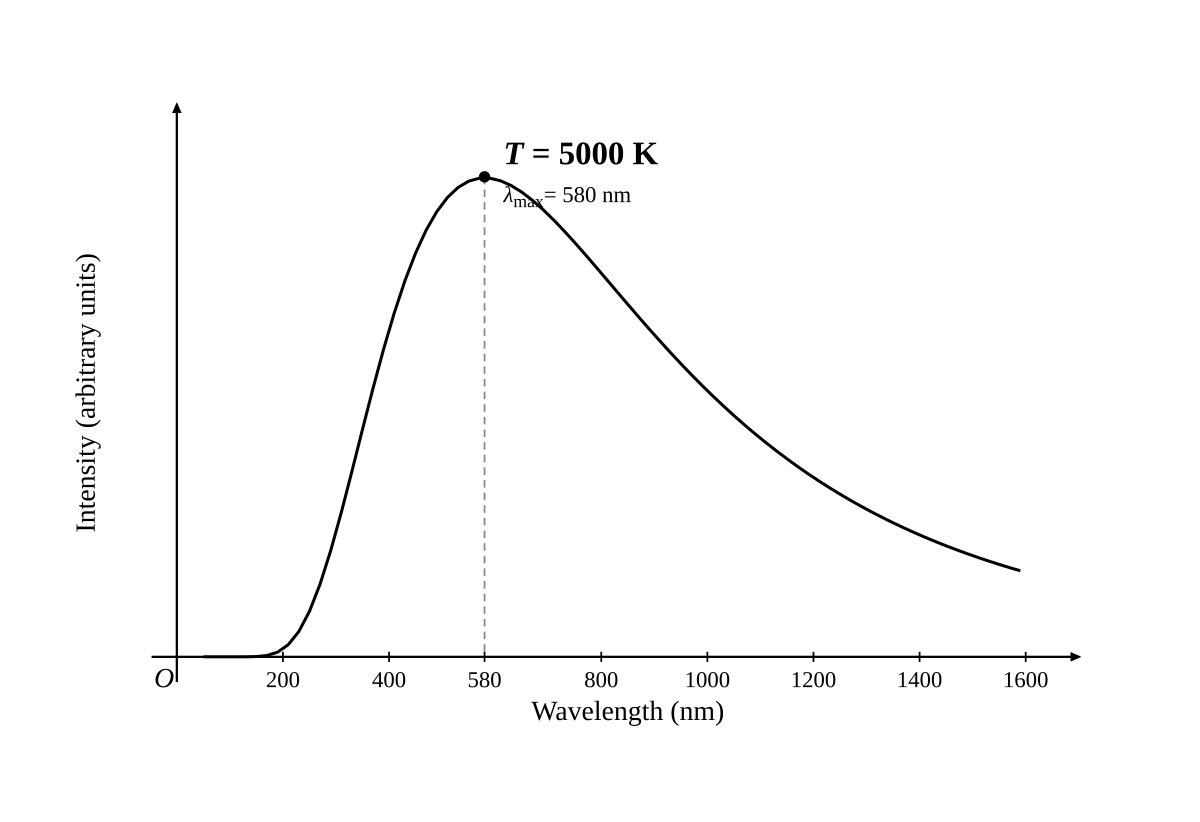
black-body radiation curve for an object at 5000 K — intensity on the y-axis against wavelength on the x-axis, rising to a single peak at 580 nm and falling away at longer wavelengths.
Diagram provided in the exam

The temperature of the object falls to 4000 K.

Compared with the curve shown, the new curve has

  • A. a higher peak at a shorter wavelength.
  • B. a higher peak at a longer wavelength.
  • C. a lower peak at a shorter wavelength.
  • D. a lower peak at a longer wavelength.

Question 13

Which of the following was a prediction of Maxwell's theory of electromagnetism?

  • A. Electromagnetic waves travel at different speeds depending on their frequency
  • B. The electric and magnetic fields of an electromagnetic wave oscillate parallel to each other
  • C. There exists a spectrum of electromagnetic waves extending beyond visible light, all travelling at c
  • D. Electromagnetic waves require a medium in order to propagate

Question 14

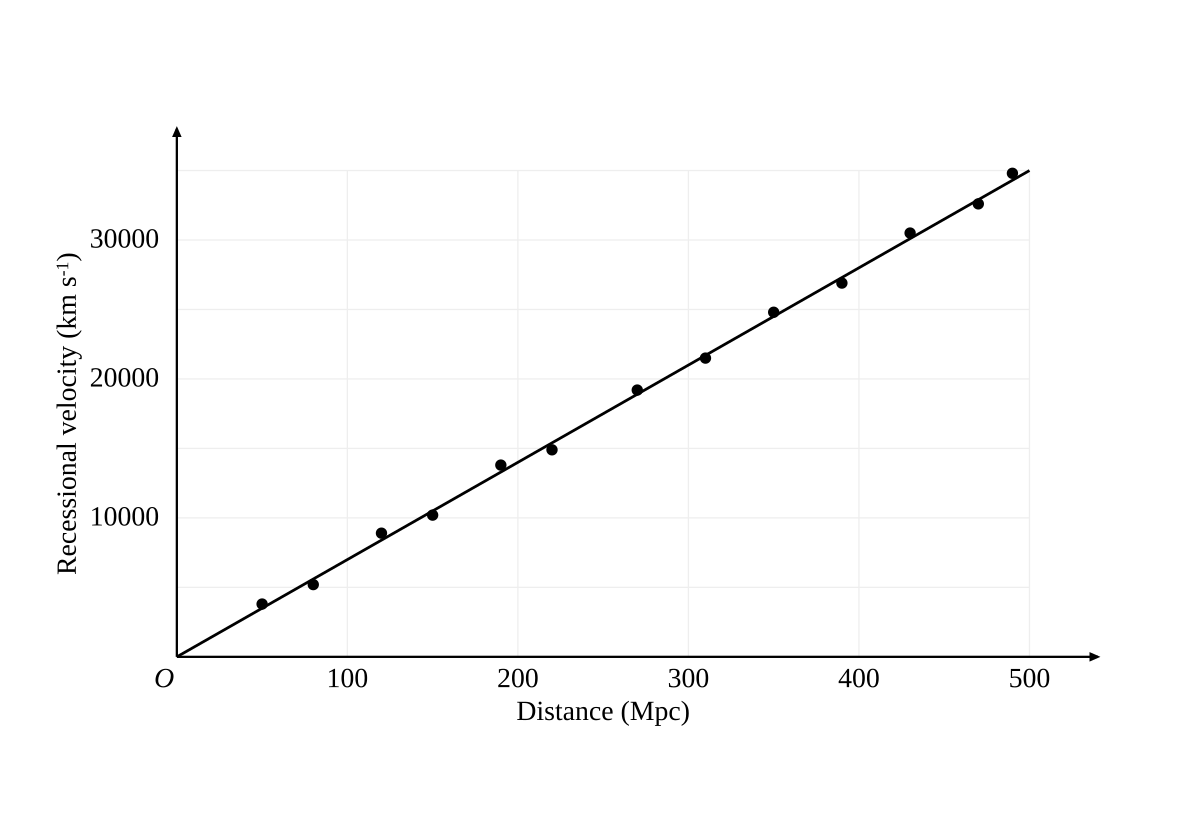
graph of recessional velocity (vertical axis, km s⁻¹) against distance (horizontal axis, Mpc) for a sample of galaxies; the points lie close to a straight line through the origin.
Diagram provided in the exam

What does the graph provide evidence for?

  • A. Galaxies orbit a common centre of mass
  • B. The universe is expanding, with more distant galaxies receding faster
  • C. All galaxies are moving at the same speed
  • D. The universe is contracting

Question 15

A proton has quark composition uud and a neutron udd.

Which quark transformation occurs in beta-minus decay?

  • A. u → d
  • B. d → u
  • C. u → s
  • D. s → d

Question 16

In the Geiger–Marsden experiment, most alpha particles passed through the gold foil with little or no deflection.

What did this observation indicate about the atom?

  • A. The atom's positive charge is spread evenly throughout its volume
  • B. Electrons occupy most of the atom's volume
  • C. The atom is mostly empty space
  • D. Alpha particles have no charge

Question 17

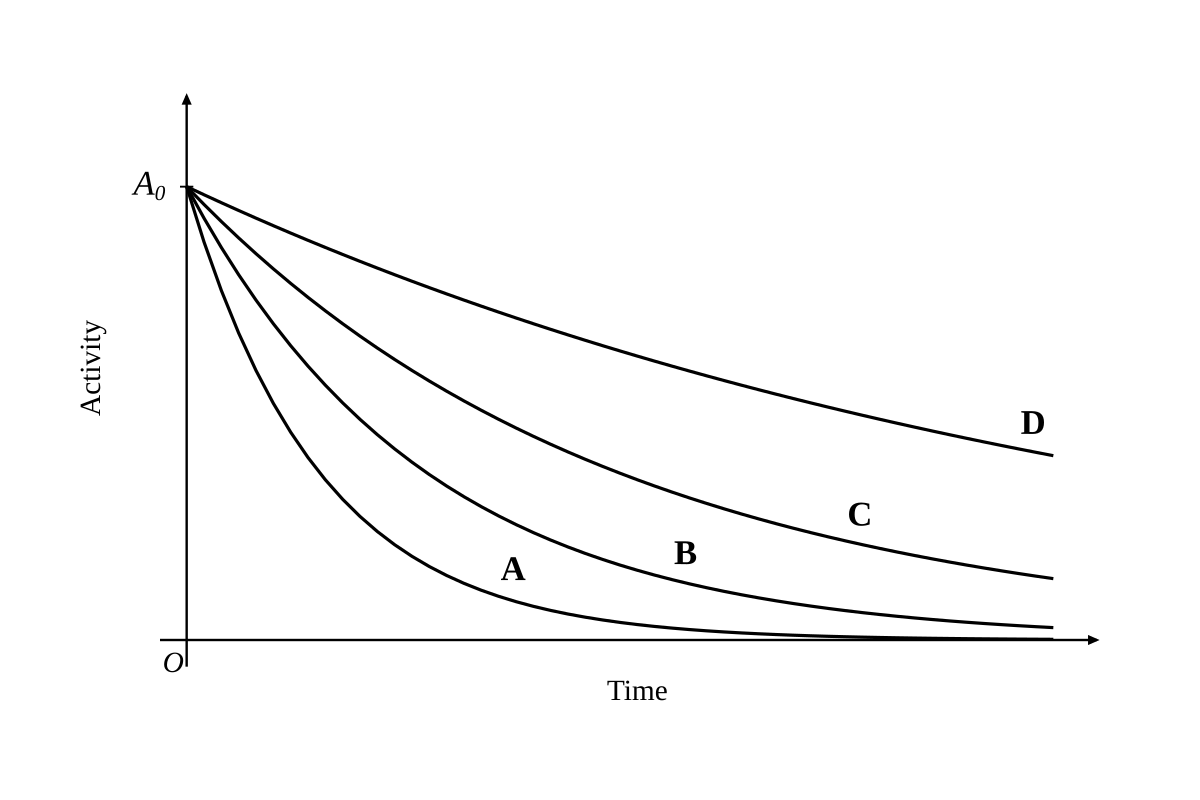
four curves of activity against time on one set of axes, all starting at the same initial activity: curve A falls steepest, curves B and C fall progressively less steeply, curve D is the flattest.
Diagram provided in the exam

Which curve represents the isotope with the smallest decay constant?

  • A. Curve A
  • B. Curve B
  • C. Curve C
  • D. Curve D

Question 18

Which nuclear process is the dominant source of the Sun's energy while it is on the main sequence?

  • A. Fission of heavy nuclei into lighter nuclei
  • B. The proton–proton chain, fusing hydrogen into helium
  • C. The triple-alpha process, fusing helium into carbon
  • D. Radioactive decay of uranium and thorium

Question 19

In a hydrogen atom, transition P is from n = 3 to n = 2 and transition Q is from n = 4 to n = 2.

Which statement is correct?

  • A. P emits a photon of longer wavelength than Q
  • B. P emits a photon of shorter wavelength than Q
  • C. P and Q emit photons of the same wavelength
  • D. P absorbs a photon while Q emits one

Question 20

The Sun radiates energy at 3.8 × 10²⁶ W.

At what rate does the Sun lose mass as a result?

  • A. 1.3 × 10¹⁸ kg s⁻¹
  • B. 4.2 × 10⁹ kg s⁻¹
  • C. 1.3 × 10⁹ kg s⁻¹
  • D. 4.2 × 10⁶ kg s⁻¹

Section II

80 marks — Attempt Questions 21–36 — Allow about 2 hours and 25 minutes for this section

Answer the questions in the spaces provided. Show all relevant working in questions involving calculations.

Question 21 (3 marks)

watch list: routine Faraday emf calculation

A square coil of 50 turns and side length 4.0 cm lies flat on a bench, entirely within a uniform magnetic field of 0.25 T directed vertically downwards through the coil.

The coil is slid horizontally completely out of the field region in 0.20 s.

(a) Calculate the average emf induced in the coil during this time. (2)

(b) Viewed from above, the field points away from the observer (into the bench). State the direction of the induced current in the coil as seen from above, and justify your answer using Lenz's law. (1)

Question 22 (4 marks)

Why this question → 5 of 6, p 0.55

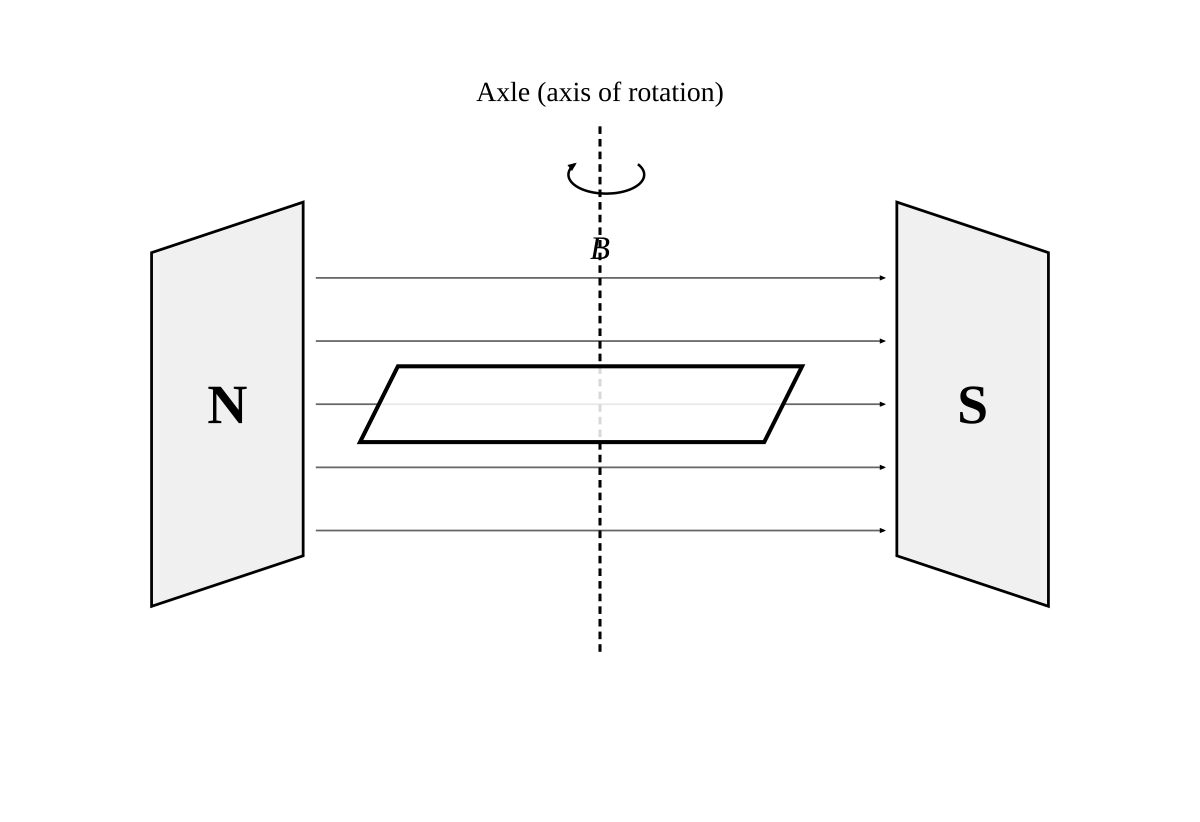
A rectangular coil of 20 turns measures 5.0 cm × 8.0 cm and carries a current of 1.5 A. It sits in a uniform magnetic field of 0.30 T, mounted on an axle so it can rotate. In the position shown, the plane of the coil is parallel to the field.

rectangular coil between two magnet poles, N on the left and S on the right; the field runs left to right across the gap; the coil's plane lies parallel to the field lines, with its axle vertical.
Diagram provided in the exam

(a) Calculate the magnitude of the torque on the coil in the position shown. (2)

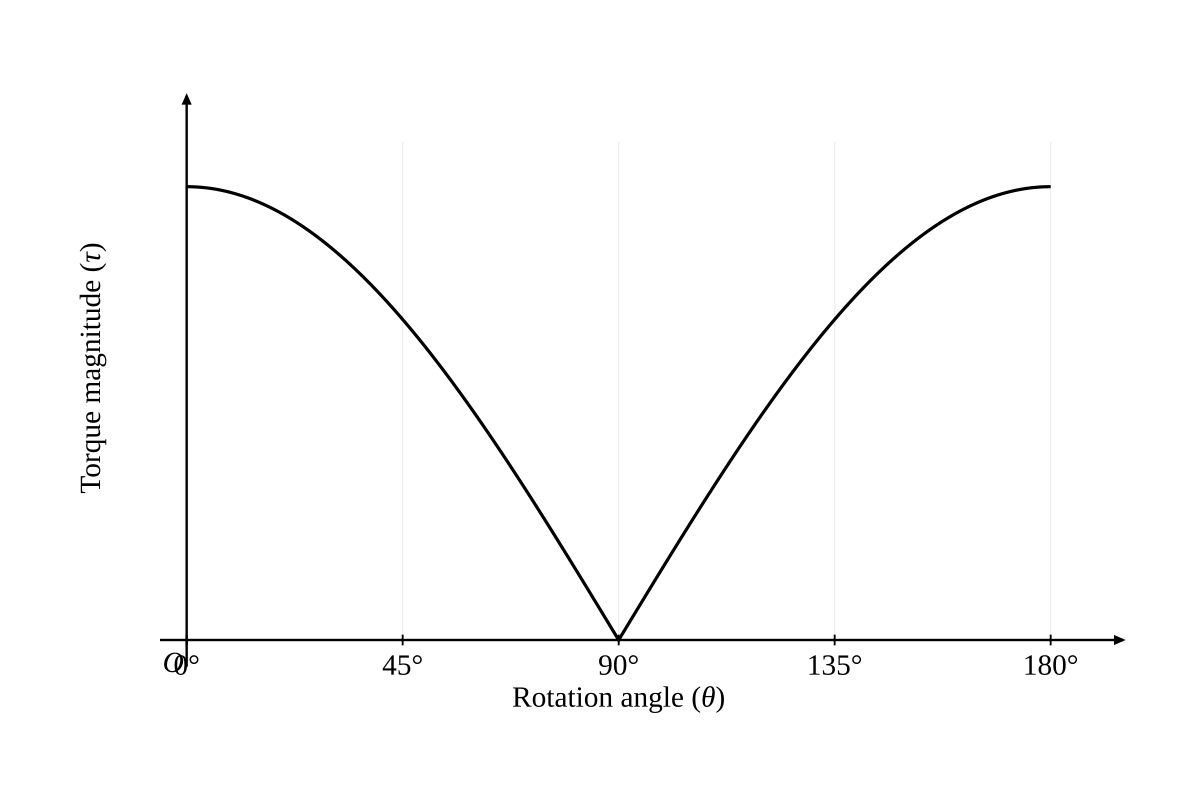
(b) On the axes provided, sketch how the magnitude of the torque varies as the coil rotates 180° from the position shown. Mark the angles at which the torque is zero and maximum. (2)

blank axes — torque magnitude on the vertical axis, rotation angle from 0° to 180° on the horizontal axis. Expected sketch: |sin|-shaped — maximum at 0°, falling to zero at 90° (coil plane perpendicular to the field), rising back to maximum at 180°.
Diagram provided in the exam

Question 23 (6 marks)

Why this question → 5 of 6, p 0.65

A ball is launched from the edge of a 25 m high vertical cliff with an initial velocity of 20 m s⁻¹ at 30° above the horizontal. It lands on the level ground at the base of the cliff. Air resistance is negligible.

(a) Show that the time of flight of the ball is approximately 3.5 s. (2)

(b) Calculate the horizontal distance from the base of the cliff to the landing point. (2)

(c) Calculate the magnitude and direction of the ball's velocity as it lands. (2)

Question 24 (5 marks)

Why this question → 4 of 6, p 0.56

(a) For a moon in a circular orbit of radius r and period T about a planet of mass M, use the expressions for gravitational force and circular motion to show that

r³/T² = GM/4π² (2)

(b) A moon of planet Z orbits at a radius of 3.8 × 10⁸ m with an orbital period of 2.0 days.

Calculate the mass of planet Z. (3)

Question 25 (5 marks)

Why this question → 5 of 6, p 0.57

The work functions of two metals are shown.

Data provided in the exam

table — caesium: work function 2.1 eV; zinc: work function 4.3 eV.

Monochromatic light of frequency 6.5 × 10¹⁴ Hz is shone on each metal in turn.

(a) Show by calculation that photoelectrons are emitted from only one of the two metals. (2)

(b) Calculate the maximum kinetic energy, in joules, of the photoelectrons emitted from that metal. (1)

(c) The intensity of the light is doubled with its frequency unchanged. Using the photon model of light, explain the effect of this change on the number of photoelectrons emitted per second and on their maximum kinetic energy. (2)

Question 26 (6 marks)

Why this question → 5 of 6, p 0.57

Laser light passes through a pair of narrow slits separated by 2.5 × 10⁻⁵ m, producing an interference pattern on a distant screen. The second-order maximum (m = 2) is observed at an angle of 3.0° from the central maximum.

(a) Calculate the wavelength of the laser light. (2)

(b) The laser is replaced with one of wavelength 450 nm. Using the interference equation, explain how the angular positions of the maxima change. (2)

(c) State TWO separate changes to the apparatus, other than changing the laser again, that would each restore the original spacing of the fringes on the screen, and justify one of them. (2)

Question 27 (5 marks)

Why this question → 5 of 6, p 0.61

Muons are created 15 km above Earth's surface and travel directly downwards at 0.995c. The average lifetime of a muon in its own rest frame is 2.2 μs. At 0.995c, the Lorentz factor is 10.0.

(a) Calculate the time taken for a muon to reach the surface, as measured in Earth's frame. (1)

(b) Calculate the average lifetime of the muons as measured by an observer on Earth. (2)

(c) A far greater fraction of muons reaches the surface than classical physics predicts. Explain this observation from the muons' frame of reference. Support your answer with a calculation. (2)

Question 28 (3 marks)

Why this question → 5 of 6, p 0.54

A proton travels in a straight line at constant velocity through a region containing an electric field of 4.0 × 10⁴ V m⁻¹ perpendicular to a magnetic field of 0.20 T.

(a) Calculate the speed of the proton. (1)

(b) The electric field is switched off. Calculate the radius of the proton's resulting circular path in the magnetic field. (2)

Question 29 (5 marks)

Why this question → 5 of 6, p 0.57

An electron is accelerated from rest through a potential difference of 500 V.

(a) Show that the final speed of the electron is approximately 1.3 × 10⁷ m s⁻¹. (2)

(b) The electron then enters a uniform magnetic field of 1.5 × 10⁻³ T, moving perpendicular to the field. Calculate the radius of its circular path. (2)

(c) A proton travelling at the same speed enters the same field. Compare the radius and sense of curvature of its path with those of the electron's path. (1)

Question 30 (4 marks)

Why this question → 5 of 6, p 0.54

An ideal transformer steps 240 V mains down to operate a 24 W lamp. The primary coil has 20 times as many turns as the secondary coil. A switch allows a second, identical lamp to be connected in parallel with the first.

(a) Calculate the voltage across the lamp and the current in the primary coil when one lamp is operating. (2)

(b) The switch is closed so that both lamps operate at normal brightness. Using conservation of energy, explain what happens to the current in the primary coil. (2)

Question 31 (5 marks)

Why this question → 4 of 6, p 0.59

The spectrum of star Q is analysed.

Data provided in the exam

intensity–wavelength plot for star Q: a smooth continuum peaking at 580 nm, crossed by dark absorption lines; an inset compares one hydrogen absorption line at 656.3 nm in a laboratory reference spectrum with the same line in star Q's spectrum, where it appears at 657.6 nm and is noticeably broader than the laboratory line.

(a) Calculate the surface temperature of star Q. (2)

(b) What does the shift of the hydrogen line from 656.3 nm to 657.6 nm indicate about the motion of star Q? (1)

(c) The star's absorption lines are broader than the corresponding laboratory lines. Explain how the star's rotation produces this broadening. (2)

Question 32 (5 marks)

Why this question → 6 of 6, p 0.61
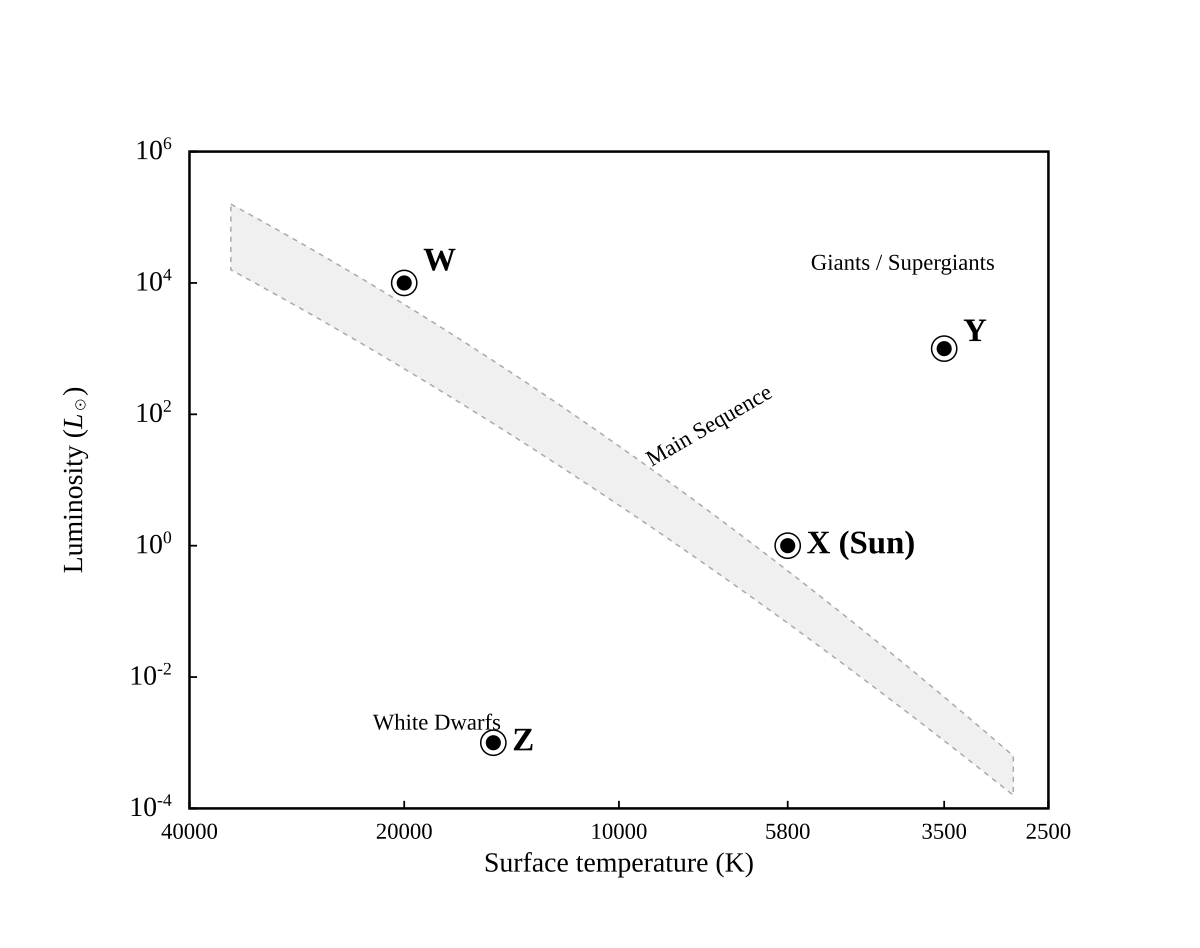
Hertzsprung–Russell diagram — luminosity (Sun = 1) on the vertical axis from 10⁻⁴ to 10⁶ on a log scale; surface temperature on the horizontal axis from 40 000 K on the LEFT to 2500 K on the right. Four labelled stars: W on the main sequence at 20 000 K and 10⁴ L☉; X on the main sequence at 5800 K and 1 L☉; Y at 3500 K and 10³ L☉ (upper right, giant region); Z at 15 000 K and 10⁻³ L☉ (lower left, white dwarf region).
Diagram provided in the exam

(a) Identify the evolutionary stage of star Y and the evolutionary stage of star Z. (2)

(b) Compare the nuclear processes occurring in the cores of stars X and Y. (2)

(c) Star Z is hotter than star X, yet far less luminous. Explain this. (1)

Question 33 (5 marks)

watch list: half-life from a decay graph

A sample initially contains 100 g of a radioactive isotope.

Data provided in the exam

graph of mass of isotope remaining (g) against time (days), from 0 to 40 days — a smooth exponential decay through the readable points (0, 100), (8.0, 50), (16, 25) and (24, 12.5).

(a) Using the graph, determine the half-life of the isotope. (1)

(b) Calculate the decay constant of the isotope, in s⁻¹. (2)

(c) Calculate the time at which 5.0 g of the isotope remains. (2)

Question 34 (7 marks)

Why this question → 5 of 6, p 0.55

A stationary polonium-210 nucleus undergoes alpha decay:

²¹⁰Po → ²⁰⁶Pb + ⁴He

Data provided in the exam

atomic masses — Po-210: 209.98286 u; Pb-206: 205.97446 u; He-4: 4.00260 u.

(a) Calculate the energy released in one decay, in MeV and in joules. (3)

(b) Almost all of the released energy appears as the kinetic energy of the alpha particle rather than of the lead nucleus.

(i) Explain this, using conservation of momentum. (2)

(ii) Calculate the kinetic energy of the alpha particle, in MeV. (2)

Question 35 (5 marks)

watch list: orbital energy transfer

An 800 kg satellite is in a circular orbit of radius 7.0 × 10⁶ m around Earth (mass 6.0 × 10²⁴ kg).

(a) Calculate the total mechanical energy of the satellite in this orbit. (2)

(b) The satellite is moved to a circular orbit of radius 1.4 × 10⁷ m. Calculate the energy that must be supplied to make this change. (2)

(c) In the higher orbit the satellite moves more slowly, yet energy had to be supplied. Explain this. (1)

Question 36 (7 marks)

Why this question → 4 of 6, p 0.60

An eddy-current brake consists of a solid aluminium disc of radius 0.10 m mounted on a frictionless axle, with a strong magnet fixed close to one face of the disc near its rim. The disc is spun to 12 revolutions per second and released at t = 0.

The experiment is repeated with an otherwise identical disc that has narrow radial slots cut through it.

Data provided in the exam

graph of rotation rate (rev s⁻¹) against time (s) for both discs, each starting at 12 rev s⁻¹. The solid disc's curve falls steeply at first — reaching 6 rev s⁻¹ at about 2 s — then flattens progressively, approaching zero with an ever-decreasing gradient. The slotted disc's curve falls only slightly over the same interval, remaining above 10 rev s⁻¹ at 8 s.

(a) Calculate the speed of a point on the rim of the solid disc at the instant it is released. (1)

(b) Explain why the solid disc slows down. In your answer, identify the complete chain of cause and effect, including the energy transformation involved. (4)

(c) Using the graph, describe how the retarding effect on the solid disc changes as the disc slows, and explain why this occurs. (1)

(d) Explain why the slotted disc slows far less than the solid disc. (1)

Answers & marking notes not part of the examination paper — try the paper first

Answers and marking notes

Section I — answer key

Q Answer Note
1 B Time of flight is set by the vertical motion only; t = 2u_y/g
2 C F = 4π²mr/T²; halving T quadruples F
3 B v = √(GM/r): smaller r is faster; E = −GMm/2r: larger r is less negative (greater)
4 D v_esc = √(2GM/r); ×2 mass and ×½ radius gives √4 = 2 times 11.2 = 22.4 km s⁻¹
5 B Anti-parallel currents repel; magnitude unchanged (F/l = μ₀I₁I₂/2πr)
6 C ω = 0 ⇒ back emf = 0 ⇒ current rises to V/R (the standing 2025 MC11 idea, written large)
7 C ε₀ ∝ rate of flux change ∝ ω, and f ∝ ω: both double
8 C Magnetic force (∝ v) doubles; electric force (qE) is unchanged
9 B First filter halves unpolarised light; then I = (I₀/2)cos²45° = I₀/4
10 A The speed of light is invariant for all inertial observers
11 B p = mv/√(1−v²/c²) grows without bound as v → c
12 D Cooler body: lower curve everywhere with λmax shifted to longer wavelength (Wien)
13 C Maxwell predicted a whole EM spectrum, all propagating at c, E ⊥ B
14 B Hubble's law: v ∝ d is the expansion signature
15 B udd → uud requires d → u (with e⁻ and antineutrino emitted)
16 C Undeflected passage ⇒ mostly empty space (backscatter ⇒ dense positive nucleus)
17 D Smallest λ ⇒ longest half-life ⇒ flattest activity curve
18 B Main-sequence Sun fuses H via the proton–proton chain
19 A 3→2 is a smaller energy gap than 4→2 ⇒ lower-energy photon ⇒ longer wavelength
20 B Δm/Δt = P/c² = 3.8 × 10²⁶ / 9.0 × 10¹⁶ = 4.2 × 10⁹ kg s⁻¹

Section II — marking notes

Q21 (a). ΔΦ per turn = BA = 0.25 × (0.040)² = 4.0 × 10⁻⁴ Wb; ε = NΔΦ/Δt = 50 × 4.0 × 10⁻⁴ / 0.20 = 0.10 V. (b). Flux into the bench is decreasing, so the induced current acts to maintain it: clockwise viewed from above (right-hand grip: clockwise current produces flux into the bench through the coil). The mark is for the Lenz reasoning, not the bare direction.

Q22 (a). τ = nBIA = 20 × 0.30 × 1.5 × (0.050 × 0.080) = 20 × 0.30 × 1.5 × 4.0 × 10⁻³ = 3.6 × 10⁻² N m. (Trap: cm → m before computing A — the flagged 2025 Q23 error.) (b). |sin θ| shape: maximum 3.6 × 10⁻² N m at 0° (plane parallel to B), zero at 90° (plane perpendicular to B), maximum again at 180°. One mark for the correct shape, one for the labelled zero/maximum angles.

Q23 (a). u_y = 20 sin 30° = +10 m s⁻¹ (up), Δy = −25 m: −25 = 10t − 4.9t² ⇒ 4.9t² − 10t − 25 = 0 ⇒ t = [10 + √(100 + 490)]/9.8 = [10 + 24.3]/9.8 = 3.5 s. Full marks require the sign convention stated and the quadratic (or an explicit two-stage up-then-down calculation) — a symmetric-flight calculation (t = 2u_y/g ≈ 2.0 s) scores at most 1. (b). u_x = 20 cos 30° = 17.3 m s⁻¹; range = 17.3 × 3.5 = 61 m. (c). v_y = 10 − 9.8 × 3.5 = −24.3 m s⁻¹; v = √(17.3² + 24.3²) = √890 ≈ 30 m s⁻¹ at 55° below the horizontal (consistency check: v² = u² + 2gΔh = 400 + 490 = 890 ✓).

Q24 (a). GMm/r² = 4π²mr/T² (gravitational force supplies the centripetal force); cancel m, rearrange: r³/T² = GM/4π². Both force expressions and the cancellation must be shown. (b). T = 2.0 × 24 × 3600 = 1.728 × 10⁵ s (the days-to-seconds conversion is the first mark). M = 4π²r³/(GT²) = 39.48 × (3.8 × 10⁸)³ / (6.67 × 10⁻¹¹ × (1.728 × 10⁵)²) = 2.17 × 10²⁷ / 1.99 = 1.1 × 10²⁷ kg.

Q25 (a). E_photon = hf = 6.626 × 10⁻³⁴ × 6.5 × 10¹⁴ = 4.31 × 10⁻¹⁹ J = 2.69 eV. 2.69 eV > 2.1 eV (caesium emits); 2.69 eV < 4.3 eV (zinc does not). Both comparisons required. (b). Kmax = 2.69 − 2.1 = 0.59 eV = 0.59 × 1.602 × 10⁻¹⁹ = 9.4 × 10⁻²⁰ J. (c). Doubling intensity doubles the number of photons per second, each of unchanged energy hf; one photon releases one electron, so the number emitted per second doubles but Kmax = hf − φ is unchanged. "Brighter light gives faster electrons" is the target misconception.

Q26 (a). λ = d sin θ / m = 2.5 × 10⁻⁵ × sin 3.0° / 2 = 2.5 × 10⁻⁵ × 0.0523 / 2 = 6.5 × 10⁻⁷ m (654 nm). (b). sin θ = mλ/d: λ falls from 654 nm to 450 nm, so sin θ (and θ) decreases in proportion — every maximum moves closer to the central maximum. The proportionality must be used, not just "the pattern shrinks". (c). Decrease the slit separation d in the same proportion (sin θ = mλ/d restored), or increase the slit-to-screen distance L (fringe spacing on the screen ≈ λL/d restored). Justification via the relevant relationship for one of the two.

Q27 (a). t = 1.5 × 10⁴ / (0.995 × 3.0 × 10⁸) = 5.0 × 10⁻⁵ s (50 μs). (b). t = γt₀ = 10.0 × 2.2 μs = 22 μs. The proper lifetime is the muon's own 2.2 μs — swapping t and t₀ (giving 0.22 μs) is the flagged error. (c). In the muons' frame the atmosphere is length-contracted: L = 15 km / 10.0 = 1.5 km, so the journey takes 1.5 × 10³ / (2.985 × 10⁸) ≈ 5.0 μs ≈ 2.3 proper lifetimes — a substantial fraction survives, whereas the classical 50 μs ≈ 23 lifetimes would leave essentially none. Both frames predict the same survival; the mark is for a single-frame, internally consistent account with the calculation.

Q28 (a). qE = qvB ⇒ v = E/B = 4.0 × 10⁴ / 0.20 = 2.0 × 10⁵ m s⁻¹. (b). r = mv/qB = 1.673 × 10⁻²⁷ × 2.0 × 10⁵ / (1.602 × 10⁻¹⁹ × 0.20) = 1.0 × 10⁻² m (1.0 cm).

Q29 (a). qV = ½mv² ⇒ v = √(2qV/m) = √(2 × 1.602 × 10⁻¹⁹ × 500 / 9.109 × 10⁻³¹) = √(1.76 × 10¹⁴) = 1.33 × 10⁷ m s⁻¹. (Trap: uppercase V is voltage, lowercase v speed.) (b). r = mv/qB = 9.109 × 10⁻³¹ × 1.33 × 10⁷ / (1.602 × 10⁻¹⁹ × 1.5 × 10⁻³) = 5.0 × 10⁻² m (5.0 cm). (c). r ∝ m/q at fixed v and B: the proton's radius is ≈ 1836 times larger (≈ 92 m), and its path curves in the opposite sense because its charge is opposite.

Q30 (a). Vs = 240/20 = 12 V; Pin = Pout = 24 W ⇒ Ip = 24/240 = 0.10 A. (b). Secondary power doubles to 48 W; for an ideal transformer Pin must equal Pout, so with Vp fixed at 240 V the primary current doubles to 0.20 A. The mark is for invoking conservation of energy to carry the change from secondary to primary — describing only the secondary caps at 1.

Q31 (a). T = b/λmax = 2.898 × 10⁻³ / 5.80 × 10⁻⁷ = 5.0 × 10³ K. (λmax in metres; answer in kelvin.) (b). The line is shifted to a longer wavelength (redshift), so star Q is receding from Earth. (c). As the star rotates, one limb approaches (its absorption blueshifted) while the other recedes (redshifted); light from the whole disc is received together, so each line is smeared over a range of wavelengths — broadened symmetrically. Faster rotation gives broader lines. (Rotation about the star's own axis, not orbital revolution — the flagged 2023 error.)

Q32 (a). Y: red giant (post-main-sequence); Z: white dwarf (final stage for a Sun-like star, fusion ceased). (b). X is on the main sequence fusing hydrogen to helium in its core via the proton–proton chain (Sun-like core temperature). Y has exhausted core hydrogen: it fuses helium (to carbon/oxygen) in its core and/or hydrogen in a surrounding shell, at a higher core temperature. Both stars named, both processes distinguished. (c). Luminosity depends on both temperature and surface area (L ∝ R²T⁴): Z's radius is tiny, so despite the higher surface temperature its radiating area — and hence luminosity — is far smaller.

Q33 (a). Mass halves every 8.0 days (100 → 50 g at 8.0 d; 50 → 25 g at 16 d). The value must be read from the graph. (b). λ = ln 2 / t½ = 0.693 / (8.0 × 24 × 3600 s) = 0.693 / 6.91 × 10⁵ = 1.0 × 10⁻⁶ s⁻¹. (Days-to-seconds conversion is the second mark.) (c). 5.0 = 100 e^(−λt) ⇒ t = ln(20)/λ = 3.00 / 0.0866 day⁻¹ = 35 days (equivalently 3.00 / 1.0 × 10⁻⁶ s⁻¹ ≈ 3.0 × 10⁶ s). Requires solving with natural logarithms, not stepping half-lives (4.32 half-lives is not an integer count).

Q34 (a). Δm = 209.98286 − (205.97446 + 4.00260) = 209.98286 − 209.97706 = 0.00580 u. E = 0.00580 × 931.5 = 5.40 MeV = 5.40 × 10⁶ × 1.602 × 10⁻¹⁹ = 8.7 × 10⁻¹³ J. (Traps: early rounding of the masses; MeV–joule conversion.) (b)(i). The nucleus is initially at rest, so total momentum is zero: the alpha particle and lead nucleus recoil with equal and opposite momenta. For equal momentum magnitudes, KE = p²/2m — the lighter particle carries the larger share of the kinetic energy, so the alpha (4 u vs 206 u) takes almost all of it. (b)(ii). KE_α = E × m_Pb/(m_Pb + m_α) = 5.40 × 205.97/209.98 = 5.30 MeV (≈ 98% of the released energy; KE_Pb ≈ 0.10 MeV).

Q35 (a). E = −GMm/2r = −(6.67 × 10⁻¹¹ × 6.0 × 10²⁴ × 800)/(2 × 7.0 × 10⁶) = −3.20 × 10¹⁷ / 1.4 × 10⁷ = −2.3 × 10¹⁰ J. The negative sign is required — it signifies a bound orbit. (b). E₂ = −3.20 × 10¹⁷ / 2.8 × 10⁷ = −1.14 × 10¹⁰ J. Energy supplied = E₂ − E₁ = −1.14 × 10¹⁰ − (−2.29 × 10¹⁰) = +1.1 × 10¹⁰ J. (Trap: a less negative total energy is an increase.) (c). Moving outwards, kinetic energy decreases but potential energy (U = −GMm/r) increases by twice as much; the total mechanical energy therefore rises, and that difference must be supplied by the thrusters. "It slows down so it loses energy" is the target misconception.

Q36 (a). v = 2πrf = 2π × 0.10 × 12 = 7.5 m s⁻¹. (b). Full chain (one mark per link band): as the disc rotates, the magnetic flux through each region of the disc near the magnet changes → an emf is induced (Faraday) → eddy currents circulate in the conducting disc → by Lenz's law these currents flow so that the magnetic forces on them oppose the relative motion, producing a retarding torque on the disc → the disc's rotational kinetic energy is transformed into heat in the disc's resistance. Answers that say only "Lenz's law opposes the motion" without the intermediate emf/current steps cap at 2. (c). The gradient of the solid-disc curve decreases in magnitude as the disc slows: the rate of flux change is proportional to the disc's speed, so the induced emf, eddy currents and retarding torque all shrink as it slows — the braking effect weakens, and the disc approaches zero asymptotically rather than stopping abruptly. (d). The radial slots interrupt the circulating paths of the eddy currents, so only much smaller currents can flow; the opposing forces are correspondingly smaller and the disc keeps most of its kinetic energy over the same interval.
Prediction provenance working — which prediction each part of the paper realises, linked both ways
Paper item Prediction Agreement

Section I Q1

↑ Q1
topic-level consensus 0.55 (grok) · 2 (grok, deepseek)

Section I Q2

↑ Q2
topic-level consensus 0.80 (opus) · 2 (opus, gemini-3.1-pro)

Section I Q3

↑ Q3
watch list 0.85 (opus), 0.55 (gpt-5.6-sol), 0.50 (grok) · 3

Section I Q4

↑ Q4
watch list 0.42 (grok) · 1

Section I Q5

↑ Q5
watch list 0.45 (deepseek), 0.38 (gpt-5.6-sol) · 2

Section I Q6

↑ Q6
watch list 0.50 (grok), 0.50 (deepseek), 0.45 (fable) · 4

Section I Q7

↑ Q7
watch list 0.55 (deepseek), 0.85 (gemini-3.1-pro as sketch) · 2

Section I Q8

↑ Q8
topic-level consensus 0.38 (grok) · 2 (grok, opus)

Section I Q9

↑ Q9
watch list 0.48 (gpt-5.6-sol), 0.45 (grok) · 4

Section I Q10

↑ Q10
watch list 0.45 (grok) · 1

Section I Q11

↑ Q11
watch list 0.50 (deepseek) · 2

Section I Q12

↑ Q12
watch list 0.55 (deepseek), 0.46 (grok as sketch) · 3

Section I Q13

↑ Q13
watch list 0.43 mean · 5

Section I Q14

↑ Q14
watch list 0.50 (fable), 0.50 (deepseek), 0.45 (opus) · 3

Section I Q15

↑ Q15
topic-level consensus 0.55 (deepseek) · 2 (deepseek, gpt-5.6-sol)

Section I Q16

↑ Q16
watch list 0.50 (deepseek), 0.40 (grok) · 4

Section I Q17

↑ Q17
topic-level consensus 0.50 (grok) · 2

Section I Q18

↑ Q18
watch list 0.40 (fable, grok) · 3

Section I Q19

↑ Q19
watch list 0.60 (fable), 0.45 (opus, grok) · 3

Section I Q20

↑ Q20
topic-level consensus 0.50 (fable) · 2

Q21

↑ Q21
watch list 0.59 mean · 3 (fable, opus, gpt-5.6-sol)

Q22

↑ Q22
phys-q12-motor-torque 0.55 · 5 (fable, opus, gemini-3.1-pro, grok, deepseek)

Q23

↑ Q23
phys-q1-asymmetric-projectile 0.65 · 5 (fable, opus, gemini-3.1-pro, grok, deepseek)

Q24

↑ Q24
phys-q10-kepler-third-law 0.56 · 4 (fable, opus, gemini-3.1-pro, deepseek)

Q25

↑ Q25
phys-q8-photoelectric 0.57 · 5 (fable, opus, gemini-3.1-pro, grok, deepseek)

Q26

↑ Q26
phys-q9-double-slit 0.57 · 5 (fable, opus, gemini-3.1-pro, gpt-5.6-sol, grok)

Q27

↑ Q27
phys-q3-time-dilation-length-contraction 0.61 · 5 (fable, opus, gemini-3.1-pro, grok, deepseek)

Q28

↑ Q28
phys-q14-crossed-fields 0.54 · 5 (fable, opus, gemini-3.1-pro, gpt-5.6-sol, grok)

Q29

↑ Q29
phys-q7-charge-in-magnetic-field 0.57 · 5 (fable, opus, gemini-3.1-pro, grok, deepseek)

Q30

↑ Q30
phys-q13-transformer-transmission 0.54 · 5 (fable, opus, gemini-3.1-pro, gpt-5.6-sol, grok)

Q31

↑ Q31
phys-q5-stellar-spectrum 0.59 · 4 (fable, opus, gemini-3.1-pro, deepseek)

Q32

↑ Q32
phys-q2-hr-diagram-fusion 0.61 · 6 (all)

Q33

↑ Q33
watch list 0.53 mean · 4 (fable, opus, gpt-5.6-sol, grok)

Q34

↑ Q34
phys-q11-mass-defect-momentum 0.55 · 5 (fable, opus, gemini-3.1-pro, grok, deepseek)

Q35

↑ Q35
watch list 0.48 mean · 4 (fable, opus, gpt-5.6-sol, grok)

Q36

↑ Q36
phys-q4-eddy-current-device 0.60 · 4 (fable, opus, deepseek, grok — fable/opus merged one vote per contamination note)

Exam Success Program

Book our ESPs now — online or in person

A paper on your desk is one thing — the clock running is another. Sit Physics practice exams under real conditions and get them marked with real feedback. Exam times run seven days a week, right up until the HSC begins.

Book your ESP →

Places are still open for 2026

Intu AI

One paper isn't enough? Generate more

Intu AI builds unlimited practice questions for Physics in these styles, marks your working, and explains what you missed — aligned to your syllabus.

Practise with Intu AI →

Share & save

Practice paper (PDF)

Every style card and paper question has its own link — hover any card and use its copy-link icon to share exactly the thing you mean. Printing this page gives a clean copy too.

Published Aug 2026, before the exams. In November 2026 we score these predictions publicly against the real paper — per-model calibration and question-level hit rates, the same harness as the 2025 backtest. How we did it.