Question 1
Muesli is sold in four packet sizes.
| Packet | 500 g | 750 g | 1 kg | 1.25 kg |
|---|---|---|---|---|
| Price | \$2.60 | \$3.60 | \$5.10 | \$6.25 |
Which packet is the best buy?
- A. The 500 g packet
- B. The 750 g packet
- C. The 1 kg packet
- D. The 1.25 kg packet
100 marks · an original Intuition practice paper realising the consensus predictions — every question links to the evidence behind it. Prefer the PDF?
This full-length practice paper was synthesised from a six-model AI consensus (Fable, Opus, GPT-5.6 Sol, Gemini 3.1 Pro, Grok, DeepSeek) over 165 question-level predictions for the 2026 HSC Mathematics Standard 2 examination. Every consensus cluster with agreement probability ≥ 0.55 is realised as a question below (all fourteen clusters qualified), with the remaining marks drawn from the panel's watch list; all questions are original Intuition Education compositions in NESA style — no question is reproduced from a past HSC paper. A prediction provenance table follows the marking notes.
General Instructions
Section I — 15 marks (Questions 1–15) Attempt Questions 1–15. Allow about 25 minutes for this section.
Section II — 85 marks (Questions 16–40) Attempt Questions 16–40. Allow about 2 hours and 5 minutes for this section.
15 marks — Attempt Questions 1–15 — Allow about 25 minutes for this section
Use the multiple-choice answer sheet for Questions 1–15.
Muesli is sold in four packet sizes.
| Packet | 500 g | 750 g | 1 kg | 1.25 kg |
|---|---|---|---|---|
| Price | \$2.60 | \$3.60 | \$5.10 | \$6.25 |
Which packet is the best buy?
A network has 5 vertices. Every pair of vertices is joined by exactly one edge.
How many edges does the network have?
Given the formula $a = \dfrac{2b - c}{5}$, which of the following makes $b$ the subject?
What is the compass bearing $\text{S}48°\text{W}$ as a three-figure true bearing?
A biased spinner landed on red 36 times in 120 spins.
Using this relative frequency, how many times would the spinner be expected to land on red in 300 spins?
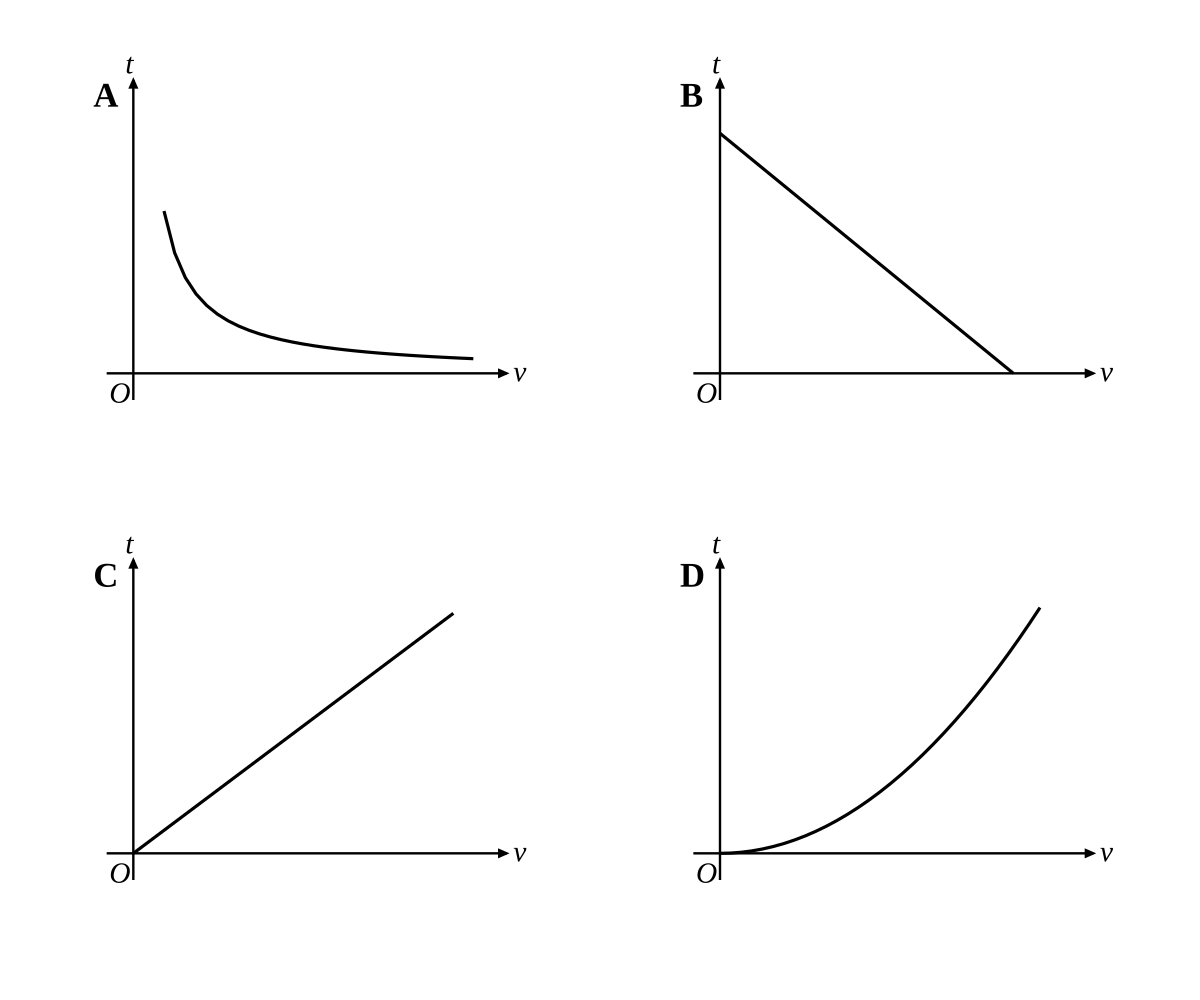
The time $t$ taken to travel a fixed distance varies inversely with the average speed $v$.
Which graph best represents $t$ as a function of $v$?
$\$8000$ is invested for 4 years at $6\%$ per annum, compounding monthly.
Which expression gives the value of the investment at the end of 4 years?
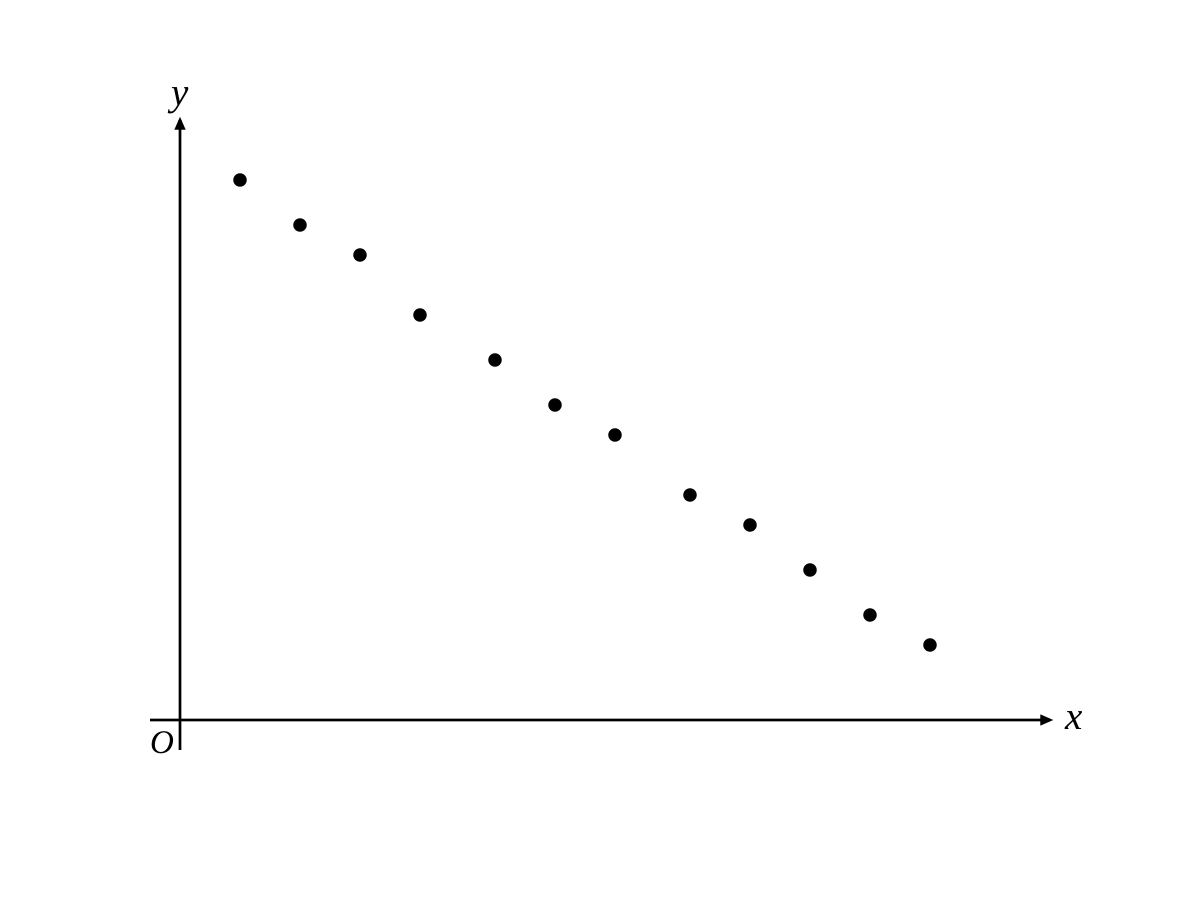
Which of the following is the most likely value of Pearson's correlation coefficient for this data set?
The heights of a large group of plants are normally distributed.
What percentage of the plants have a height with a $z$-score less than $1$?
The length of a bolt is measured as $6.4$ cm, correct to the nearest millimetre.
What is the percentage error in this measurement, correct to two decimal places?
Ali sat tests in four subjects. The table shows his mark, the class mean and the class standard deviation for each subject.
| Subject | Ali's mark | Mean | Standard deviation |
|---|---|---|---|
| English | 75 | 65 | 8 |
| Mathematics | 72 | 60 | 10 |
| Music | 68 | 60 | 5 |
| Science | 80 | 70 | 12 |
Relative to his class, in which subject did Ali perform best?
In a triangle, the angle $\theta$ is known to be obtuse and $\sin\theta = 0.5$.
What is the value of $\theta$?
A data set has a Pearson's correlation coefficient of $0.9$, with the least-squares regression line drawn.
A new data point is added with a large $x$-value, lying well BELOW the regression line.
What is the effect of the new point?
To estimate the number of fish in a dam, 40 fish were caught, tagged and released. Later, a sample of 60 fish was caught, of which 8 were tagged.
What is the estimate of the fish population of the dam?
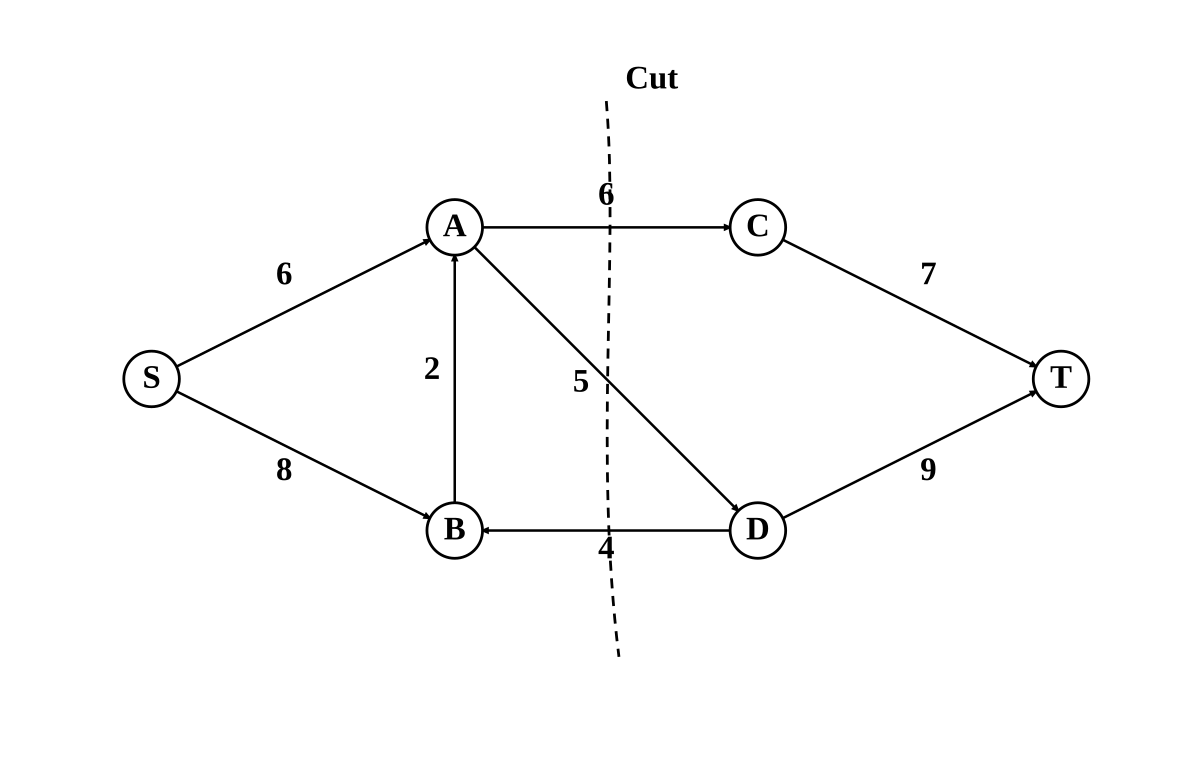
What is the capacity of the cut shown?
85 marks — Attempt Questions 16–40 — Allow about 2 hours and 5 minutes for this section
Answer the questions in the spaces provided. Your responses should include relevant mathematical reasoning and/or calculations.
A supermarket receipt shows a total of $\$87.45$, which includes $\$4.50$ of GST. GST of $10\%$ is charged only on the taxable items on the receipt.
Find the total value of the GST-free items on the receipt. (2 marks)
A heater is rated at $900$ W. Electricity costs $32$ cents per kilowatt-hour.
(a) The heater runs for 5 hours per day for 30 days. Calculate the total cost of running the heater. (2 marks)
(b) In another month, the same heater cost $\$21.60$ to run. For how many hours did it run in that month? (1 mark)
A bag contains 5 red discs and 3 blue discs. Two discs are drawn at random, without replacement.
(a) Draw a tree diagram showing the probabilities on each branch. (1 mark)
(b) Find the probability that the two discs are the same colour. (2 marks)
The table shows the lengths, in kilometres, of the roads directly joining five towns. A dash indicates that there is no direct road.
| $A$ | $B$ | $C$ | $D$ | $E$ | |
|---|---|---|---|---|---|
| $A$ | – | 7 | 5 | 9 | – |
| $B$ | 7 | – | 6 | – | 8 |
| $C$ | 5 | 6 | – | 4 | 10 |
| $D$ | 9 | – | 4 | – | 3 |
| $E$ | – | 8 | 10 | 3 | – |
(a) Draw a network to represent the information in the table. (1 mark)
(b) Draw a minimum spanning tree for the network and state its total length. (2 marks)
(c) The road joining $A$ and $C$ is closed by flooding. State the shortest route from $A$ to $E$, listing every town passed through, and its length. (1 mark)
The time $t$ hours needed to drain a flooded worksite varies inversely with the number of pumps $n$ used. With 4 pumps, draining takes 18 hours.
(a) Find the equation relating $t$ and $n$. (1 mark)
(b) How long would draining take with 6 pumps? (1 mark)
(c) What is the smallest number of pumps needed to drain the site in no more than 8 hours? (1 mark)
The table shows income tax rates for a financial year.
| Taxable income | Tax payable |
|---|---|
| $0 – \$18{,}200$ | Nil |
| $\$18{,}201 – \$45{,}000$ | 19 cents for each \$1 over \$18,200 |
| $\$45{,}001 – \$120{,}000$ | \$5,092 plus 32.5 cents for each \$1 over \$45,000 |
| $\$120{,}001 – \$180{,}000$ | \$29,467 plus 37 cents for each \$1 over \$120,000 |
Jo's taxable income for the year was $\$87{,}500$. In addition to income tax, Jo must pay a Medicare levy of $2\%$ of her taxable income.
Calculate the total amount Jo must pay, including the Medicare levy. (3 marks)
The revenue $\$R$ from selling tickets to a concert at a price of $\$p$ per ticket is modelled by
$$R = -5p^2 + 200p, \qquad 0 \le p \le 40.$$
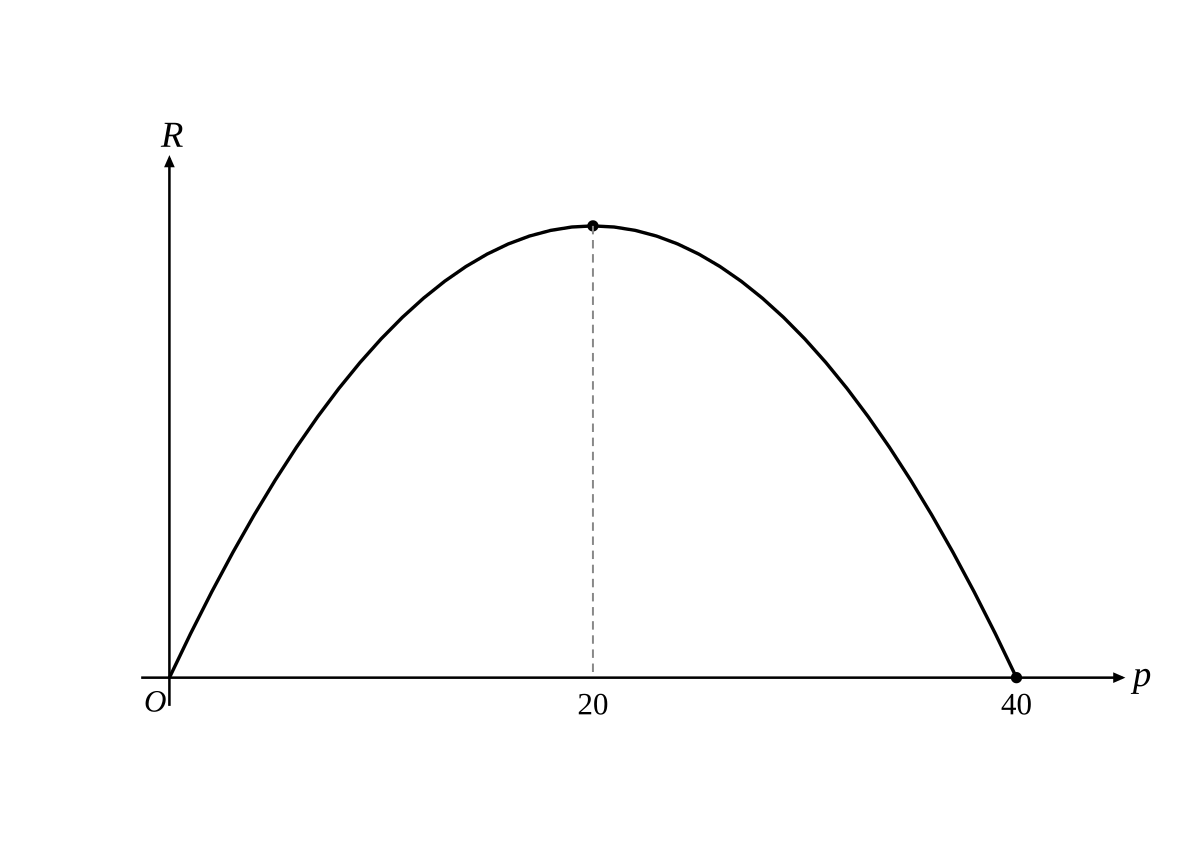
(a) Find the ticket price that gives the maximum revenue. (1 mark)
(b) Find the maximum revenue. (1 mark)
(c) Find BOTH ticket prices for which the revenue is $\$1500$. (1 mark)
Sydney is in time zone UTC$+10$ and Los Angeles is in time zone UTC$-7$.
A flight leaves Sydney at 9:50 am on Tuesday, Sydney time. The flight takes 13 hours and 40 minutes.
Find the local time and day in Los Angeles when the flight arrives. (3 marks)
Priya's credit card charges interest at $18.25\%$ per annum, compounding daily, with an interest-free period of 55 days.
Priya makes a single purchase of $\$840$ and pays her account in full 75 days after the purchase, so interest is charged on 20 days.
Calculate the interest charged, correct to the nearest cent. (2 marks)
The scatterplot shows the number of hours of revision, $x$, and the examination mark, $y$ (out of 100), for a class of students. The least-squares regression line has been drawn.
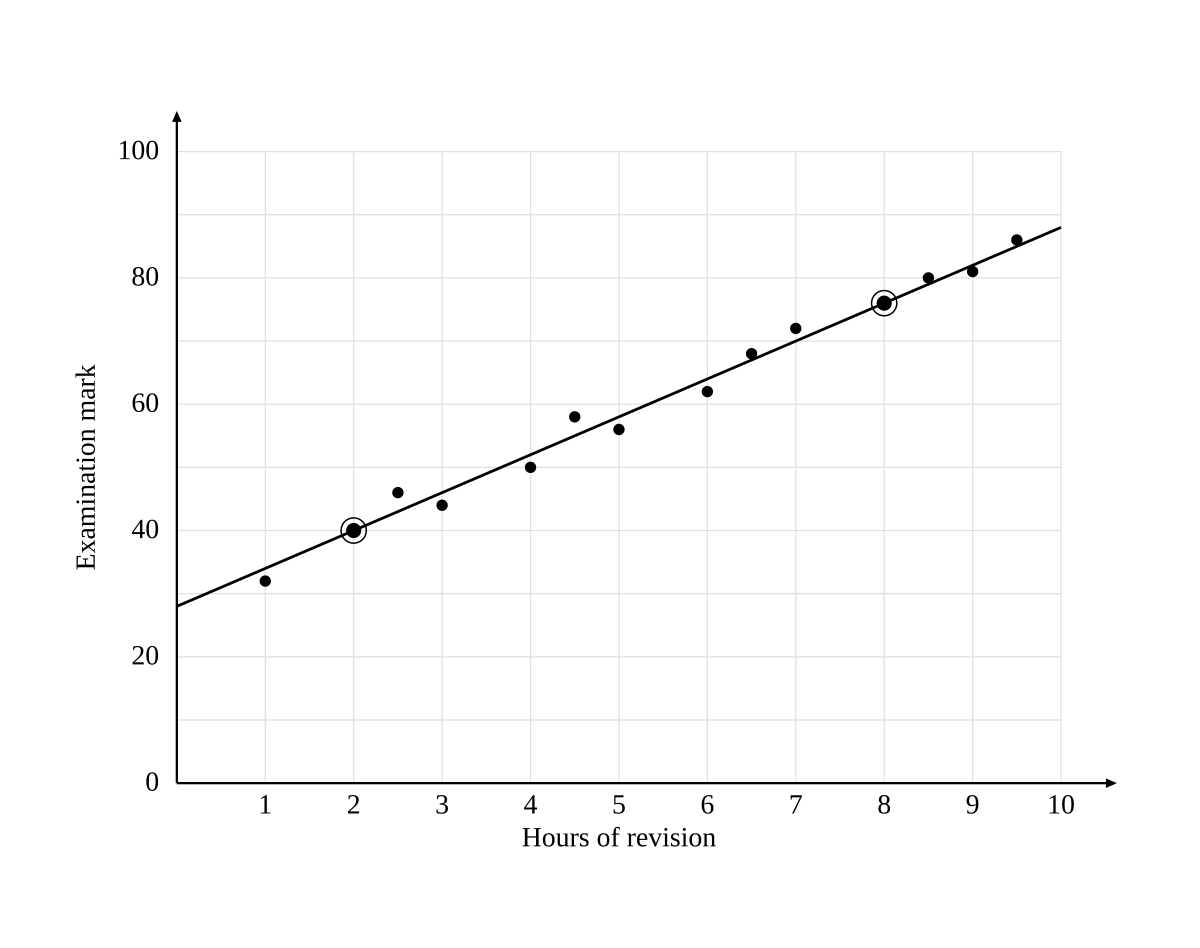
(a) Using the two marked points, find the equation of the regression line. (2 marks)
(b) Interpret the gradient of the line in the context of the data. (1 mark)
(c) Use the equation to predict the mark of a student who revised for 5 hours. (1 mark)
(d) Explain why the equation should NOT be used to predict the mark of a student who revised for 20 hours. (1 mark)
A grain silo is made from a cylinder of diameter 4 m and height 5 m, with a hemisphere of the same diameter on top.
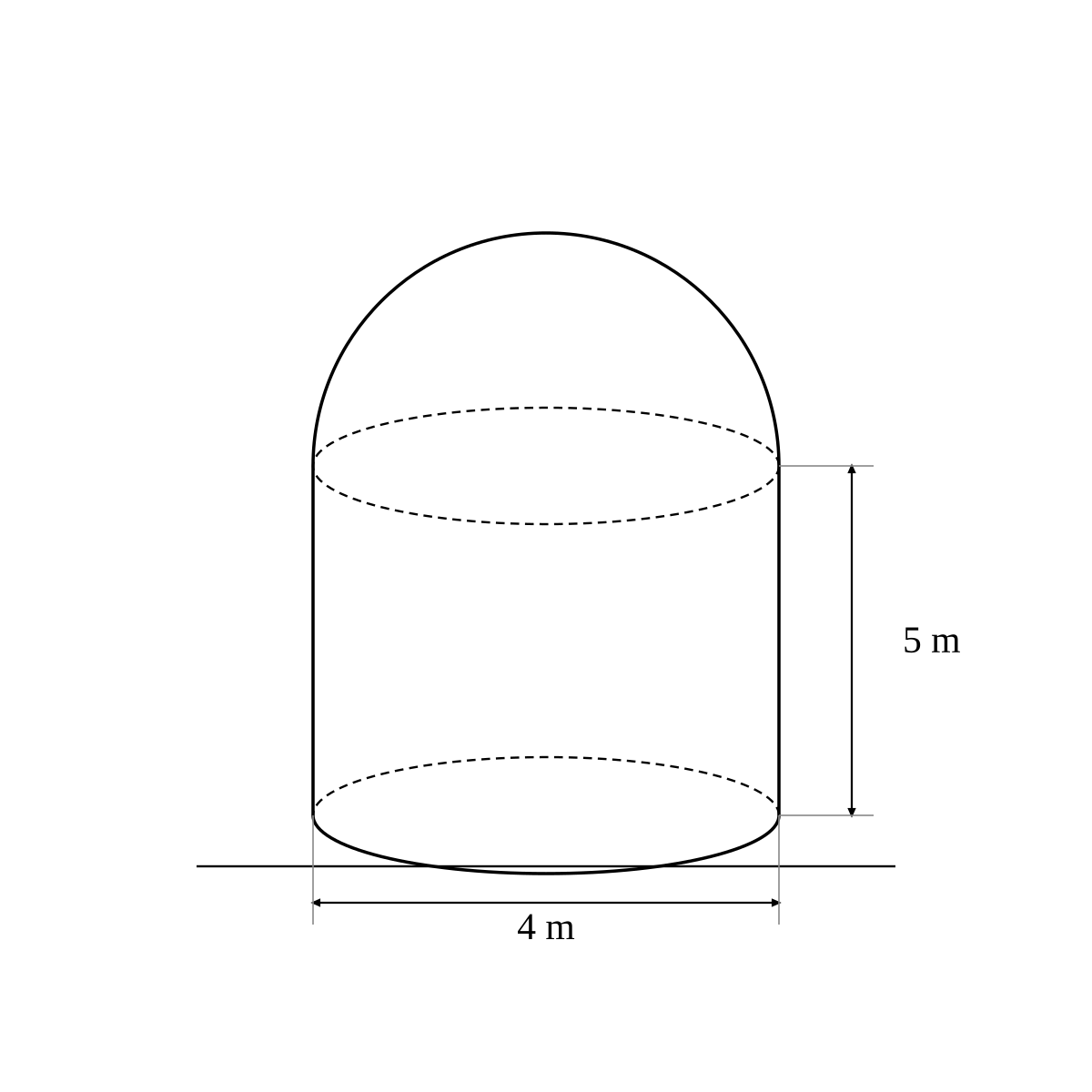
(a) Show that the volume of the silo is $79.6 \text{ m}^3$, correct to one decimal place. (3 marks)
(b) Find the capacity of the silo in litres, correct to three significant figures. (1 mark)
The table shows the future value of an annuity of $\$1$ per period.
| Periods | 0.5% | 0.75% | 3% |
|---|---|---|---|
| 8 | 8.141 | 8.213 | 8.892 |
| 12 | 12.336 | 12.508 | 14.192 |
| 16 | 16.614 | 16.932 | 20.157 |
| 24 | 25.432 | 26.188 | 34.426 |
Zoe wants to save $\$20{,}000$ in 4 years. She will deposit an equal amount at the end of every quarter into an account earning $3\%$ per annum, compounding quarterly.
(a) Use the table to find the amount Zoe must deposit each quarter, correct to the nearest dollar. (2 marks)
(b) Find the total interest Zoe will earn, correct to the nearest dollar. (1 mark)
The cumulative frequency graph shows the delivery times, in minutes, of 60 pizza deliveries. The fastest delivery took 12 minutes and the slowest took 48 minutes.
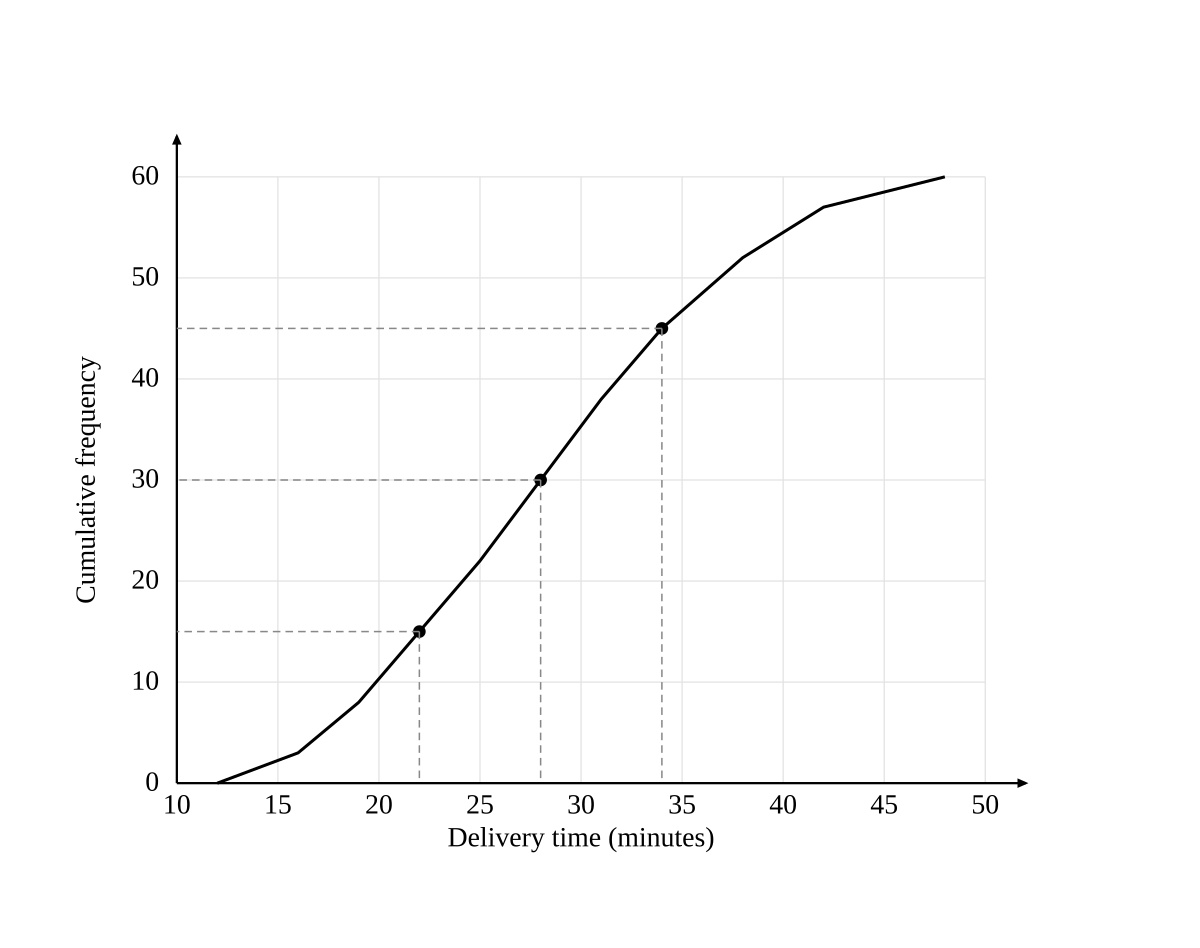
(a) Use the graph to find the median and the quartiles of the delivery times. (2 marks)
(b) Draw a box-plot of the delivery times on the scale provided. (1 mark)
For the delivery times in Question 28, determine, with calculations, whether the slowest delivery time of 48 minutes is an outlier. (2 marks)
The blood alcohol content of a male can be estimated using the formula
$$BAC_{Male} = \dfrac{10N - 7.5H}{6.8M}$$
where $N$ is the number of standard drinks consumed, $H$ is the number of hours of drinking, and $M$ is the person's mass in kilograms.
Marco has a mass of 68 kg. Between 8:30 pm and 11:30 pm he drinks 4 glasses of wine. Each glass contains 1.5 standard drinks.
(a) Show that Marco's estimated blood alcohol content at 11:30 pm is $0.081$, correct to three decimal places. (2 marks)
(b) The time in hours for blood alcohol content to fall to zero is estimated by $\text{time} = \dfrac{BAC}{0.015}$. Using the answer from part (a), find this time in hours and minutes. (1 mark)
(c) Hence find the earliest time at which Marco's blood alcohol content is estimated to be zero. (1 mark)
A delivery van is bought for $\$48{,}000$. Its value can be depreciated using either
(a) Find the value of the van after 4 years using the straight-line method. (1 mark)
(b) Find the value of the van after 4 years using the declining-balance method, correct to the nearest cent. (2 marks)
(c) Which method gives the higher value after 4 years, and by how much? (1 mark)
The lifetimes of a brand of battery are normally distributed. It is known that
Find the mean and standard deviation of the lifetimes. (3 marks)
The diagram shows a scale drawing of a garden bed beside a straight path, drawn at a scale of $1 : 500$.
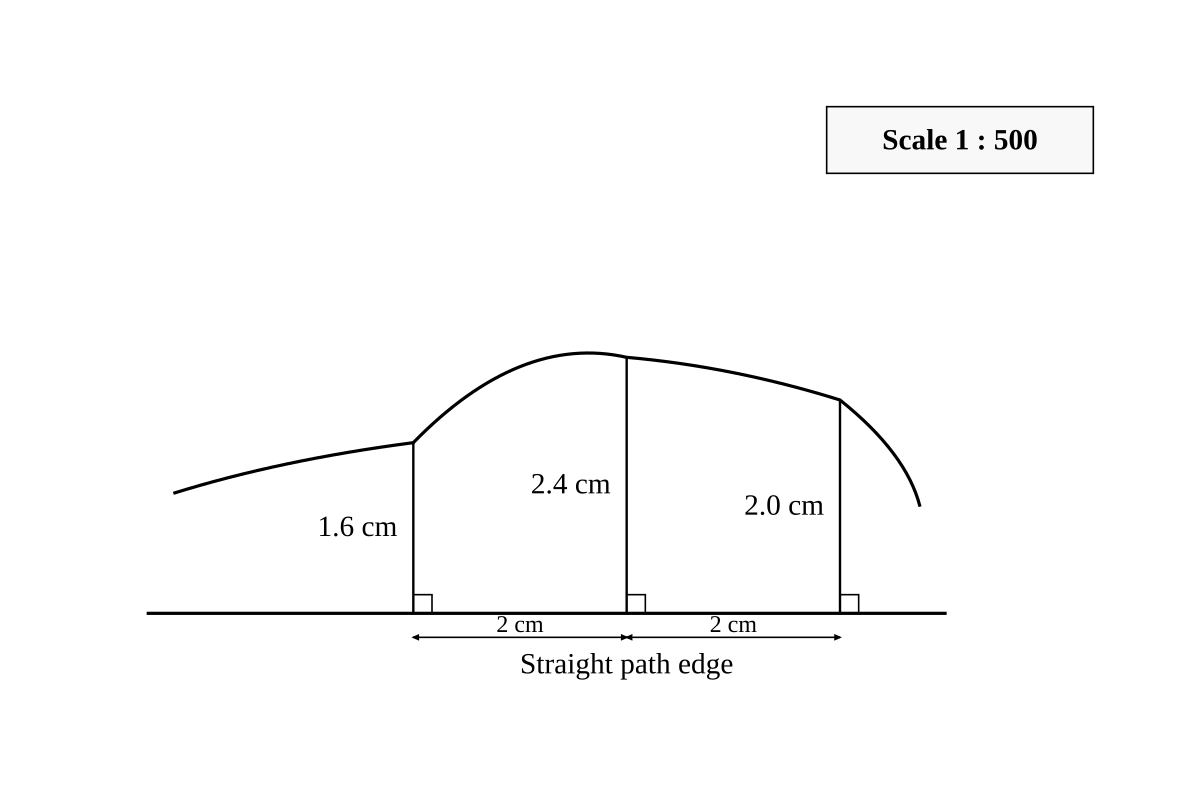
(a) Show that the three offsets represent actual distances of 8 m, 12 m and 10 m, and that they are 10 m apart. (1 mark)
(b) Use two applications of the trapezoidal rule to estimate the area of the garden bed. (2 marks)
(c) The garden bed is to be covered with topsoil to a depth of 0.15 m. Find the volume of topsoil needed, correct to two significant figures. (1 mark)
The diagram shows two triangular garden beds, $ABC$ and $ACD$, which share the boundary $AC$.
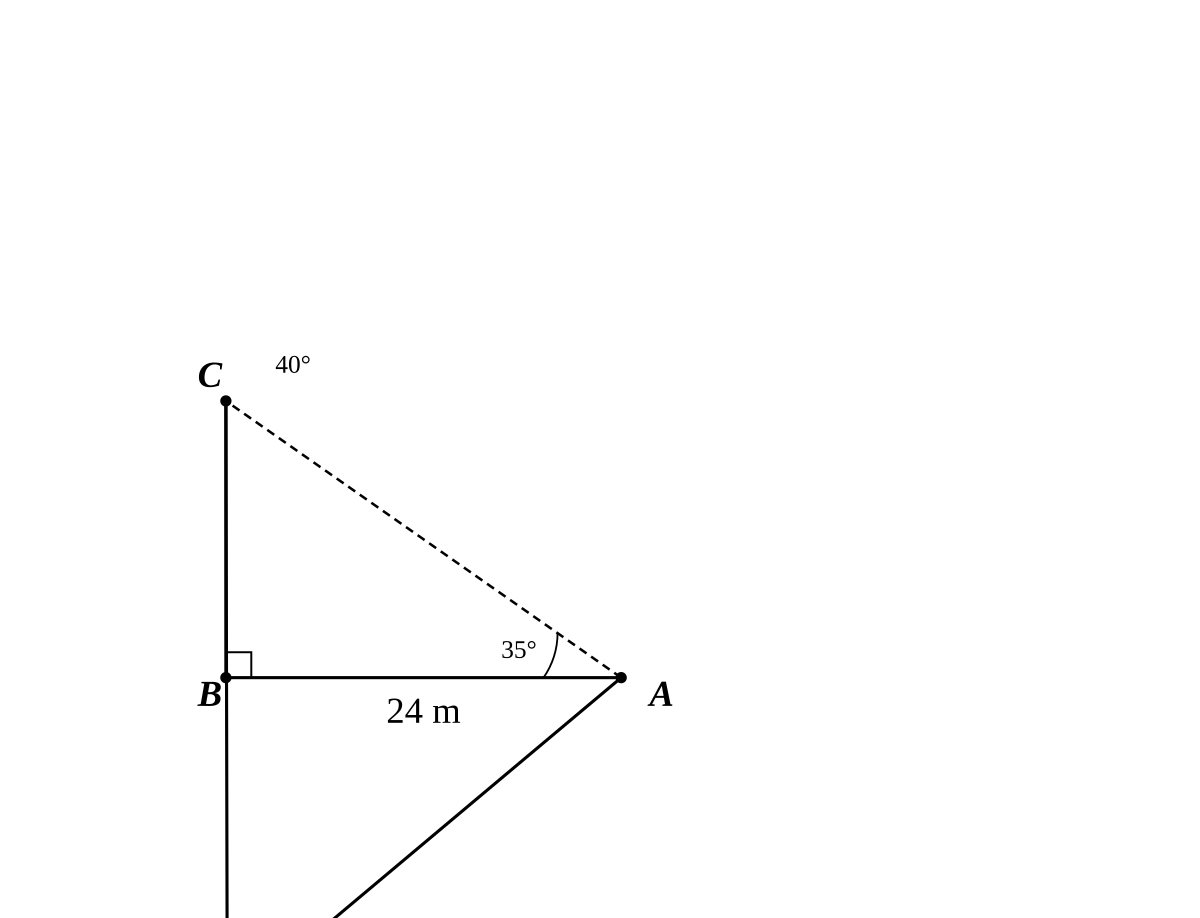
In triangle $ABC$, angle $ABC = 90°$, $AB = 24$ m and angle $BAC = 35°$. In triangle $ACD$, angle $ACD = 40°$ and angle $ADC = 65°$.
(a) Show that $AC = 29.3$ m, correct to one decimal place. (1 mark)
(b) Find the length of $AD$, correct to one decimal place. (2 marks)
Erin prints T-shirts. Her costs are $\$400$ for equipment plus $\$12$ per T-shirt, so the cost of producing $n$ T-shirts is $C = 400 + 12n$. She sells the T-shirts for $\$28$ each, so her revenue is $R = 28n$.
(a) Complete the table of values for $C$ and $R$ for $n = 0, 10, 20, 30, 40$. (1 mark)
(b) Draw the graphs of $C = 400 + 12n$ and $R = 28n$ on the grid provided, for $0 \le n \le 40$. (1 mark)
(c) How many T-shirts must Erin sell to break even? (1 mark)
(d) Find Erin's profit if she sells 40 T-shirts. (1 mark)
The masses of adult echidnas are normally distributed with a mean of 4.2 kg and a standard deviation of 0.5 kg.
The table gives values of $P(Z < z)$ for a standard normal variable $Z$.
| $z$ | $1.2$ | $1.3$ | $1.4$ | $1.5$ | $1.6$ |
|---|---|---|---|---|---|
| $P(Z < z)$ | $0.8849$ | $0.9032$ | $0.9192$ | $0.9332$ | $0.9452$ |
(a) Find the $z$-score of an echidna with a mass of 4.9 kg. (1 mark)
(b) Using the table, find the probability that a randomly chosen adult echidna has a mass greater than 4.9 kg. (2 marks)
(c) In a population of 250 adult echidnas, how many would be expected to have a mass greater than 4.9 kg? (1 mark)
The network shows the activities in a project, with the duration of each activity in days.
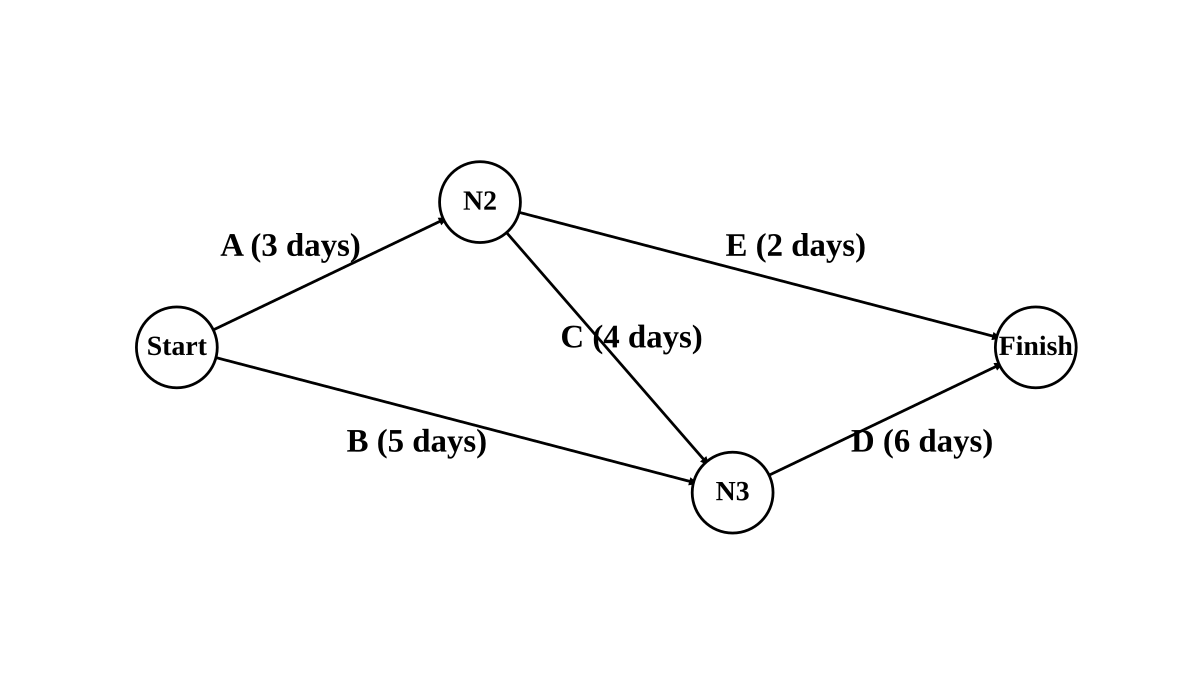
(a) Find the minimum completion time of the project and state the critical path. (2 marks)
(b) Find the float time of activity $B$. (1 mark)
(c) The duration of activity $B$ increases from 5 days to 8 days. Explain, using your answer to part (b), why the critical path changes, and state the new minimum completion time. (1 mark)
The network shows a system of water pipes from a source $S$ to a sink $T$, with the capacity of each pipe in litres per minute.
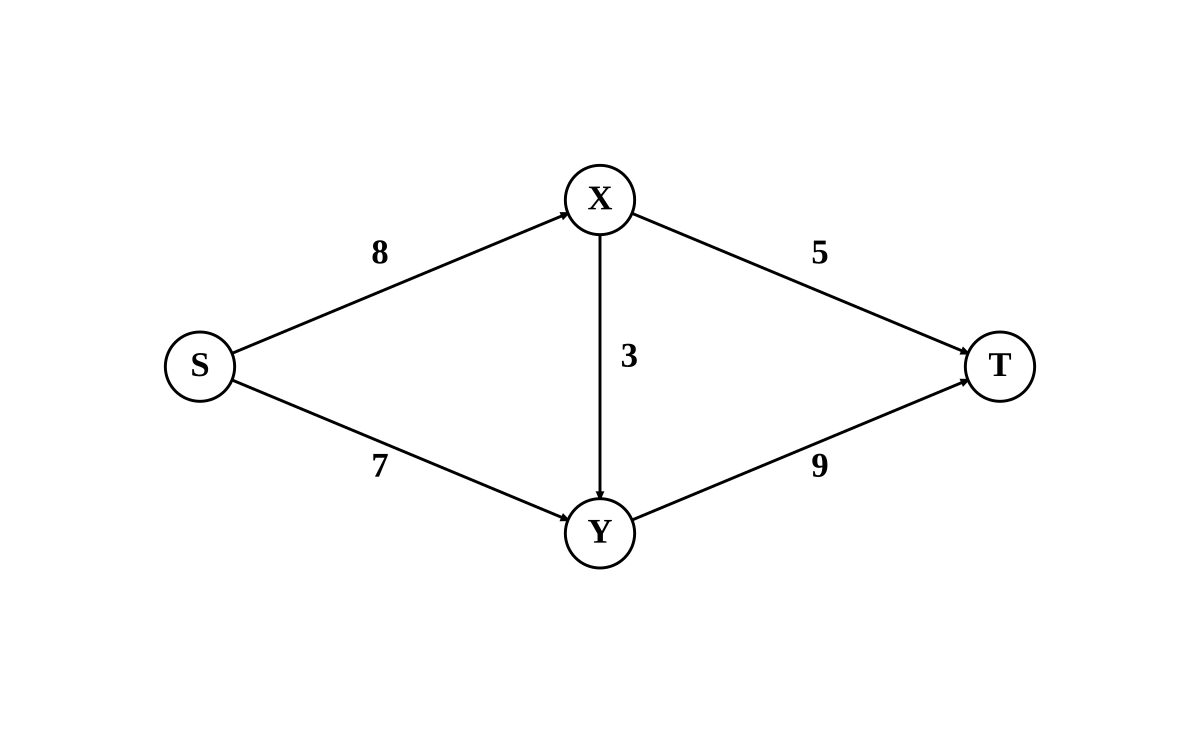
(a) Find the capacity of the cut that separates $S$ from all other vertices. (1 mark)
(b) The maximum flow from $S$ to $T$ is 14 litres per minute. Identify a cut with capacity 14, justifying why the maximum flow cannot exceed 14. (1 mark)
(c) The capacity of ONE pipe can be increased. Which pipe should it be, in order to increase the maximum flow? Justify your answer. (1 mark)
From a port $P$, boat $X$ sails 25 km on a bearing of $048°$ and boat $Y$ sails 32 km on a bearing of $122°$.
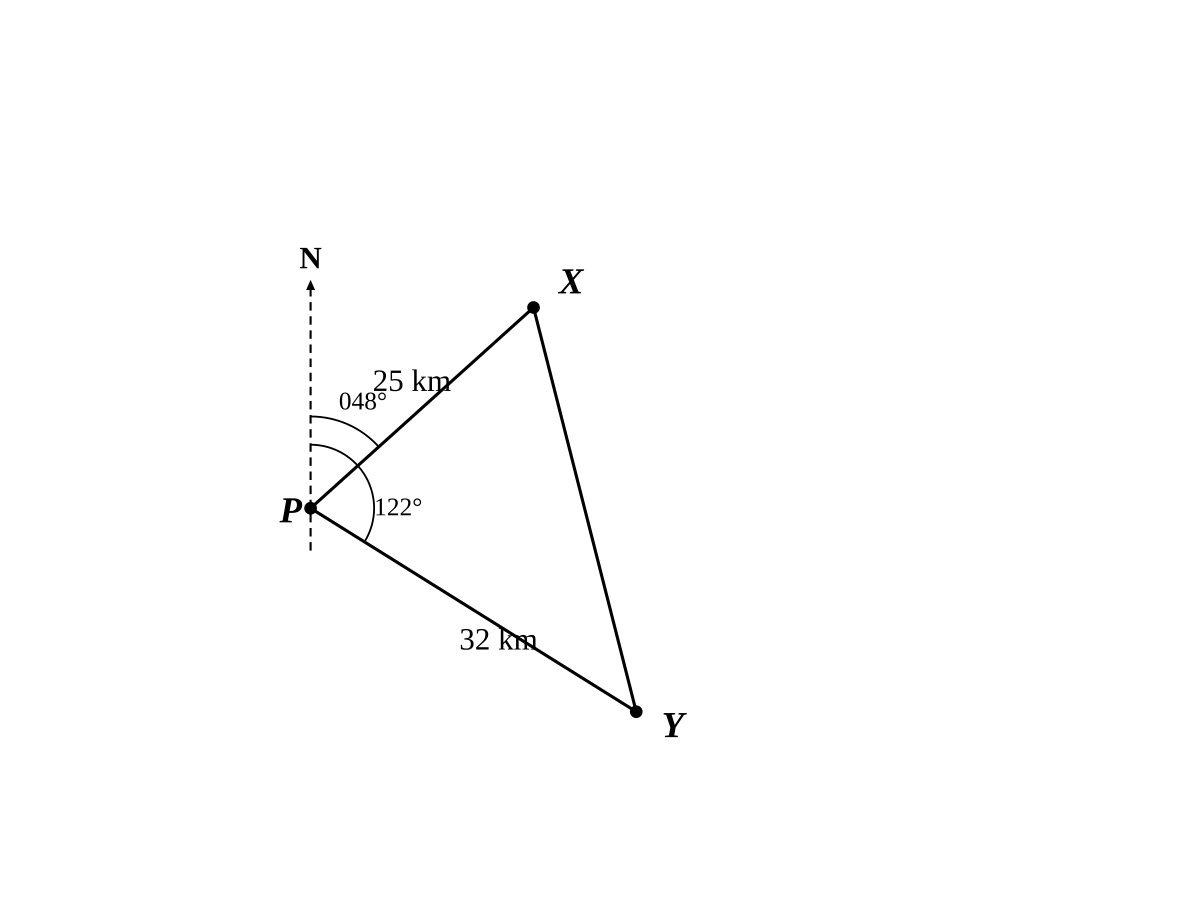
(a) Show that angle $XPY = 74°$. (1 mark)
(b) Find the distance between the two boats, correct to one decimal place. (2 marks)
(c) Find angle $PXY$, correct to the nearest degree. (1 mark)
(d) Hence find the bearing of boat $Y$ from boat $X$, correct to the nearest degree. (1 mark)
The table shows the present value of an annuity of $\$1$ per year.
| Years | 3% | 4% |
|---|---|---|
| 5 | 4.580 | 4.452 |
| 10 | 8.530 | 8.111 |
Ivy is setting up a fund earning $4\%$ per annum, compounding yearly, from which she will withdraw $\$2{,}000$ at the end of each year for the first 5 years, and then $\$3{,}000$ at the end of each year for the following 5 years.
(a) Find the present value of the first 5 years of withdrawals. (1 mark)
(b) Explain why the present value of the second 5 years of withdrawals is given by $3000 \times (8.111 - 4.452)$, and evaluate it. (2 marks)
(c) Hence find the minimum amount Ivy needs to open the fund with, correct to the nearest dollar. (1 mark)
(Intuition Education — not part of the examination paper.)
| Q | 1 | 2 | 3 | 4 | 5 | 6 | 7 | 8 | 9 | 10 | 11 | 12 | 13 | 14 | 15 |
|---|---|---|---|---|---|---|---|---|---|---|---|---|---|---|---|
| Answer | B | D | A | C | C | A | D | B | D | B | C | D | C | C | A |
Brief reasons:
Taxed items (GST-inclusive) $= 11 \times 4.50 = \$49.50$. GST-free items $= 87.45 - 49.50 = \$37.95$. (1 mark ×11 recognition; 1 mark answer. The ×10-vs-÷11 confusion scores 0 for $\$45.00$.)
(a) Energy $= 0.9 \text{ kW} \times 5 \times 30 = 135$ kWh; cost $= 135 \times \$0.32 = \$43.20$. (1 mark W→kW and kWh; 1 mark cost in dollars.) (b) $21.60 \div 0.32 = 67.5$ kWh; $67.5 \div 0.9 = 75$ hours.
(a) First branch $\tfrac{5}{8}$ R, $\tfrac{3}{8}$ B; second branches $\tfrac{4}{7}/\tfrac{3}{7}$ after R and $\tfrac{5}{7}/\tfrac{2}{7}$ after B. (b) $P(\text{same}) = \tfrac{5}{8}\cdot\tfrac{4}{7} + \tfrac{3}{8}\cdot\tfrac{2}{7} = \tfrac{20 + 6}{56} = \tfrac{26}{56} = \tfrac{13}{28}$. (1 mark both products; 1 mark sum. Unreduced $\tfrac{26}{56}$ accepted.)
(a) Network on vertices $A$–$E$ with the eight weighted edges from the table. (b) MST edges: $DE(3), CD(4), AC(5), BC(6)$ — total $18$ km. (1 mark correct tree — it is unique; 1 mark length.) (c) With $AC$ closed: $A\to D\to E = 9 + 3 = 12$ km (beats $A\to B\to E = 15$). The shortest path does not use the MST's $A$–$C$ entry point — the designed trap.
(a) $t = \dfrac{k}{n}$ with $k = 4 \times 18 = 72$, so $t = \dfrac{72}{n}$. (b) $t = \tfrac{72}{6} = 12$ hours. (c) $\tfrac{72}{n} \le 8 \Rightarrow n \ge 9$: 9 pumps.
Tax $= 5092 + 0.325 \times (87{,}500 - 45{,}000) = 5092 + 13{,}812.50 = \$18{,}904.50$. Medicare levy $= 0.02 \times 87{,}500 = \$1{,}750$. Total $= \$20{,}654.50$. (1 mark correct bracket in dollars not cents; 1 mark levy; 1 mark total.)
(a) Axis of symmetry: $p = \dfrac{-200}{2(-5)} = \$20$. (b) $R = -5(400) + 200(20) = \$2000$. (c) $-5p^2 + 200p = 1500 \Rightarrow p^2 - 40p + 300 = 0 \Rightarrow (p-10)(p-30) = 0$: $p = \$10$ or $\$30$.
Arrival in Sydney time: 9:50 am + 13 h 40 min = 11:30 pm Tuesday. Time difference $10 - (-7) = 17$ hours (LA behind). $11{:}30$ pm Tuesday $- 17$ h $=$ 6:30 am Tuesday in Los Angeles. (1 mark arrival in Sydney time; 1 mark 17-hour difference in the right direction; 1 mark time AND day.)
Daily rate $= \tfrac{18.25\%}{365} = 0.05\%$. Interest $= 840\left(1.0005^{20} - 1\right) = 840 \times 0.0100476 = \$8.44$. (1 mark daily rate and $n = 20$; 1 mark interest only, not the future value $\$848.44$.)
(a) Gradient $= \tfrac{76 - 40}{8 - 2} = 6$; $40 = 6(2) + c \Rightarrow c = 28$: $y = 6x + 28$. (b) Each additional hour of revision is associated with an increase of 6 marks, on average. (Context, both variables, per-unit language required.) (c) $y = 6(5) + 28 = 58$ marks. (d) $x = 20$ gives $y = 148 > 100$, an impossible mark — 20 hours is far outside the data range, so extrapolation is unreliable.
(a) $V = \pi r^2 h + \tfrac{1}{2}\cdot\tfrac{4}{3}\pi r^3$ with $r = 2$: $V = \pi(4)(5) + \tfrac{2}{3}\pi(8) = 20\pi + \tfrac{16\pi}{3} = \tfrac{76\pi}{3} = 79.587\ldots \approx 79.6 \text{ m}^3$. (1 mark diameter→radius; 1 mark halved sphere formula; 1 mark combined and rounded.) (b) $79.587 \text{ m}^3 \times 1000 = 79{,}587$ L $\approx$ 79,600 L (3 s.f.).
(a) Quarterly rate $= \tfrac{3\%}{4} = 0.75\%$, $n = 16$ quarters → factor $16.932$. Deposit $= \dfrac{20{,}000}{16.932} = \$1{,}181$. (1 mark rate/period conversion and correct cell; 1 mark divide — not multiply — and round.) (b) Interest $= 20{,}000 - 16 \times 1{,}181.20 = \$1{,}101$ (accept $\$1{,}101$–$\$1{,}104$ depending on rounding of the deposit).
(a) From the ogive at cumulative frequencies 15, 30 and 45: $Q_1 = 22$, median $= 28$, $Q_3 = 34$ minutes. (b) Box from 22 to 34 with median line at 28; whiskers to 12 and 48.
$IQR = 34 - 22 = 12$; upper fence $= Q_3 + 1.5 \times IQR = 34 + 18 = 52$. Since $48 \le 52$, 48 minutes is not an outlier. (1 mark fence; 1 mark comparison WITH a stated conclusion.)
(a) $N = 4 \times 1.5 = 6$, $H = 3$, $M = 68$: $BAC = \dfrac{10(6) - 7.5(3)}{6.8 \times 68} = \dfrac{37.5}{462.4} = 0.0811\ldots \approx 0.081$. (1 mark $N = 6$; 1 mark substitution and rounding.) (b) $\tfrac{0.081}{0.015} = 5.4$ h $= 5$ h $24$ min (0.4 h $= 24$ min, not 40 min — the flagged trap). (c) 11:30 pm $+ 5$ h $24$ min $=$ 4:54 am.
(a) $48{,}000 - 4 \times 6{,}000 = \$24{,}000$. (b) $48{,}000(1 - 0.15)^4 = 48{,}000 \times 0.85^4 = 48{,}000 \times 0.52200625 = \$25{,}056.30$. (1 mark $S = V_0(1-r)^n$ with $r = 0.15$; 1 mark value.) (c) Declining balance, by $25{,}056.30 - 24{,}000 = \$1{,}056.30$.
$16\%$ above 660 → $660$ is one standard deviation above the mean: $\mu + \sigma = 660$. $2.5\%$ below 540 → $540$ is two standard deviations below: $\mu - 2\sigma = 540$. Subtracting: $3\sigma = 120$, so $\sigma = 40$ hours and $\mu = 620$ hours. (1 mark each correct $z$-identification; 1 mark solving the pair.)
(a) Scale $1:500$ → 1 cm represents 5 m. Offsets: $1.6 \times 5 = 8$ m, $2.4 \times 5 = 12$ m, $2.0 \times 5 = 10$ m; spacing $2 \times 5 = 10$ m. (Scale conversion BEFORE the rule.) (b) $A \approx \tfrac{10}{2}(8 + 12) + \tfrac{10}{2}(12 + 10) = 100 + 110 = 210 \text{ m}^2$. (1 mark per application.) (c) $V = 210 \times 0.15 = 31.5 \approx$ 32 m³ (2 s.f.).
(a) $\cos 35° = \dfrac{24}{AC} \Rightarrow AC = \dfrac{24}{\cos 35°} = 29.2986\ldots \approx 29.3$ m. (b) Sine rule in $ACD$: $\dfrac{AD}{\sin 40°} = \dfrac{AC}{\sin 65°} \Rightarrow AD = \dfrac{29.3 \sin 40°}{\sin 65°} = 20.78\ldots \approx 20.8$ m. (1 mark sine rule with sides opposite the correct angles; 1 mark answer. Full-accuracy $AC$ gives the same rounded answer — no early-rounding penalty here, but working from $29.3$ or $29.2986$ both accepted.)
(a) $R$: 0, 280, 560, 840, 1120; $C$: 400, 520, 640, 760, 880. (b) Two straight lines; $C$ has intercept 400, $R$ passes through the origin. (c) $400 + 12n = 28n \Rightarrow 16n = 400 \Rightarrow n = 25$ T-shirts (intersection of the graphs). (d) Profit $= 1120 - 880 = \$240$.
(a) $z = \dfrac{4.9 - 4.2}{0.5} = 1.4$. (b) $P(Z < 1.4) = 0.9192$, so $P(\text{mass} > 4.9) = 1 - 0.9192 = 0.0808$. (1 mark table value; 1 mark complement.) (c) $250 \times 0.0808 = 20.2 \approx$ 20 echidnas (a whole-number count, not a probability).
(a) Paths: $A$–$C$–$D$ $= 3+4+6 = 13$; $B$–$D$ $= 11$; $A$–$C$–$E$ $= 9$. Minimum completion time 13 days, critical path $A$–$C$–$D$. (1 mark time; 1 mark path.) (b) $D$ must start by day $13 - 6 = 7$, so $LST_B = 7 - 5 = 2$: float $= 2 - 0 = 2$ days. (c) The increase of 3 days exceeds $B$'s float of 2 days, so $B$ becomes critical: new critical path $B$–$D$, new minimum time $8 + 6 = 14$ days.
(a) $8 + 7 = 15$ L/min. (b) The cut through $XT$ and $YT$ has capacity $5 + 9 = 14$; no flow can exceed the capacity of any cut, so maximum flow $\le 14$ (and 14 is achieved). (c) Increase $YT$ (the saturated edge in the minimum cut). Increasing it to 10 lifts the minimum cut, and the flow, to 15 (spare capacity exists on $S\to X\to Y$); increasing $XT$ alone also lies on the min cut — accept $XT$ or $YT$ with a min-cut justification; reject $SX$/$SY$/$XY$ (not in the minimum cut).
(a) Both bearings are measured clockwise from north at $P$: $\angle XPY = 122° - 48° = 74°$. (b) $XY^2 = 25^2 + 32^2 - 2(25)(32)\cos 74° = 1649 - 1600(0.27564) = 1207.98$, so $XY = 34.8$ km. (1 mark cosine rule; 1 mark answer.) (c) $\dfrac{\sin \angle PXY}{32} = \dfrac{\sin 74°}{34.756} \Rightarrow \sin \angle PXY = 0.8850 \Rightarrow \angle PXY = 62°$. (d) Bearing of $P$ from $X$ is $48° + 180° = 228°$; bearing of $Y$ from $X$ = $228° - 62° = $ 166°. (The "of/from" reversal and the parallel-north-lines transfer are the marked skills.)
(a) $2000 \times 4.452 = \$8{,}904$. (b) $3000 \times 8.111$ would fund $\$3{,}000$ every year for all 10 years; the withdrawals in years 1–5 are only $\$2{,}000$, so the years 6–10 stream is valued as the 10-year factor minus the 5-year factor: $3000 \times (8.111 - 4.452) = 3000 \times 3.659 = \$10{,}977$. (1 mark explanation as a difference of two present values; 1 mark evaluation.) (c) $8{,}904 + 10{,}977 = \$19{,}881$.
| Paper item | Prediction | Agreement |
|---|---|---|
|
Q22 quadratic revenue model, maximum via symmetry + equal-output prices ↑ Q22 |
std2-q1-quadratic-model | 0.70 · 5 (fable, gemini-3.1-pro, opus, deepseek, grok) |
|
Q19 MST from a distance table + road-closure shortest path ↑ Q19 |
std2-q2-mst-network | 0.69 · 5 (gemini-3.1-pro, deepseek, grok, opus, gpt-5.6-sol) |
|
Q39 two-leg bearings: cosine rule, sine rule, bearing of Y from X ↑ Q39 |
std2-q3-bearings-navigation | 0.69 · 4 (gemini-3.1-pro, deepseek, fable, gpt-5.6-sol) |
|
Q37 critical path, float, duration-change justification ↑ Q37 |
std2-q4-critical-path | 0.69 · 4 (opus, deepseek, fable, grok) |
|
Q17 appliance running cost + reverse hours ↑ Q17 |
std2-q5-running-cost | 0.67 · 4 (fable, opus, gpt-5.6-sol, deepseek) |
|
Q27 FV annuity factor table, rate/period conversion, divide for deposit ↑ Q27 |
std2-q6-annuity-factor-table | 0.66 · 4 (fable, gemini-3.1-pro, opus, grok) |
|
Q31 straight-line vs declining-balance comparison ↑ Q31 |
std2-q7-depreciation-comparison | 0.66 · 4 (gemini-3.1-pro, opus, fable, grok) |
|
Q26 cylinder + hemisphere silo, volume and litres ↑ Q26 |
std2-q8-composite-solid | 0.65 · 4 (fable, opus, gpt-5.6-sol, grok) |
|
Q25 regression: equation, slope in context, interpolation, extrapolation critique ↑ Q25 |
std2-q9-regression-interpretation | 0.64 · 6 (all) |
|
Q30 BAC formula → time to zero → clock time ↑ Q30 |
std2-q10-bac-formula | 0.63 · 4 (gemini-3.1-pro, deepseek, fable, gpt-5.6-sol) |
|
Q36 z-table → tail probability → expected count ↑ Q36 |
std2-q11-ztable-expected-count | 0.62 · 5 (fable, grok, gpt-5.6-sol, deepseek, opus) |
|
Q18 two draws without replacement, P(same colour) ↑ Q18 |
std2-q12-without-replacement | 0.62 · 5 (gemini-3.1-pro, fable, opus, gpt-5.6-sol, deepseek) |
|
Q21 income tax table + Medicare levy ↑ Q21 |
std2-q13-income-tax | 0.61 · 5 (gemini-3.1-pro, opus, deepseek, grok; fable dissents at 0.35 — see its no-tax-table bold call) |
|
Q33 trapezoidal rule twice from a 1:500 plan → topsoil volume ↑ Q33 |
std2-q14-trapezoidal-scale | 0.57 · 5 (fable, deepseek, gpt-5.6-sol, opus, grok) |
|
Q34 two triangles sharing side AC ↑ Q34 |
watch list | ~0.61 · 4 |
|
Q23 time zones with day + time demanded ↑ Q23 |
watch list | ~0.55 · 5 |
|
Q24 credit-card daily compounding, 20 chargeable days ↑ Q24 |
watch list | ~0.57 · 4 |
|
MC Q11 z-score relative-performance comparison ↑ Q11 |
watch list | ~0.57 · 4 |
|
Q28 + Q29 box-plot from ogive + 1.5×IQR outlier test ↑ Q28 ↑ Q29 |
watch list | ~0.55 · 4 |
|
Q20 + MC Q6 inverse variation ↑ Q20 ↑ Q6 |
watch list | ~0.55 · 4 |
|
Q32 empirical-rule fractions (16%/2.5%) run in reverse ↑ Q32 |
watch list | ~0.55 · 3 |
|
Q40 two-phase annuity closer (difference of two PV factors) ↑ Q40 |
watch list | ~0.50 · 5 (the panel's widest-held watch item; placed as the paper's final question per deepseek's structural prediction) |
|
Q35 break-even table–graph–profit ↑ Q35 |
watch list | ~0.52 · 4 |
|
Q38 + MC Q15 max-flow min-cut, backward edge excluded ↑ Q38 ↑ Q15 |
watch list | ~0.49 · 4 |
|
MC Q3 change the subject ↑ Q3 |
watch list | 0.80 (single model) · fable — the panel's highest single question probability |
|
Q16 GST reverse on a receipt (×10 vs ÷11) ↑ Q16 |
watch list | ~0.45 · 3 |
|
MC Q1, Q2, Q4, Q5, Q8, Q9, Q10, Q12, Q13, Q14 ↑ Q1 ↑ Q2 ↑ Q4 ↑ Q5 ↑ Q8 ↑ Q9 ↑ Q10 ↑ Q12 ↑ Q13 ↑ Q14 |
topic-level consensus | — · — |
|
Not realised: radial survey with a supplied triangle area (3 models, ~0.55) |
watch list | — · bearings cluster realised at Q39 instead; practise the ½ab sin C rearrangement separately |
Exam Success Program
Our 2027 program offers Maths Standard 2 practice exams under real conditions, with marking and personal feedback. See the ESP page for the program start and enquire about exam session availability.
2027 session times to be confirmed
Intu AI
Intu AI builds unlimited practice questions for Maths Standard 2 in these styles, marks your working, and explains what you missed — aligned to your syllabus.
Published Aug 2026, before the exams. In November 2026 we score these predictions publicly against the real paper — per-model calibration and question-level hit rates, the same harness as the 2025 backtest. How we did it.