Answers and marking notes
(Intuition Education — not part of the examination paper.)
Section I — correct responses
| Q |
1 |
2 |
3 |
4 |
5 |
6 |
7 |
8 |
9 |
10 |
| Answer |
B |
C |
D |
C |
B |
A |
A |
D |
B |
C |
Brief reasons:
- Contrapositive negates and swaps: "not multiple of 3 $\Rightarrow$ not multiple of 6". A is the converse, C the inverse, D a (false) conjunction. B
- Negating $\forall\,\exists$ gives $\exists\,\forall$: there is some $x$ that is no cube. A negates only the inner clause; D over-negates. C
- $-1 - \sqrt{3}i$ lies in the third quadrant with reference angle $\tfrac{\pi}{3}$; the principal argument in $(-\pi, \pi]$ is $-\pi + \tfrac{\pi}{3} = -\tfrac{2\pi}{3}$ (B is the non-principal $\tfrac{4\pi}{3}$). D
- Direction $\overrightarrow{AB} = (2, 1, -2)$ through point $A$. A and B use a position vector as the direction; D uses $B - A$ as the point. C
- $a = v\dfrac{dv}{dx} = (x^2+1)(2x)$; at $x = 1$: $2 \times 2 = 4$. (A is the omitted-$v$ error $\tfrac{dv}{dx} = 2$.) B
- $v^2 = 16 - (x - 2)^2$: $n = 1$, centre $2$, amplitude $4$. (B is the read-the-constant-term error $A^2 = 12$; D is the centre.) A
- Conjugate $2 - i$ is also a zero; sum of zeros $= 7$, so the third is $7 - 4 = 3$ (or $15 \div |2+i|^2 = 3$ from the product). A
- Irreducible quadratic $x^2 + 4$ needs a linear numerator $Bx + C$; it does not factor over the reals (B), and $\tfrac{A}{x-1}$ needs only a constant (C). D
- $1 + i = \sqrt{2}\operatorname{cis}\tfrac{\pi}{4}$, so $(1+i)^{10} = 2^5 \operatorname{cis}\tfrac{5\pi}{2} = 32\operatorname{cis}\tfrac{\pi}{2} = 32i$. B
- Equidistant from $1$ and $-i$: the perpendicular bisector of the segment joining $(1, 0)$ and $(0, -1)$, which passes through the origin with gradient $-1$: the line $y = -x$. C
Question 11
(a)(i) $\bar{z}w = (3 + i)(1 + 2i) = 3 + 6i + i - 2 = 1 + 7i$.
(a)(ii) $\dfrac{3 - i}{1 + 2i} \cdot \dfrac{1 - 2i}{1 - 2i} = \dfrac{3 - 6i - i - 2}{5} = \dfrac{1 - 7i}{5} = \dfrac{1}{5} - \dfrac{7}{5}i$. (1 mark multiplying by the conjugate, 1 mark answer.)
(b) $|\sqrt{3} - i| = 2$, $\arg = -\tfrac{\pi}{6}$, so $\sqrt{3} - i = 2e^{-i\pi/6}$. Then $\left(\sqrt{3} - i\right)^7 = 2^7 e^{-7i\pi/6} = 128\operatorname{cis}\tfrac{5\pi}{6} = 128\left(-\tfrac{\sqrt{3}}{2} + \tfrac{1}{2}i\right) = -64\sqrt{3} + 64i$. (1 mark exponential form with principal argument, 1 mark De Moivre, 1 mark exact Cartesian.)
(c) $\underset{\sim}{a}\cdot\underset{\sim}{b} = 2 - 3 - 4 = -5$; $|\underset{\sim}{a}| = 3$, $|\underset{\sim}{b}| = \sqrt{14}$. $\cos\theta = \dfrac{-5}{3\sqrt{14}}$, so $\theta \approx 116°$. (Keep the negative cosine — the angle is obtuse.)
(d)(i) $\overrightarrow{AB} = (2, -1, 2)$: $\underset{\sim}{r} = \begin{pmatrix} 1 \\ 2 \\ -1 \end{pmatrix} + \lambda\begin{pmatrix} 2 \\ -1 \\ 2 \end{pmatrix}$.
(d)(ii) Require $(7, -1, 5) = (1 + 2\lambda,\ 2 - \lambda,\ -1 + 2\lambda)$: the first gives $\lambda = 3$, the second $\lambda = 3$, the third $\lambda = 3$ — one consistent parameter, so $C$ lies on $\ell$. (The mark is for checking all three components against a single $\lambda$.)
(e) Suppose $\log_2 3 = \tfrac{p}{q}$ with $p, q$ positive integers (positive since $\log_2 3 > 0$). Then $2^{p/q} = 3$, so $2^p = 3^q$. But $2^p$ is even and $3^q$ is odd — a contradiction. Hence $\log_2 3$ is irrational. (1 mark stating the assumption in lowest form, 1 mark reaching $2^p = 3^q$, 1 mark exhibiting the parity contradiction and writing the conclusion.)
(f) $z = \pm 3i$.
Question 12
(a)(i) $2x^2 + x + 2 = A(x^2 + 4) + (Bx + C)(x - 1)$. At $x = 1$: $5 = 5A$, so $A = 1$. Comparing $x^2$: $B = 1$; comparing constants: $4A - C = 2$, so $C = 2$. Thus $A = 1$, $B = 1$, $C = 2$.
(a)(ii) $\displaystyle\int \left(\frac{1}{x - 1} + \frac{x + 2}{x^2 + 4}\right) dx = \ln|x - 1| + \tfrac{1}{2}\ln\left(x^2 + 4\right) + \tan^{-1}\frac{x}{2} + C$. (Absolute value on the first logarithm required.)
(b) $dx = \dfrac{2\,dt}{1 + t^2}$, $\sin x = \dfrac{2t}{1 + t^2}$, $\cos x = \dfrac{1 - t^2}{1 + t^2}$; limits $x = 0 \to t = 0$, $x = \tfrac{\pi}{2} \to t = 1$. The denominator becomes $\dfrac{2 + 2t}{1 + t^2}$, so the integral is $\displaystyle\int_0^1 \frac{dt}{1 + t} = \ln 2$. (1 mark substitution including both limits, 1 mark simplification, 1 mark $\ln 2$.)
(c)(i) $\ddot{x} = \tfrac{1}{2}\dfrac{d(v^2)}{dx} = \tfrac{1}{2}(18 - 18x) = -9(x - 1)$, which is of the form $\ddot{x} = -n^2(x - c)$: SHM with centre $x = 1$ and $n = 3$, period $\dfrac{2\pi}{3}$.
(c)(ii) $v^2 = 36 - 9(x - 1)^2$: amplitude $A = 2$; maximum speed $nA = 6 \text{ m s}^{-1}$ (at the centre).
(c)(iii) Maximum $|\ddot{x}| = n^2 A = 9 \times 2 = 18 \text{ m s}^{-2}$ (at the endpoints $x = -1, 3$).
(c)(iv) $4A = 8$ m.
(d) Base case $n = 5$: $2^5 = 32 > 25 = 5^2$. Assume $2^k > k^2$ for some integer $k \ge 5$. Then $2^{k+1} = 2 \cdot 2^k > 2k^2$. Now for $k \ge 5$, $k^2 - 2k - 1 = (k - 1)^2 - 2 > 0$, so $2k^2 > k^2 + 2k + 1 = (k + 1)^2$. Hence $2^{k+1} > (k+1)^2$, and the result follows by induction. (The middle mark is for the auxiliary inequality $2k^2 > (k+1)^2$ with justification valid for $k \ge 5$ — the step where the assumption is used, not restated.)
Question 13
(a)(i) With $u = x^n$, $dv = e^x dx$, so $du = nx^{n-1}dx$, $v = e^x$:
$$I_n = \left[x^n e^x\right]_0^1 - n\int_0^1 x^{n-1}e^x dx = e - nI_{n-1} \quad (n \ge 1).$$
(1 mark naming $u$, $dv$, $v$, $du$; 1 mark the parts step; 1 mark substituting the limits.)
(a)(ii) $I_0 = e - 1$; $I_1 = e - I_0 = 1$; $I_2 = e - 2I_1 = e - 2$; $I_3 = e - 3I_2 = 6 - 2e$.
(b) $|z - 2| \le 2$ is the closed disc centre $(2, 0)$ radius $2$ (solid boundary). $|z| > |z - 2i| \iff x^2 + y^2 > x^2 + (y-2)^2 \iff y > 1$: the open half-plane above the dashed line $y = 1$. The region is the part of the disc strictly above $y = 1$; the circle meets $y = 1$ at $\left(2 \pm \sqrt{3},\ 1\right)$ (excluded endpoints, open dots). (1 mark disc with solid boundary, 1 mark dashed bisector $y = 1$ with correct side, 1 mark intersection points and correct shading.)
(c)(i) $(\sqrt{a} - \sqrt{b})^2 \ge 0 \Rightarrow a + b \ge 2\sqrt{ab} \Rightarrow \dfrac{a+b}{2} \ge \sqrt{ab}$.
(c)(ii) By (i), $a + b \ge 2\sqrt{ab}$, $b + c \ge 2\sqrt{bc}$, $c + a \ge 2\sqrt{ca}$. All six quantities are positive, so the inequalities may be multiplied:
$$(a+b)(b+c)(c+a) \ge 8\sqrt{a^2b^2c^2} = 8abc.$$
(1 mark applying (i) three times, 1 mark justifying the multiplication by positivity, 1 mark completing; equality iff $a = b = c$. Start from the known truth — do not work backwards from the target.)
(d) General point $Q(1 + 2\lambda,\ \lambda,\ -1 + 2\lambda)$; $\overrightarrow{PQ} = (2\lambda - 2,\ \lambda + 1,\ 2\lambda - 3)$. Perpendicularity: $\overrightarrow{PQ}\cdot(2, 1, 2) = 9\lambda - 9 = 0$, so $\lambda = 1$ and the closest point is $(3, 1, 1)$. Then $\overrightarrow{PQ} = (0, 2, -1)$ and the shortest distance is $\sqrt{5}$. (1 mark general point, 1 mark perpendicularity condition, 1 mark foot and distance.)
Question 14
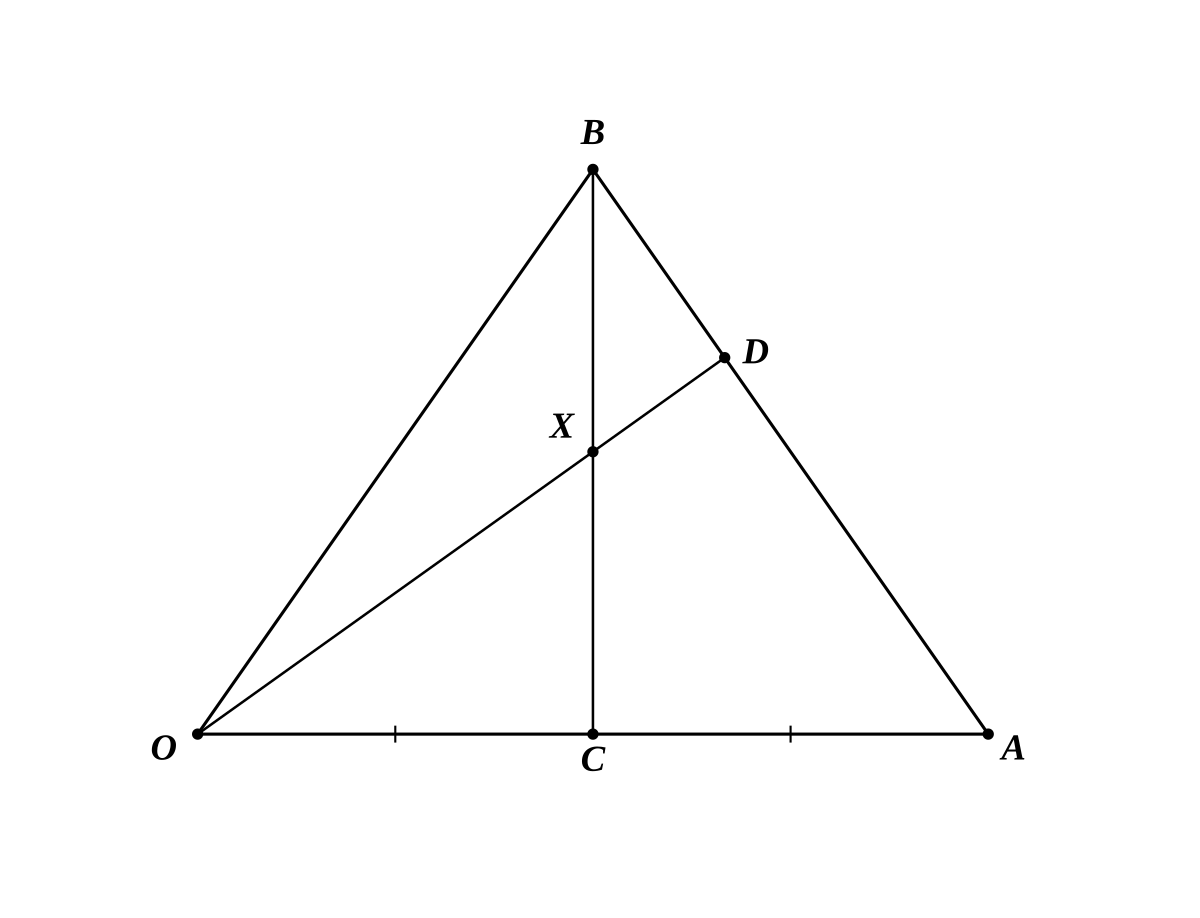
(a)(i) $\overrightarrow{OD} = \underset{\sim}{a} + \tfrac{2}{3}\left(\underset{\sim}{b} - \underset{\sim}{a}\right) = \tfrac{1}{3}\underset{\sim}{a} + \tfrac{2}{3}\underset{\sim}{b}$.
(a)(ii) $X$ on $OD$: $\overrightarrow{OX} = t\left(\tfrac{1}{3}\underset{\sim}{a} + \tfrac{2}{3}\underset{\sim}{b}\right)$. $X$ on $BC$: $\overrightarrow{OX} = \underset{\sim}{b} + s\left(\tfrac{1}{2}\underset{\sim}{a} - \underset{\sim}{b}\right) = \tfrac{s}{2}\underset{\sim}{a} + (1 - s)\underset{\sim}{b}$. Since $\underset{\sim}{a}$ and $\underset{\sim}{b}$ are non-zero and non-parallel, coefficients may be equated: $\tfrac{t}{3} = \tfrac{s}{2}$ and $\tfrac{2t}{3} = 1 - s$. Solving: $t = \tfrac{3}{4}$, $s = \tfrac{1}{2}$. So $X = B + \tfrac{1}{2}(C - B)$ is the midpoint of $BC$, and $\overrightarrow{OX} = \tfrac{3}{4}\overrightarrow{OD}$ gives $OX : XD = 3 : 1$. (1 mark the two expressions, 1 mark equating coefficients with the non-parallel justification, 1 mark both conclusions.)
(b)(i) $\cos 5\theta + i\sin 5\theta = (\cos\theta + i\sin\theta)^5$. The imaginary part of the binomial expansion (with $c = \cos\theta$, $s = \sin\theta$): $\sin 5\theta = 5c^4 s - 10c^2 s^3 + s^5$. Substituting $c^2 = 1 - s^2$:
$$\sin 5\theta = 5s(1 - s^2)^2 - 10s^3(1 - s^2) + s^5 = 16s^5 - 20s^3 + 5s.$$
(b)(ii) For $\theta = \tfrac{\pi}{5}$ and $\theta = \tfrac{2\pi}{5}$, $\sin 5\theta = \sin\pi = \sin 2\pi = 0$, so $s\left(16s^4 - 20s^2 + 5\right) = 0$ with $s = \sin\theta \ne 0$; hence both values satisfy $16x^4 - 20x^2 + 5 = 0$.
(b)(iii) Putting $y = x^2$: $16y^2 - 20y + 5 = 0$ has roots $y_1 = \sin^2\tfrac{\pi}{5}$ and $y_2 = \sin^2\tfrac{2\pi}{5}$ (distinct, as $0 < \sin\tfrac{\pi}{5} < \sin\tfrac{2\pi}{5}$). By Vieta, $y_1 y_2 = \tfrac{5}{16}$, so $\left(\sin\tfrac{\pi}{5}\sin\tfrac{2\pi}{5}\right)^2 = \tfrac{5}{16}$; both sines are positive, hence the product is $\tfrac{\sqrt{5}}{4}$. (The justification that the two roots of the quadratic are exactly these two values — and the positive-root choice — carries a mark.)
(c) Real coefficients $\Rightarrow$ $1 - 2i$ is also a zero. Sum of zeros $= 5$: third zero $= 5 - (1 + 2i) - (1 - 2i) = 3$. (Check: $(1 + 4) \times 3 = 15$ ✓.) Other zeros: $1 - 2i$ and $3$.
(d) Discriminant: $(3 + i)^2 - 4(2 + 2i) = 8 + 6i - 8 - 8i = -2i$. Seek $(x + iy)^2 = -2i$: $x^2 - y^2 = 0$, $2xy = -2$, giving $x = 1, y = -1$ (or $x = -1, y = 1$), so $\sqrt{-2i} = \pm(1 - i)$. Then
$$z = \frac{(3 + i) \pm (1 - i)}{2} = 2 \quad \text{or} \quad 1 + i.$$
(1 mark discriminant, 1 mark Cartesian square root, 1 mark both roots. Check: sum $= 3 + i$ ✓, product $= 2 + 2i$ ✓.)
Question 15
(a)(i) $v\dfrac{dv}{dx} = -(g + kv^2)$, so $x = -\displaystyle\int \frac{v\,dv}{g + kv^2} = -\frac{1}{2k}\ln\left(g + kv^2\right) + C$. At $x = 0$, $v = u$; at the top $v = 0$:
$$H = \frac{1}{2k}\ln\frac{g + ku^2}{g} = \frac{1}{2k}\ln\!\left(1 + \frac{ku^2}{g}\right).$$
(1 mark separating with the correct acceleration form, 1 mark the log integral with its constant, 1 mark applying both conditions to reach the given form — show every step in a "show that".)
(a)(ii) $\dfrac{dv}{dt} = -(g + kv^2)$, so
$$T = \int_0^u \frac{dv}{g + kv^2} = \frac{1}{k}\cdot\frac{1}{\sqrt{g/k}}\left[\tan^{-1}\frac{v}{\sqrt{g/k}}\right]_0^u = \frac{1}{\sqrt{gk}}\tan^{-1}\!\left(u\sqrt{\frac{k}{g}}\right).$$
(The question is sequenced to force both acceleration forms — the marking-centre theme of 2020, 2021, 2023, 2024, 2025.)
(a)(iii) Falling: $\ddot{x} = g - kv^2$ (resistance now opposes the downward motion), so the terminal velocity is $v_T = \sqrt{g/k}$, where the acceleration vanishes. While falling, $v < v_T$ always: the speed increases towards $v_T$ but the acceleration $g - kv^2 \to 0$ as $v \to v_T$, so $v_T$ is approached asymptotically and never attained in the finite fall from height $H$. Hence the landing speed is less than $\sqrt{g/k}$.
(b)(i) $|-8 + 8\sqrt{3}i| = 16$, $\arg = \tfrac{2\pi}{3}$. The fourth roots have modulus $16^{1/4} = 2$ and arguments $\tfrac{2\pi/3 + 2k\pi}{4} = \tfrac{\pi}{6} + \tfrac{k\pi}{2}$:
$$z = 2e^{i\pi/6},\quad 2e^{2i\pi/3},\quad 2e^{-5i\pi/6},\quad 2e^{-i\pi/3}.$$
(b)(ii) Four points on the circle $|z| = 2$, equally spaced at right angles — the vertices of a square centred at $O$.
(b)(iii) $2e^{i\pi/6} = 2\left(\tfrac{\sqrt{3}}{2} + \tfrac{1}{2}i\right) = \sqrt{3} + i$.
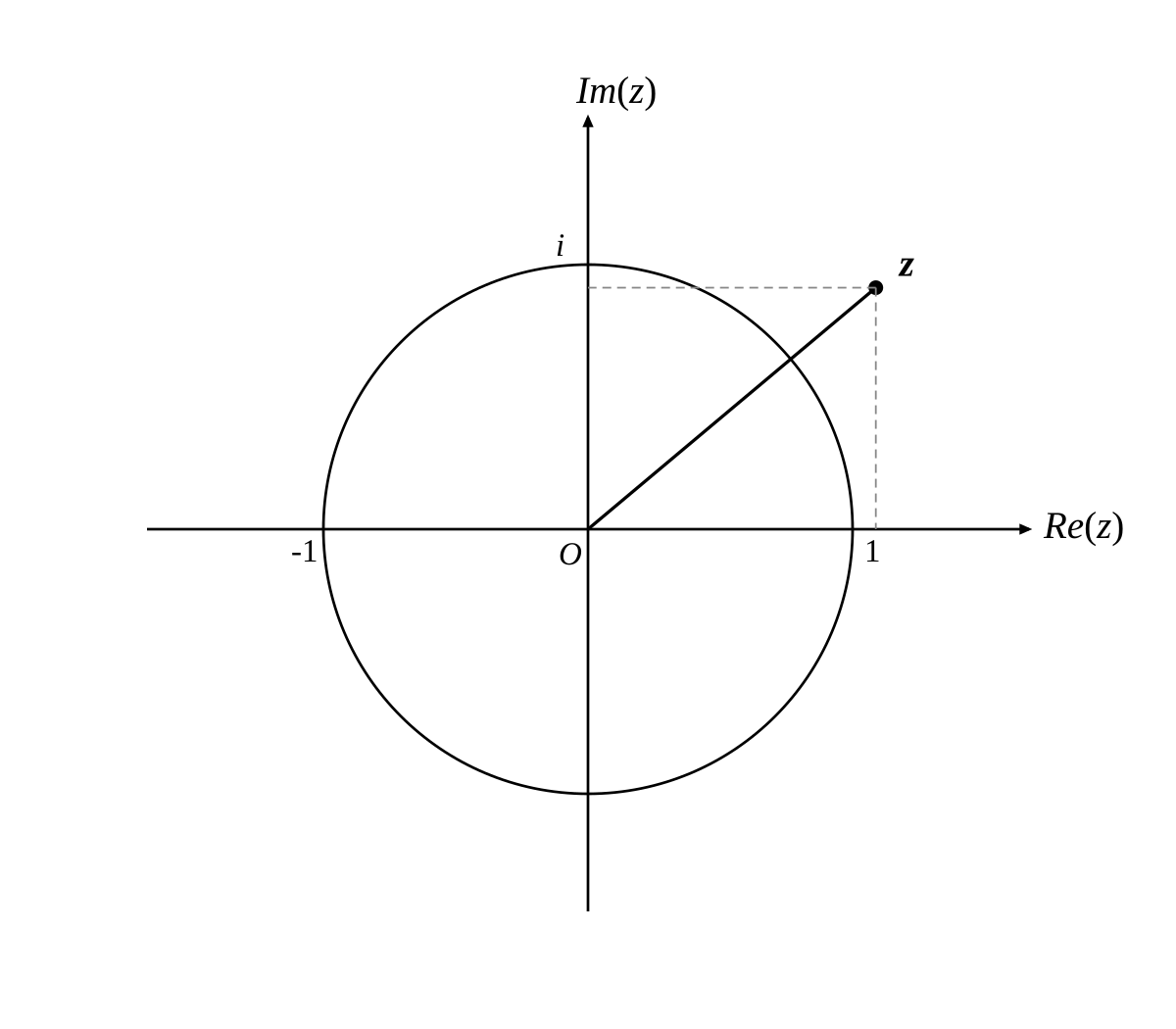
(c) (i) $\bar{z}$: reflect $z$ in the real axis — fourth quadrant, same modulus (outside the unit circle). (ii) $i\bar{z}$: rotate $\bar{z}$ anticlockwise by $\tfrac{\pi}{2}$ — argument $\tfrac{\pi}{2} - \arg z \approx 50°$, same modulus. (iii) $\dfrac{z^2}{|z|}$: argument doubles to $\approx 80°$, modulus $\dfrac{|z|^2}{|z|} = |z|$ — the same distance from $O$ as $z$, rotated to twice the argument. (1 mark each; the marks are for correct modulus and argument reasoning, not computation.)
Question 16
(a)(i) $|z + w|^2 + |z - w|^2 = (z + w)(\bar{z} + \bar{w}) + (z - w)(\bar{z} - \bar{w}) = 2z\bar{z} + 2w\bar{w} = 2|z|^2 + 2|w|^2$ (the cross terms $z\bar{w} + w\bar{z}$ cancel).
(a)(ii) With $|z| = |w| = 1$, part (i) gives $|z + w|^2 + |z - w|^2 = 4$. Suppose, for contradiction, that $|z + w| < \sqrt{2}$ and $|z - w| < \sqrt{2}$. Then $|z + w|^2 + |z - w|^2 < 2 + 2 = 4$ — contradicting the identity. Hence at least one of them is $\ge \sqrt{2}$. (1 mark the assumption stated, 1 mark the contradiction exhibited and the conclusion written.)
(a)(iii) $z = 1$, $w = i$: $|1 + i| = |1 - i| = \sqrt{2}$, and $|z| = |w| = 1$. (Any perpendicular pair on the unit circle works.)
(b)(i) $v\dfrac{dv}{dx} = -(c + kv)$, so
$$D = \int_0^u \frac{v\,dv}{c + kv} = \int_0^u \left(\frac{1}{k} - \frac{c/k}{c + kv}\right) dv = \frac{u}{k} - \frac{c}{k^2}\ln\frac{c + ku}{c} = \frac{u}{k} - \frac{c}{k^2}\ln\!\left(1 + \frac{ku}{c}\right).$$
(1 mark the correct acceleration form and separation, 1 mark the division/decomposition of $\tfrac{v}{c + kv}$, 1 mark limits to the given form.)
(b)(ii) $\dfrac{dv}{dt} = -(c + kv)$: $T = \displaystyle\int_0^u \frac{dv}{c + kv} = \frac{1}{k}\ln\!\left(1 + \frac{ku}{c}\right)$.
(c)(i) With $u = \pi - x$ (so $\sin x = \sin u$, $\cos x = -\cos u$, $dx = -du$, limits swap):
$$I = \int_0^{\pi} \frac{(\pi - u)\sin u}{1 + \cos^2 u}\; du = \pi\int_0^{\pi} \frac{\sin u}{1 + \cos^2 u}\; du - I,$$
so $2I = \pi\displaystyle\int_0^{\pi} \frac{\sin x}{1 + \cos^2 x}\; dx$. (1 mark the substitution with both limits, 1 mark collecting $I$.)
(c)(ii) Let $c = \cos x$, $dc = -\sin x\,dx$: $\displaystyle\int_{-1}^{1} \frac{dc}{1 + c^2} = \left[\tan^{-1}c\right]_{-1}^{1} = \frac{\pi}{2}$.
(c)(iii) $I = \dfrac{\pi}{2}\cdot\dfrac{\pi}{2} = \dfrac{\pi^2}{4}$.