Question 1
Why this question → 5 of 6, p 0.77What is the domain of the function $f(x) = \dfrac{1}{\sqrt{4 - x^2}}$?
- A. $[-2, 2]$
- B. $(0, 2)$
- C. $(-2, 2)$
- D. all real $x$, $x \ne \pm 2$
100 marks · an original Intuition practice paper realising the consensus predictions — every question links to the evidence behind it. Prefer the PDF?
This full-length practice paper was synthesised from a six-model AI consensus (Fable, Opus, GPT-5.6 Sol, Gemini 3.1 Pro, Grok, DeepSeek) over 190 question-level predictions for the 2026 HSC Mathematics Advanced examination. Every consensus cluster with agreement probability ≥ 0.55 is realised as a question below, with the remaining marks drawn from the panel's watch list; all questions are original Intuition Education compositions in NESA style — no question is reproduced from a past HSC paper. A prediction provenance table follows the marking notes.
General Instructions
Section I — 10 marks (Questions 1–10) Attempt Questions 1–10. Allow about 15 minutes for this section.
Section II — 90 marks (Questions 11–31) Attempt Questions 11–31. Allow about 2 hours and 45 minutes for this section.
10 marks — Attempt Questions 1–10 — Allow about 15 minutes for this section
Use the multiple-choice answer sheet for Questions 1–10.
What is the domain of the function $f(x) = \dfrac{1}{\sqrt{4 - x^2}}$?
The point $(4, 3)$ lies on the graph of $y = f(x)$.
Which point must lie on the graph of $y = f(2x) + 1$?
A data set of nine house prices has mean $\$620\,000$ and median $\$580\,000$. A tenth house, sold for $\$3\,000\,000$, is added to the data set.
Which of the following best describes the effect?
What is the range of the function $y = 3 - 2\cos(4x)$?
The table shows values of the functions $f$ and $g$ and their derivatives at $x = 1$ and $x = 2$.
| $x$ | $f(x)$ | $f'(x)$ | $g(x)$ | $g'(x)$ |
|---|---|---|---|---|
| $1$ | $7$ | $4$ | $2$ | $6$ |
| $2$ | $5$ | $3$ | $-1$ | $8$ |
Let $h(x) = f(g(x))$. What is the value of $h'(1)$?
What is the domain of the function $f(x) = \ln(3 - x)$?
The table shows the probability distribution of a random variable $X$.
| $x$ | $0$ | $1$ | $2$ |
|---|---|---|---|
| $P(X = x)$ | $0.2$ | $0.5$ | $0.3$ |
What is $E(X)$?
The lifetimes of a type of battery are normally distributed with mean $20$ hours and standard deviation $5$ hours.
Using the empirical rule, approximately what percentage of batteries have a lifetime between $15$ hours and $30$ hours?
Which of the following functions is odd?
The diagram shows the graph of $y = f'(x)$, the derivative of a function $f$.
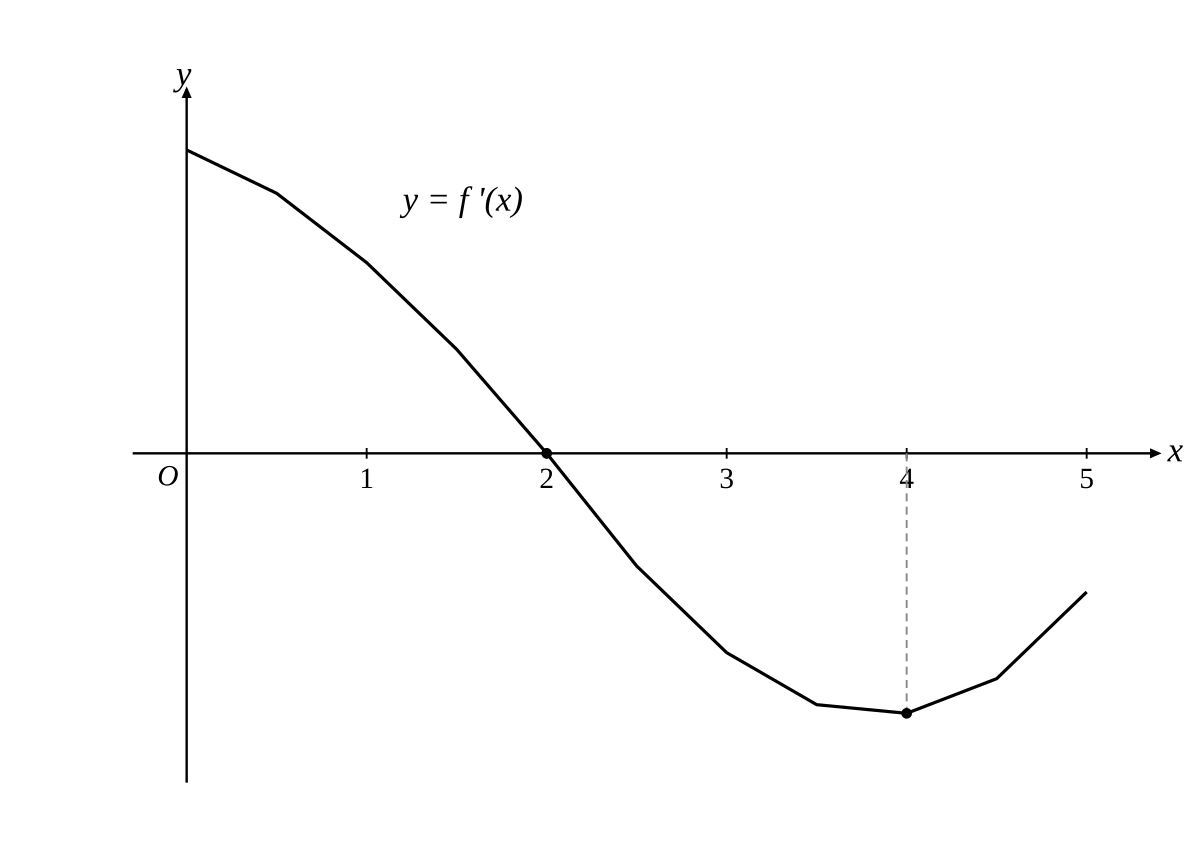
Which statement about the function $f$ is correct?
90 marks — Attempt Questions 11–31 — Allow about 2 hours and 45 minutes for this section
Answer the questions in the Section II answer booklet. Your responses should include relevant mathematical reasoning and/or calculations.
An arithmetic sequence begins $6,\ 11,\ 16,\ \ldots$
(a) Show that $2026$ is a term of the sequence, and find which term it is. (2 marks)
(b) Find the sum of all the terms of the sequence from $6$ up to and including $2026$. (1 mark)
The table shows the probability distribution of a random variable $X$, where $k$ is a constant.
| $x$ | $1$ | $2$ | $3$ | $4$ |
|---|---|---|---|---|
| $P(X = x)$ | $0.1$ | $0.3$ | $k$ | $0.2$ |
(a) Find the value of $k$. (1 mark)
(b) Find $E(X)$ and the standard deviation of $X$. (2 marks)
Prove that $\dfrac{1}{1 + \sin\theta} + \dfrac{1}{1 - \sin\theta} = 2\sec^2\theta$, for $\cos\theta \ne 0$. (2 marks)
Let $h(x) = \dfrac{3}{x^2 + 2}$.
(a) State the domain of $h(x)$. (1 mark)
(b) Explain why the maximum value of $h(x)$ is $\dfrac{3}{2}$. (1 mark)
(c) Hence state the range of $h(x)$. (1 mark)
(a) Differentiate $y = x^2 \ln x$. (2 marks)
(b) Hence find $\displaystyle\int x \ln x \; dx$. (2 marks)
A factory has three machines, $A$, $B$ and $C$, which produce items in the ratio $5 : 3 : 2$. Of the items produced, $2\%$ of machine $A$'s, $4\%$ of machine $B$'s and $5\%$ of machine $C$'s are defective.
An item is selected at random from the factory's output.
(a) By drawing a tree diagram, or otherwise, show that the probability that the selected item is defective is $0.032$. (2 marks)
(b) Given that the selected item is defective, find the probability that it was produced by machine $C$. (2 marks)
The table gives the future value of an annuity of $\$1$ per period, for various interest rates per period.
| Number of periods | $1\%$ | $1.5\%$ | $2\%$ |
|---|---|---|---|
| $16$ | $17.258$ | $17.932$ | $18.639$ |
| $20$ | $22.019$ | $23.124$ | $24.297$ |
| $24$ | $26.973$ | $28.634$ | $30.422$ |
(a) Leo deposits $\$2000$ into a savings account at the end of every quarter for $5$ years. The account earns interest at $6\%$ per annum, compounding quarterly.
Find the value of Leo's account at the end of the $5$ years. (2 marks)
(b) Mia wants her account to be worth $\$80\,000$ after $6$ years. Her account earns interest at $8\%$ per annum, compounding quarterly, and she will make equal deposits at the end of every quarter.
Find the size of each quarterly deposit, correct to the nearest cent. (2 marks)
(c) Find the total amount of interest Mia's account will earn over the $6$ years. (2 marks)
Using the definition $f'(x) = \displaystyle\lim_{h \to 0} \frac{f(x+h) - f(x)}{h}$, find the derivative of $f(x) = x^2 - 3x$. (2 marks)
The loudness of a sound, in decibels (dB), is given by $L = 10 \log_{10}\left(\dfrac{I}{I_0}\right)$, where $I$ is the intensity of the sound and $I_0$ is a reference intensity.
(a) A concert measures $95$ dB and normal conversation measures $65$ dB. How many times more intense is the concert than normal conversation? (1 mark)
(b) Sound $P$ is $6$ dB louder than sound $Q$. Show that sound $P$ is approximately $4$ times more intense than sound $Q$. (1 mark)
The parabola $y = x^2$ is translated $k$ units to the right and $k$ units up, where $0 < k < 5$, so that its equation becomes
$$y = (x - k)^2 + k.$$
The translated parabola passes through the point $(5, 11)$.
Find the value of $k$, justifying your rejection of any invalid solution. (3 marks)
The table shows the values of a function $f(x)$ at five equally spaced values of $x$.
| $x$ | $0$ | $1$ | $2$ | $3$ | $4$ |
|---|---|---|---|---|---|
| $f(x)$ | $2$ | $2.9$ | $4.4$ | $6.5$ | $9.2$ |
(a) Use the trapezoidal rule with these five values to estimate $\displaystyle\int_0^4 f(x)\; dx$. (2 marks)
(b) The graph of $y = f(x)$ is concave up on $0 \le x \le 4$. State, with a reason, whether the estimate in part (a) is greater than or less than the exact value of the integral. (1 mark)
Consider the curves $y = x^2 - 4x$ and $y = 2x - x^2$.
(a) Show that the curves intersect at $x = 0$ and $x = 3$. (2 marks)
(b) Determine which curve lies above the other for $0 < x < 3$. (1 mark)
(c) Find the exact area enclosed between the two curves. (3 marks)
Questions 11–22 are worth 41 marks in total.
A machine fills bags of rice. The masses of the bags are normally distributed with mean $505$ g and standard deviation $6$ g.
The table gives values of $P(Z \le z)$ for a standard normal variable $Z$.
| $z$ | $1.0$ | $1.2$ | $1.4$ | $1.5$ | $1.6$ |
|---|---|---|---|---|---|
| $P(Z \le z)$ | $0.8413$ | $0.8849$ | $0.9192$ | $0.9332$ | $0.9452$ |
(a) Find the probability that a randomly selected bag has a mass less than $514$ g. (1 mark)
(b) Find the probability that a randomly selected bag has a mass between $499$ g and $514$ g. (2 marks)
(c) In a shipment of $2000$ bags, how many bags are expected to have a mass greater than $514$ g? (1 mark)
(d) The lightest $8.08\%$ of bags are rejected by a quality check. Find the maximum mass of a rejected bag. (1 mark)
The number of bacteria in a culture is modelled by $N(t) = 800e^{kt}$, where $t$ is the time in hours and $k$ is a positive constant. After $5$ hours there are $1200$ bacteria.
(a) Show that $k = \dfrac{1}{5}\ln\dfrac{3}{2} \approx 0.0811$. (1 mark)
(b) Show that after $10$ hours there are exactly $1800$ bacteria. (1 mark)
(c) Find the rate at which the number of bacteria is increasing when $t = 10$, correct to the nearest whole number per hour. (1 mark)
(d) Find the time at which the number of bacteria first reaches $3000$, correct to one decimal place. (1 mark)
A hiker walks $9$ km from $P$ on a bearing of $040°$ to $Q$, then $7$ km from $Q$ on a bearing of $150°$ to $R$.
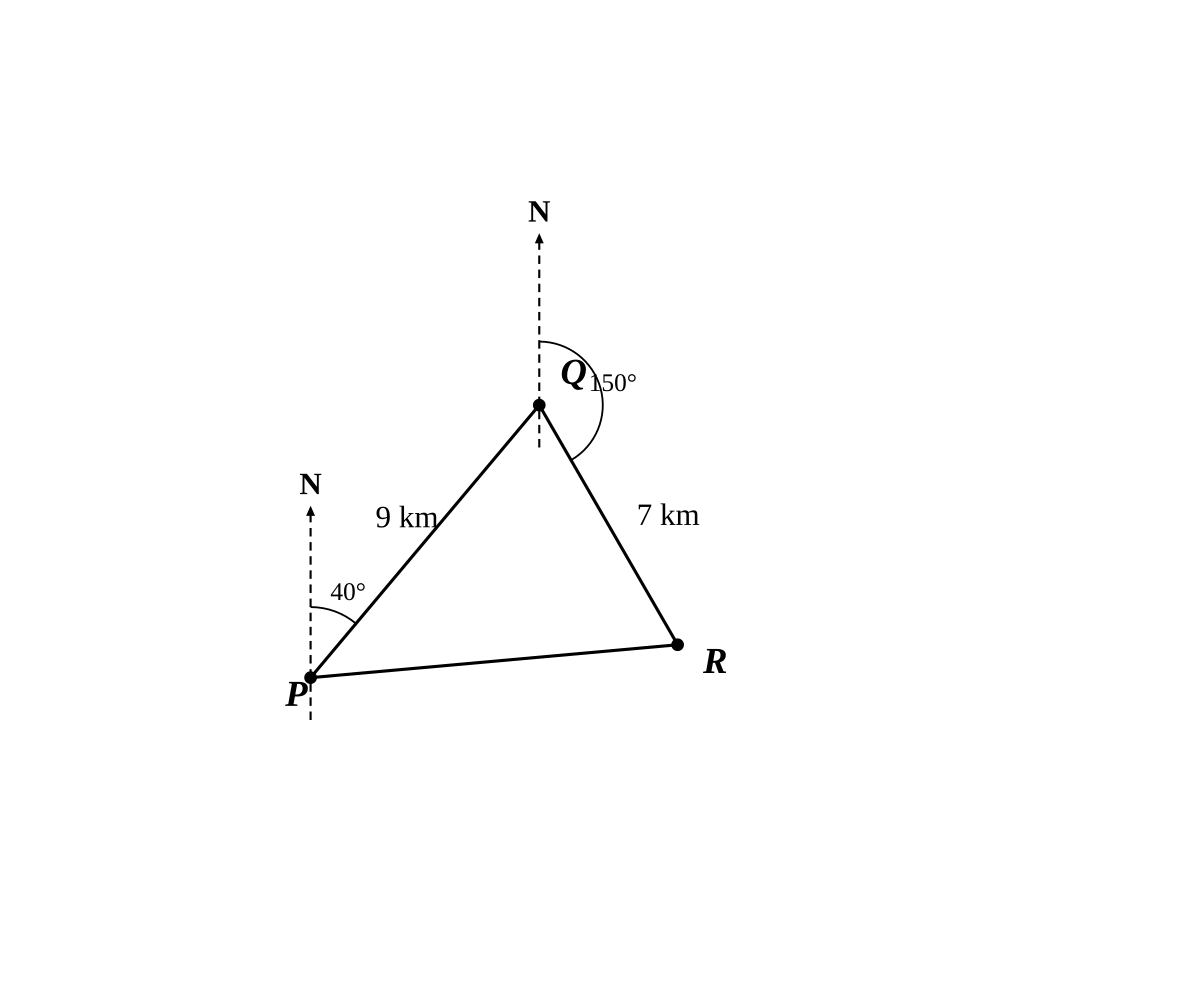
(a) Show that $\angle PQR = 70°$. (1 mark)
(b) Find the distance $PR$, correct to two decimal places. (2 marks)
(c) Find the bearing of $R$ from $P$, correct to the nearest degree. (2 marks)
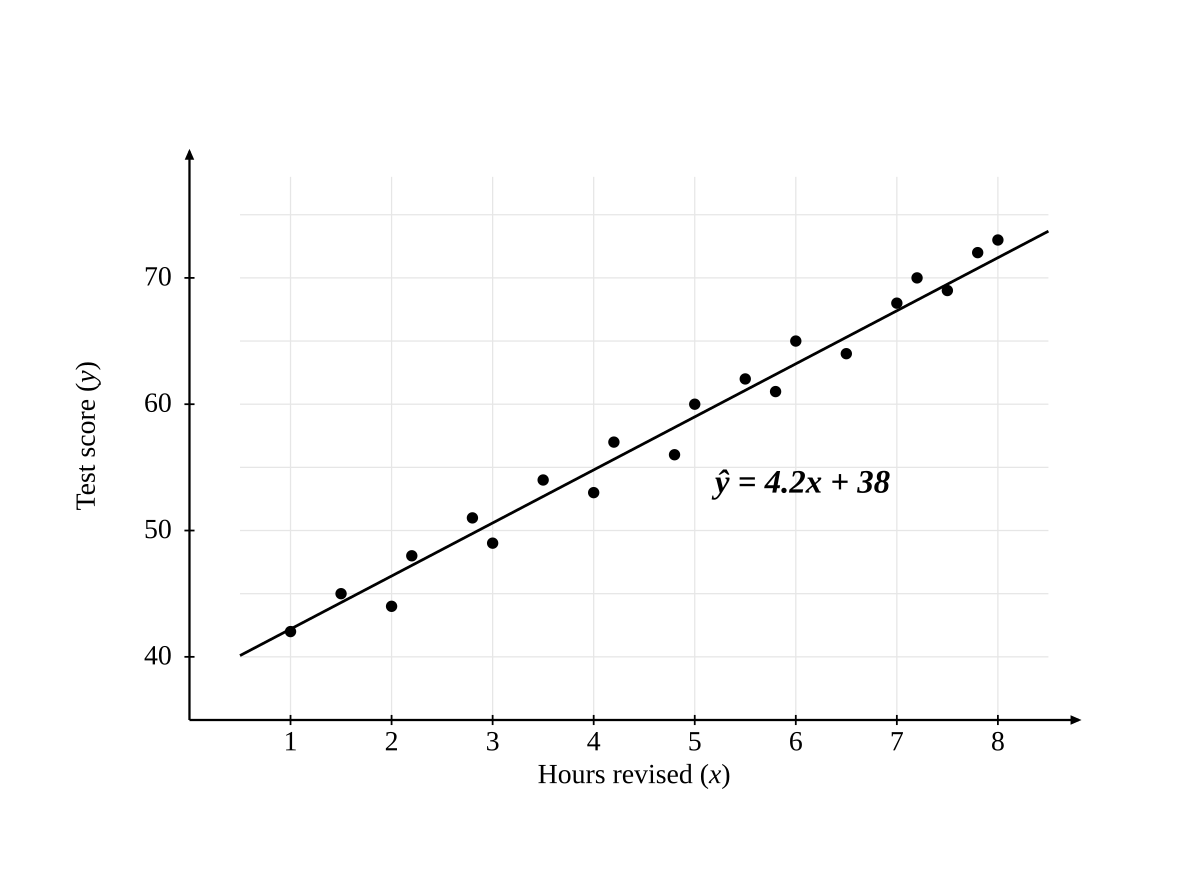
A teacher records the number of hours, $x$, that each student in a class spent revising, and their test score, $y$. The hours revised range from $1$ to $8$. The least-squares regression line is
$$\hat{y} = 4.2x + 38, \qquad r = 0.87.$$
(a) Interpret the gradient of the regression line in the context of the data. (1 mark)
(b) Predict the test score of a student who revised for $6$ hours. (1 mark)
(c) Explain why this regression line should not be used to predict the score of a student who revised for $20$ hours. Support your answer with a calculation. (1 mark)
(d) A student claims that the gradient of $4.2$ shows that the correlation is strong. Explain the error in this claim. (1 mark)
A continuous random variable $X$ has probability density function
$$f(x) = \begin{cases} k(4 - x), & 0 \le x \le 4 \\ 0, & \text{otherwise,} \end{cases}$$
where $k$ is a constant.
(a) Show that $k = \dfrac{1}{8}$. (1 mark)
(b) Show that the cumulative distribution function of $X$ is $F(x) = \dfrac{8x - x^2}{16}$ for $0 \le x \le 4$. (1 mark)
(c) Find the exact value of the median of $X$. (2 marks)
(d) Write down the mode of $X$, justifying your answer. (1 mark)
(e) Find $P(X > 2)$. (1 mark)
Let $f(x) = x e^{-x}$.
(a) Show that $f'(x) = (1 - x)e^{-x}$. (1 mark)
(b) Find the coordinates of the stationary point of the graph of $y = f(x)$ and determine its nature. (2 marks)
(c) Show that $f''(x) = (x - 2)e^{-x}$, and hence show that the graph of $y = f(x)$ has a point of inflection at $x = 2$, justifying your answer. (2 marks)
(d) Sketch the graph of $y = f(x)$, showing the intercept, the stationary point, the point of inflection and the behaviour of the graph as $x \to \infty$. (1 mark)
The depth of water in a harbour is modelled by
$$D(t) = A + B\cos\left(\frac{\pi t}{6}\right),$$
where $D$ is the depth in metres and $t$ is the time in hours after midnight. High tide, of depth $9$ m, occurs at midnight, and low tide, of depth $3$ m, occurs at $6$ am.
(a) Show that $A = 6$ and $B = 3$. (2 marks)
(b) Sketch the graph of $D(t)$ for $0 \le t \le 12$. (2 marks)
(c) A ship needs a depth of at least $7.5$ m to enter the harbour. For how many hours during each $12$-hour tidal cycle can the ship enter? (2 marks)
Priya borrows $\$400\,000$ to buy an apartment. Interest is charged at $0.5\%$ per month on the balance owing. At the end of each month, immediately after the interest has been charged, Priya makes a repayment of $\$M$. Let $A_n$ be the balance owing after the $n$th repayment.
(a) Show that $A_2 = 400\,000(1.005)^2 - M(1 + 1.005)$. (1 mark)
(b) Show that $A_n = 400\,000(1.005)^n - 200M\left((1.005)^n - 1\right)$. (2 marks)
(c) Find the value of $M$, correct to the nearest cent, for which the loan is repaid after exactly $300$ monthly repayments. (2 marks)
(d) Suppose instead Priya repays $\$3000$ each month. Show that $A_n = 600\,000 - 200\,000(1.005)^n$, and find the number of months needed for the balance owing to first fall below $\$200\,000$. (2 marks)
A company manufactures closed rectangular boxes with a square base of side $x$ cm and height $h$ cm. Each box must have a volume of $432 \text{ cm}^3$. The material for the base and the top costs $2$ cents per $\text{cm}^2$, and the material for the four sides costs $1$ cent per $\text{cm}^2$.
(a) Show that the total cost of the material for one box, in cents, is
$$C = 4x^2 + \frac{1728}{x}.$$
(2 marks)
(b) Find the value of $x$ that minimises the cost, verifying that it gives a minimum. (3 marks)
(c) Find the minimum cost of the material for one box, in dollars. (1 mark)
(Intuition Education — not part of the examination paper.)
| Q | 1 | 2 | 3 | 4 | 5 | 6 | 7 | 8 | 9 | 10 |
|---|---|---|---|---|---|---|---|---|---|---|
| Answer | C | B | D | A | B | C | B | C | A | D |
Brief reasons:
(a) $T_n = 6 + 5(n-1) = 5n + 1$. Setting $5n + 1 = 2026$ gives $n = 405$, a positive integer — so $2026$ is the $405$th term. (1 mark forming $T_n$, 1 mark solving and stating $n$ integer.) (b) $S_{405} = \dfrac{405}{2}(6 + 2026) = 405 \times 1016 = 411\,480$.
(a) $0.1 + 0.3 + k + 0.2 = 1 \Rightarrow k = 0.4$. (b) $E(X) = 0.1 + 0.6 + 1.2 + 0.8 = 2.7$. $E(X^2) = 0.1 + 1.2 + 3.6 + 3.2 = 8.1$, so $\text{Var}(X) = 8.1 - 2.7^2 = 0.81$ and $\sigma = 0.9$. (Marking note: the recurring flag — the standard deviation is the square root of the variance.)
LHS $= \dfrac{(1 - \sin\theta) + (1 + \sin\theta)}{(1+\sin\theta)(1-\sin\theta)} = \dfrac{2}{1 - \sin^2\theta} = \dfrac{2}{\cos^2\theta} = 2\sec^2\theta$ = RHS. (Work one side only; 1 mark common denominator, 1 mark Pythagorean identity and completion.)
(a) $x^2 + 2 \ge 2 > 0$ for all $x$, so the domain is all real $x$. (b) The denominator has minimum value $2$ (at $x = 0$), so $h$ has maximum value $\tfrac{3}{2}$. (c) As $|x| \to \infty$, $h(x) \to 0^+$ but never reaches $0$: range is $0 < h(x) \le \tfrac{3}{2}$, i.e. $\left(0, \tfrac{3}{2}\right]$.
(a) $\dfrac{dy}{dx} = 2x\ln x + x^2 \cdot \dfrac{1}{x} = 2x \ln x + x$. (b) From (a), $\displaystyle\int (2x\ln x + x)\,dx = x^2 \ln x$, so $\displaystyle\int x \ln x\;dx = \tfrac{1}{2}\left(x^2 \ln x - \tfrac{x^2}{2}\right) + C = \tfrac{x^2 \ln x}{2} - \tfrac{x^2}{4} + C$. (The "hence" is compulsory in spirit: recognition, not integration by parts, which is not in this course.)
(a) $P(D) = 0.5(0.02) + 0.3(0.04) + 0.2(0.05) = 0.01 + 0.012 + 0.01 = 0.032$. (1 mark converting the ratio $5:3:2$ to $0.5, 0.3, 0.2$; 1 mark total probability.) (b) $P(C \mid D) = \dfrac{P(C \cap D)}{P(D)} = \dfrac{0.01}{0.032} = \dfrac{5}{16} = 0.3125$. (The conditioning event is the outcome — the reduced sample space is the defective items.)
(a) $6\%$ p.a. quarterly $\Rightarrow r = 1.5\%$ per quarter, $n = 20$ periods: factor $23.124$. $FV = 2000 \times 23.124 = \$46\,248$. (b) $8\%$ p.a. quarterly $\Rightarrow r = 2\%$, $n = 24$: factor $30.422$. Deposit $= \dfrac{80\,000}{30.422} = \$2629.68$. (Divide by the factor — the unknown is the contribution.) (c) Total deposits $= 24 \times 2629.68 = \$63\,112.32$; interest $= 80\,000 - 63\,112.32 = \$16\,887.68$.
$\dfrac{f(x+h) - f(x)}{h} = \dfrac{(x+h)^2 - 3(x+h) - x^2 + 3x}{h} = \dfrac{2xh + h^2 - 3h}{h} = 2x + h - 3$. As $h \to 0$, $f'(x) = 2x - 3$. (1 mark correct expansion of the difference quotient, 1 mark taking the limit.)
(a) $\Delta L = 30 = 10\log_{10}\left(\tfrac{I_1}{I_2}\right) \Rightarrow \tfrac{I_1}{I_2} = 10^3 = 1000$ times more intense. (b) $\tfrac{I_P}{I_Q} = 10^{6/10} = 10^{0.6} \approx 3.98 \approx 4$.
$(5 - k)^2 + k = 11 \Rightarrow 25 - 10k + k^2 + k = 11 \Rightarrow k^2 - 9k + 14 = 0 \Rightarrow (k-2)(k-7) = 0$, so $k = 2$ or $k = 7$. Since $0 < k < 5$, reject $k = 7$: $k = 2$. (1 mark substituting the point into the transformed equation — apply the translation to the equation, not the coordinate; 1 mark solving the quadratic; 1 mark the explicit rejection. Both roots satisfy the equation — the rejection must cite the condition.)
(a) $h = 1$: $\displaystyle\int_0^4 f(x)\,dx \approx \frac{1}{2}\left[2 + 9.2 + 2(2.9 + 4.4 + 6.5)\right] = \frac{1}{2}(11.2 + 27.6) = 19.4$. (Five function values = four applications; the flagged error is confusing the two counts.) (b) Concave up $\Rightarrow$ each chord lies above the curve, so the estimate is greater than the exact value (an overestimate).
(a) $x^2 - 4x = 2x - x^2 \Rightarrow 2x^2 - 6x = 0 \Rightarrow 2x(x - 3) = 0 \Rightarrow x = 0, 3$. (b) At $x = 1$: $2x - x^2 = 1$ and $x^2 - 4x = -3$, so $y = 2x - x^2$ lies above. (c) $\displaystyle A = \int_0^3 \left[(2x - x^2) - (x^2 - 4x)\right] dx = \int_0^3 (6x - 2x^2)\,dx = \left[3x^2 - \tfrac{2x^3}{3}\right]_0^3 = 27 - 18 = 9$ square units. (Subtract in the correct order; substitute limits with brackets.)
(a) $z = \dfrac{514 - 505}{6} = 1.5$: $P(X < 514) = 0.9332$. (b) $z$-scores $-1$ and $1.5$: $P = 0.9332 - (1 - 0.8413) = 0.9332 - 0.1587 = 0.7745$. (1 mark both $z$-scores, 1 mark symmetry for the lower tail.) (c) $P(X > 514) = 0.0668$: expected number $= 2000 \times 0.0668 = 133.6 \approx 134$ bags. (d) $0.0808 = 1 - 0.9192 \Rightarrow z = -1.4$: mass $= 505 - 1.4 \times 6 = 496.6$ g. (Reverse use of the table with symmetry.)
(a) $1200 = 800e^{5k} \Rightarrow e^{5k} = \tfrac{3}{2} \Rightarrow k = \tfrac{1}{5}\ln\tfrac{3}{2} \approx 0.0811$. (b) $N(10) = 800e^{10k} = 800\left(e^{5k}\right)^2 = 800 \times \left(\tfrac{3}{2}\right)^2 = 1800$ exactly. (c) $N'(t) = kN(t)$, so $N'(10) = 0.0811 \times 1800 \approx 146$ bacteria per hour. ("Rate" means the derivative — the perennial flag.) (d) $800e^{kt} = 3000 \Rightarrow e^{kt} = 3.75 \Rightarrow t = \dfrac{\ln 3.75}{k} \approx \dfrac{1.3218}{0.0811} \approx 16.3$ hours.
(a) The back-bearing from $Q$ to $P$ is $040° + 180° = 220°$; the bearing of $R$ from $Q$ is $150°$; hence $\angle PQR = 220° - 150° = 70°$. (b) $PR^2 = 9^2 + 7^2 - 2(9)(7)\cos 70° = 130 - 126\cos 70° \approx 86.91$, so $PR \approx 9.32$ km. (Cosine rule — no right angle is available.) (c) Sine rule: $\dfrac{\sin \angle QPR}{7} = \dfrac{\sin 70°}{9.32} \Rightarrow \sin\angle QPR \approx 0.7055 \Rightarrow \angle QPR \approx 45°$ (acute, since the largest angle is at $Q$, opposite the longest side). Bearing of $R$ from $P$ $= 040° + 45° = 085°$. (Convert the internal angle to a bearing — the flagged step.)
(a) For each additional hour of revision, the predicted test score increases by $4.2$ marks. (Context and value both required.) (b) $\hat{y} = 4.2(6) + 38 = 63.2$. (c) $x = 20$ is far outside the observed data range (\$1$ to $8$ hours) — extrapolation; the line predicts $4.2(20) + 38 = 122$, an impossible score out of $100$. (d) The gradient measures the rate of change of predicted score, not the strength of the association; the correlation is measured by $r = 0.87$. A steep line can have weak correlation and vice versa.
(a) $\displaystyle\int_0^4 k(4 - x)\,dx = k\left[4x - \tfrac{x^2}{2}\right]_0^4 = 8k = 1 \Rightarrow k = \tfrac{1}{8}$. (b) $F(x) = \displaystyle\int_0^x \tfrac{4 - t}{8}\,dt = \tfrac{1}{8}\left(4x - \tfrac{x^2}{2}\right) = \dfrac{8x - x^2}{16}$ (and $F(4) = 1$, as required). (c) $F(m) = \tfrac{1}{2}$: $8m - m^2 = 8 \Rightarrow m^2 - 8m + 8 = 0 \Rightarrow m = 4 \pm 2\sqrt{2}$. Since $0 \le m \le 4$, the median is $m = 4 - 2\sqrt{2}$. (Equate the CDF to $0.5$ — pdf/CDF confusion is the flagged error.) (d) $f$ is decreasing on $[0, 4]$, so its maximum is at the left endpoint: the mode is $x = 0$. (Do not differentiate — the monotone-density endpoint trap.) (e) $P(X > 2) = 1 - F(2) = 1 - \tfrac{12}{16} = \tfrac{1}{4}$.
(a) Product rule: $f'(x) = e^{-x} + x(-e^{-x}) = (1 - x)e^{-x}$. (b) $f'(x) = 0 \Rightarrow x = 1$ (as $e^{-x} \ne 0$): stationary point $\left(1, e^{-1}\right)$. For $x < 1$, $f' > 0$; for $x > 1$, $f' < 0$: a local maximum. (Reject $e^{-x} = 0$; justify the nature.) (c) $f''(x) = -e^{-x} - (1 - x)e^{-x} = (x - 2)e^{-x}$. $f''(2) = 0$, and $f''$ changes sign at $x = 2$ (negative before, positive after) — concavity changes, so $\left(2, 2e^{-2}\right)$ is a point of inflection. ($f'' = 0$ alone is not sufficient.) (d) Curve through the origin, rising to the maximum $\left(1, e^{-1}\right)$, inflection at $x = 2$, then decreasing and approaching the asymptote $y = 0$ from above as $x \to \infty$; unbounded below as $x \to -\infty$.
(a) Centre $= \tfrac{9 + 3}{2} = 6 = A$; amplitude $= \tfrac{9 - 3}{2} = 3 = B$. (Check: period $= \tfrac{2\pi}{\pi/6} = 12$ h, maximum $9$ at $t = 0$, minimum $3$ at $t = 6$. ✓) (b) One full cosine cycle from $(0, 9)$ down to $(6, 3)$ and back to $(12, 9)$, passing through $(3, 6)$ and $(9, 6)$; axes labelled, only the stated domain $[0, 12]$ drawn. (c) $6 + 3\cos\tfrac{\pi t}{6} \ge 7.5 \Rightarrow \cos\tfrac{\pi t}{6} \ge \tfrac{1}{2}$. Within one cycle, $\tfrac{\pi t}{6} \in \left[0, \tfrac{\pi}{3}\right] \cup \left[\tfrac{5\pi}{3}, 2\pi\right]$, i.e. $t \in [0, 2] \cup [10, 12]$ — a total of $\mathbf{4}$ hours per cycle. (Adjust the domain before solving; take both quadrant solutions.)
(a) $A_1 = 400\,000(1.005) - M$; $A_2 = A_1(1.005) - M = 400\,000(1.005)^2 - M(1.005) - M = 400\,000(1.005)^2 - M(1 + 1.005)$. (b) Iterating, $A_n = 400\,000(1.005)^n - M\left(1 + 1.005 + \cdots + (1.005)^{n-1}\right)$. The geometric series (with $n$ terms) sums to $\dfrac{(1.005)^n - 1}{0.005} = 200\left((1.005)^n - 1\right)$, giving the stated form. (1 mark building the series with the correct number of terms — the perennial flag; 1 mark summing.) (c) $A_{300} = 0$: $M = \dfrac{400\,000(1.005)^{300} \times 0.005}{(1.005)^{300} - 1}$. With $(1.005)^{300} \approx 4.46497$: $M = \dfrac{2000 \times 4.46497}{3.46497} \approx \$2577.20$. (d) With $M = 3000$: $A_n = 400\,000(1.005)^n - 600\,000\left((1.005)^n - 1\right) = 600\,000 - 200\,000(1.005)^n$. Then $A_n < 200\,000 \Rightarrow (1.005)^n > 2 \Rightarrow n > \dfrac{\ln 2}{\ln 1.005} \approx 138.98$, so $n = 139$ months. ($n$ must be a whole number of months, rounded up.)
(a) $h = \dfrac{432}{x^2}$. Base and top: area $2x^2$, cost $2 \times 2x^2 = 4x^2$ cents. Sides: area $4xh = \dfrac{1728}{x}$, cost $1 \times \dfrac{1728}{x}$ cents. Total $C = 4x^2 + \dfrac{1728}{x}$. (b) $C'(x) = 8x - \dfrac{1728}{x^2} = 0 \Rightarrow x^3 = 216 \Rightarrow x = 6$. $C''(x) = 8 + \dfrac{3456}{x^3} > 0$ for $x > 0$, so $x = 6$ gives a minimum. (Verify the nature — the four-times-flagged omission.) (c) $C(6) = 4(36) + \dfrac{1728}{6} = 144 + 288 = 432$ cents $= \$4.32$. (Answer the quantity asked — the cost, in dollars.)
| Paper item | Prediction | Agreement |
|---|---|---|
|
Q31 cost-objective optimisation with nature verification ↑ Q31 |
adv-q1-optimisation-capstone | 0.75 · 6 (all) — gemini's cost-context structural twist adopted |
|
MC Q1 domain with open/closed endpoint distractors ↑ Q1 |
adv-q2-domain-mc | 0.77 · 5 (fable, opus, grok, gpt-5.6-sol, deepseek) |
|
Q22 area between two parabolas, intersections first ↑ Q22 |
adv-q3-area-between-curves | 0.72 · 6 (all) — fresh curves; DeepSeek's pack-grounded $4x - x^2$ not reused |
|
Q30 reducing-balance loan: show $A_2$, sum series, log solve ↑ Q30 |
adv-q4-loan-annuity-recurrence | 0.71 · 6 (all) |
|
Q23 normal with supplied $z$-table, reverse lookup in (d) ↑ Q23 |
adv-q5-normal-z-table | 0.71 · 6 (all) |
|
Q27 pdf chain: $k$, CDF, exact median, endpoint mode ↑ Q27 |
adv-q6-crv-pdf-chain | 0.69 · 6 (all) |
|
MC Q2 transformation point-mapping + Q20 written variant ↑ Q2 ↑ Q20 |
adv-q7-graph-transformations | 0.69 · 6 (all) |
|
Q29 tide model: fit constants, sketch, duration inequality ↑ Q29 |
adv-q8-trig-modelling | 0.69 · 5 (fable, opus, deepseek, grok, gpt-5.6-sol) — fresh constants, not DeepSeek's illustrative 5.2 m/1.4 m |
|
Q11 arithmetic-series opener with 2026 planted as a term ↑ Q11 |
adv-q9-series-opener | 0.67 · 5 (grok, opus, fable, gpt-5.6-sol, deepseek) |
|
Q16 ratio-prior tree, then P(machine | defective) ↑ Q16 |
adv-q10-conditional-probability | 0.67 · 5 (fable, deepseek, grok, opus, gpt-5.6-sol) — type only; DeepSeek's canonical disease-test constants not used |
|
Q15 differentiate $x^2 \ln x$, hence $\int x\ln x\,dx$ ↑ Q15 |
adv-q11-hence-pair | 0.66 · 5 (fable, opus, grok, gpt-5.6-sol, deepseek) |
|
Q25 two-leg bearing walk: cosine rule, sine rule, bearing ↑ Q25 |
adv-q12-bearings-3d-trig | 0.66 · 6 (all) |
|
Q17 future-value factor table: multiply AND divide parts ↑ Q17 |
adv-q13-interest-factor-table | 0.65 · 6 (all) — the shared 6% p.a. surface detail verified present in the evidence pack (no contamination) |
|
Q26 regression: gradient in context, predict, refuse extrapolation, gradient ≠ r ↑ Q26 |
adv-q14-regression-scatterplot | 0.64 · 6 (all) |
|
Q24 exponential growth: find $k$, rate, threshold time ↑ Q24 |
watch list | ~0.63 · 6 |
|
Q21 trapezoidal rule + concavity overestimate ↑ Q21 |
watch list | ~0.60 · 6 |
|
Q28 curve sketch of $xe^{-x}$ with concavity-change proof ↑ Q28 |
watch list | ~0.62 · 5 |
|
Q12 discrete RV: missing $k$, $E(X)$, $\sigma$ ↑ Q12 |
watch list | ~0.55 · 5 |
|
Q14 composite-style range via the denominator's minimum ↑ Q14 |
watch list | ~0.60 · 4 |
|
Q20 equal-shift parabola, quadratic in $k$, reject a root ↑ Q20 |
watch list | ~0.48 · 4 (2025 Q30 lineage) |
|
Q13 trig identity by common denominator ↑ Q13 |
watch list | ~0.50 · 3 (fable, opus, gpt-5.6-sol) |
|
Q18 first principles (MA-C1 coverage-gap comeback) ↑ Q18 |
watch list | 0.50 / 0.30 · deepseek / opus bold — the panel's only rested topic, realised as the cheap-insurance 2-marker |
|
Q19 logarithmic scale (decibels) — never examined 2020–25 ↑ Q19 |
watch list | 0.35 / 0.38 · fable / gpt-5.6-sol bold coverage-gap calls |
|
MC Q5 chain rule from tabulated values ↑ Q5 |
watch list | ~0.55 · 3 (fable, grok, gemini variant) |
|
MC Q3 outlier effect on mean vs median; MC Q7 $E(X)$; MC Q4 trig range; MC Q6 ln domain; MC Q8 empirical rule; MC Q9 odd function; MC Q10 reasoning from $f'$ ↑ Q3 ↑ Q7 ↑ Q4 ↑ Q6 ↑ Q8 ↑ Q9 ↑ Q10 |
topic-level consensus | — · — |
|
Not realised (closest cuts): arc/sector/segment (5 models, ~0.51), parallel box plots (4, ~0.53), trig equation quadratic in cos (gemini 0.75/deepseek 0.50), ambiguous-case sine rule revival, parameter-count trig finale (~0.49) |
watch list | — · — |
Exam Success Program
Our 2027 program offers Maths Advanced practice exams under real conditions, with marking and personal feedback. See the ESP page for the program start and enquire about exam session availability.
2027 session times to be confirmed
Intu AI
Intu AI builds unlimited practice questions for Maths Advanced in these styles, marks your working, and explains what you missed — aligned to your syllabus.
Published Aug 2026, before the exams. In November 2026 we score these predictions publicly against the real paper — per-model calibration and question-level hit rates, the same harness as the 2025 backtest. How we did it.