Question 1
Which of the following pathogens contains NO nucleic acid?
- A. Virus
- B. Prion
- C. Bacterium
- D. Protozoan
100 marks · an original Intuition practice paper realising the consensus predictions — every question links to the evidence behind it. Prefer the PDF?
This full-length practice paper was built from the consensus of a six-model AI panel (fable, opus, gpt-5.6-sol, gemini-3.1-pro, grok, deepseek), each of which independently predicted the 2026 examination from the 2019–2025 papers and NESA marking feedback. The 162 question-level predictions were clustered; every cluster with consensus probability ≥ 0.55 is realised in this paper, the remainder is drawn from the panel's watch list, and reproduction and the extended adaptive-immunity cascade are deliberately light in line with the panel's rested calls. Each Section II question is tagged with the consensus cluster it realises and the probability that a question of that kind appears in 2026. Every question is original — none is copied from a past paper.
General instructions
20 marks — Attempt Questions 1–20 — Allow about 35 minutes for this section
Use the multiple-choice answer sheet for Questions 1–20.
Which of the following pathogens contains NO nucleic acid?
Which of the following shows the correct sequence of events in early mammalian reproduction?
A section of the template strand of a gene has the base sequence:
C T A G G T
What is the base sequence of the mRNA transcribed from this template?
Analysis of a sample of double-stranded DNA shows that 30% of its bases are adenine.
What percentage of the bases are guanine?
A woman with blood group AB has children with a man with blood group O.
What proportion of their children is expected to have blood group O?
During which process do homologous chromosomes exchange segments of DNA, producing new combinations of alleles in gametes?
Mutations occurred separately in four different cells of one animal.
Which mutation could be inherited by the animal's offspring?
A cyclone kills most of the lizards on an isolated island. In the small surviving population, the frequency of a shell-pattern allele is very different from its frequency before the cyclone, and the survivors were not better adapted than the lizards that died.
Which process caused the change in allele frequency?
In the production of recombinant DNA, the same restriction enzyme is used to cut both the plasmid and the DNA containing the gene of interest.
Why is the same enzyme used for both?
In somatic cell nuclear transfer (whole-organism cloning), the nucleus of a body cell from animal X is inserted into an enucleated egg cell from animal Y, and the embryo is carried by surrogate mother Z.
The offspring's nuclear DNA is identical to that of
Malaria is caused by Plasmodium, which is carried between humans by Anopheles mosquitoes.
Which row of the table is correct?
| Pathogen | Vector | Mode of transmission | |
|---|---|---|---|
| A. | Plasmodium | Mosquito | Indirect |
| B. | Mosquito | Plasmodium | Direct |
| C. | Plasmodium | Mosquito | Direct |
| D. | Mosquito | Plasmodium | Indirect |
Which of the following is part of the adaptive (third-line) immune response?
After a deep puncture wound, a patient is injected with tetanus immunoglobulin (pre-formed antibodies).
The immunity provided by this injection is
A fungal pathogen infects the leaf of a plant.
Which of the following is an active response of the plant to this infection?
A study finds that people who drink more soft drink have a higher rate of a non-infectious disease.
Which conclusion is valid from this evidence alone?
A new treatment allows people with a previously fatal chronic disease to live much longer, but does not cure the disease or change the number of new cases each year.
Which row shows the effect of the treatment on incidence and prevalence?
| Incidence | Prevalence | |
|---|---|---|
| A. | Increases | Increases |
| B. | Unchanged | Increases |
| C. | Unchanged | Unchanged |
| D. | Decreases | Decreases |
A person's core body temperature rises during exercise on a hot day.
Which response helps return their body temperature to normal?
A patient has a completely and permanently blocked outer ear canal. Their cochlea and auditory nerve function normally.
Which technology is most appropriate for restoring this patient's hearing?
In a person with myopia (short-sightedness), light from distant objects is focused in front of the retina.
Which technology corrects this disorder, and how?
The table shows the composition of a patient's blood entering a dialysis machine and the dialysate fluid used.
table — Blood entering dialyser: urea 28 mmol L⁻¹, glucose 5.0 mmol L⁻¹; Dialysate: urea 0 mmol L⁻¹, glucose 5.0 mmol L⁻¹.
Which substance moves from the blood into the dialysate by diffusion, and why?
80 marks — Attempt Questions 21–35 — Allow about 2 hours and 25 minutes for this section
Answer the questions in the spaces provided. Show all relevant working in questions involving calculations.
The incomplete dichotomous key below is used to classify four pathogens: a prion, a bacterium, a fungus and a virus.
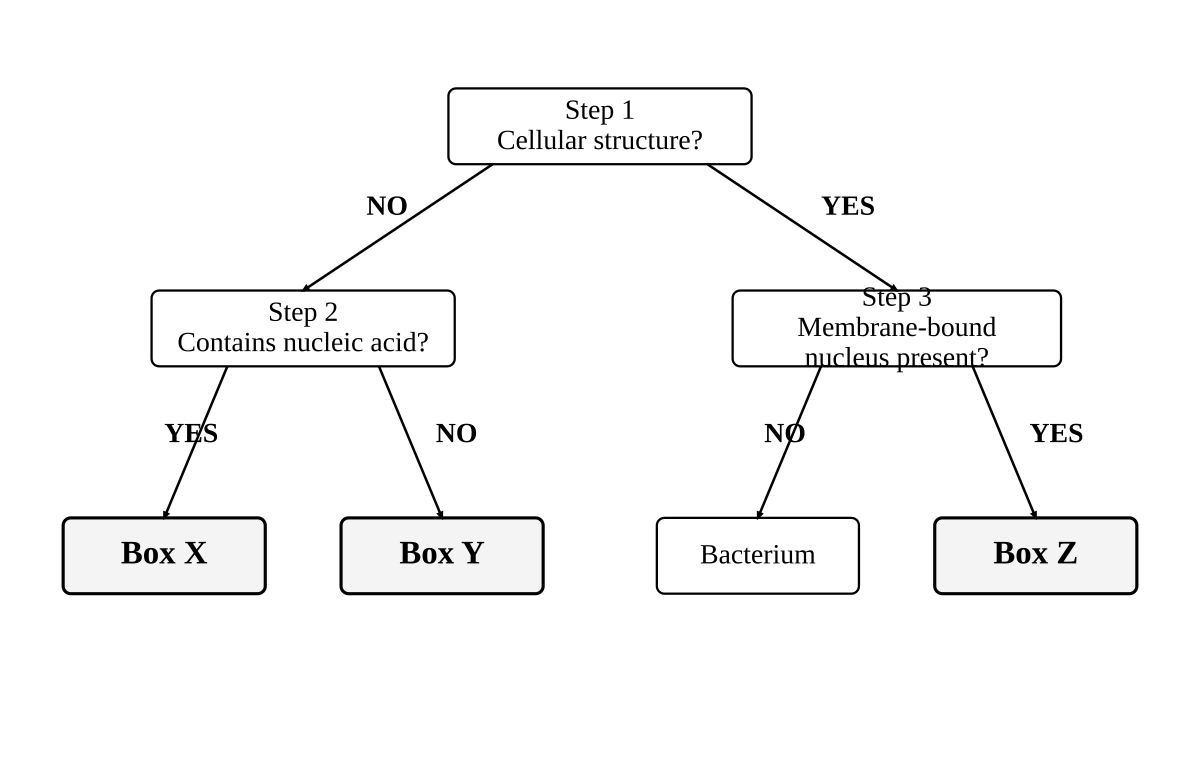
(a) Identify the pathogens belonging in boxes X, Y and Z. (2)
(b) Vibrio cholerae, the bacterium that causes cholera, produces a toxin that causes severe watery diarrhoea in its host. Explain how this feature is an adaptation that facilitates the transmission of the pathogen to new hosts. (1)
The diagram shows where two mutations arose in the body of one animal during its life.
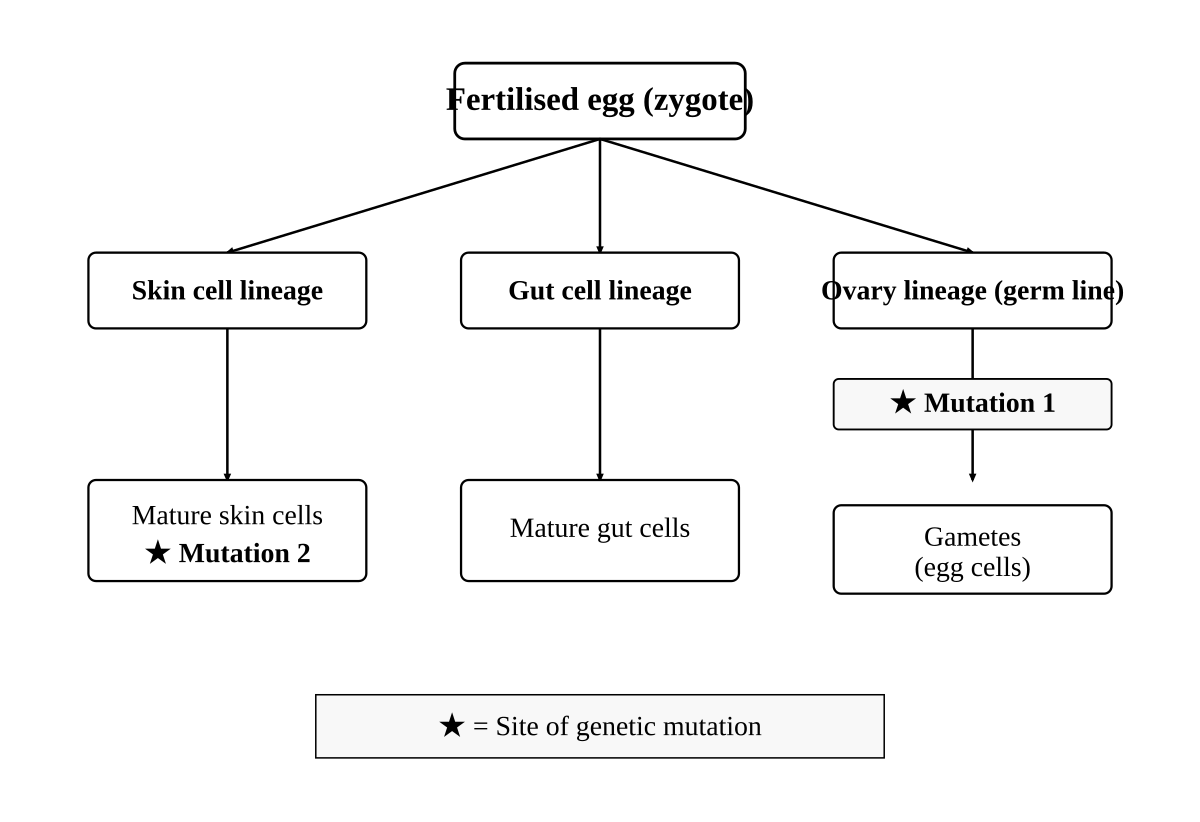
(a) Identify which mutation could be inherited by this animal's offspring, and justify your answer. (2)
(b) Describe ONE possible consequence of Mutation 2 for this animal. (1)
In Andalusian fowl (a breed of chicken), a cross between a black-feathered bird and a white-feathered bird always produces offspring with blue-grey feathers. When two blue-grey birds are crossed, black, blue-grey and white offspring are all produced.
(a) Identify the pattern of inheritance shown by feather colour in these birds, and justify your answer using the results of the first cross. (1)
(b) Using a Punnett square and an appropriate key, determine the expected phenotypic ratio of the offspring of the cross between two blue-grey birds. (3)
The pedigree shows the inheritance of a rare disorder in one family.
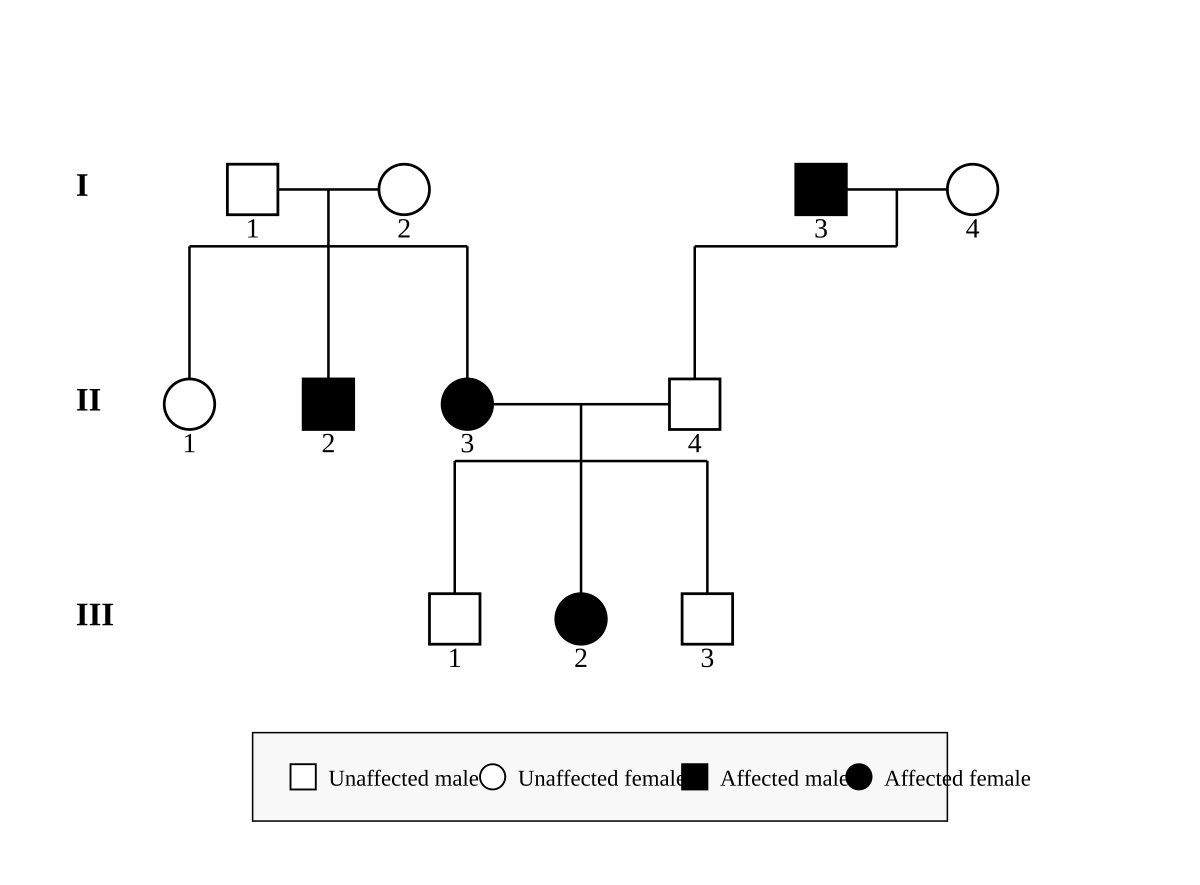
(a) Identify the mode of inheritance of this disorder. Justify your answer with reference to specific individuals in the pedigree, ruling out ONE alternative mode of inheritance. (3)
(b) Using a Punnett square with an appropriate key, determine the probability that the next child of II-3 and II-4 will be affected. (2)
DNA replication and transcription both occur in the nucleus of a eukaryotic cell.
Compare DNA replication with transcription. In your answer, include the enzymes involved, the template used, and the product formed by each process. (4)
The table shows part of the template strand of a gene, and the same region in a mutated cell.
Normal template DNA: TAC GGA TTT ACA ATT. Mutated template DNA: TAC GGA ATT ACA ATT (the seventh base has changed from T to A, shown in bold).
standard mRNA codon table supplied, as in HSC papers. Relevant codons: AUG = methionine (start); CCU = proline; AAA = lysine; UGU = cysteine; UAA = STOP.
(a) Using the codon table, determine the mRNA sequence and the amino acid sequence produced from the NORMAL template strand. (2)
(b) Identify the type of mutation shown, and explain its effect on the polypeptide produced and the likely consequence for the function of the protein. (3)
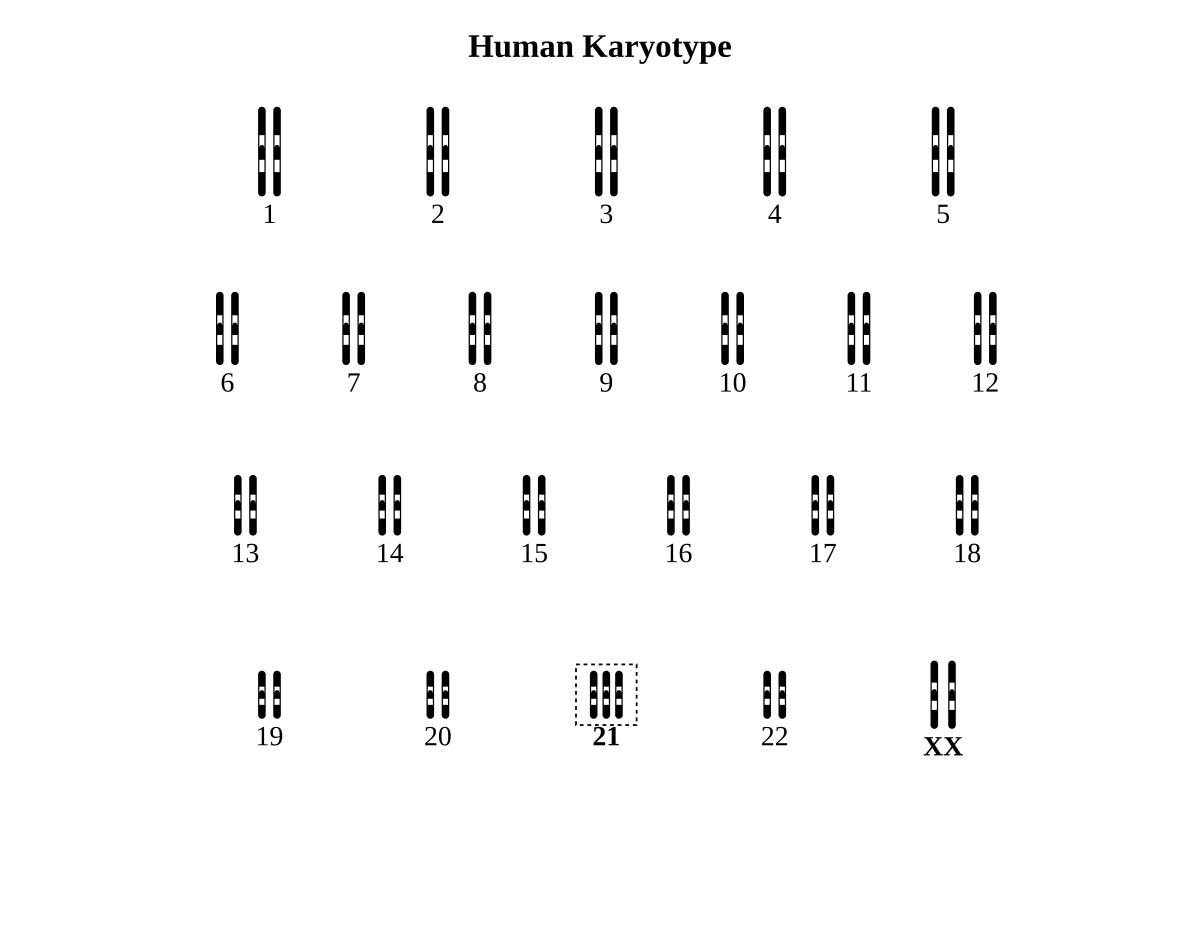
(a) Identify the chromosomal abnormality shown in the karyotype. (1)
(b) Explain how an error during meiosis in one parent, followed by fertilisation, produced this karyotype. (4)
The graphs show a healthy person's blood glucose concentration and the concentrations of two pancreatic hormones after a carbohydrate-rich meal eaten at time 0.
three aligned time-series graphs, 0–150 minutes. Graph 1 — blood glucose: 5.0 mmol L⁻¹ at 0 min, rising to a peak of 7.6 mmol L⁻¹ at 30 min, falling to 5.2 mmol L⁻¹ by 120 min. Graph 2 — insulin: 40 pmol L⁻¹ at 0 min, rising to a peak of 280 pmol L⁻¹ at 45 min, falling to 60 pmol L⁻¹ by 150 min. Graph 3 — glucagon: 90 ng L⁻¹ at 0 min, falling to a trough of 55 ng L⁻¹ at 60 min, returning to 85 ng L⁻¹ by 150 min.
(a) Using data from the graphs, identify the stimulus and the hormonal response that follows it. (2)
(b) Explain how the changes shown in the graphs demonstrate negative feedback. In your answer, name the cells that detect the change, the effector organ, and the fate of the excess glucose. (4)
(a) During a hot, windy day, a plant begins to lose water faster than its roots can absorb it. Explain how the plant detects and responds to this internal change to maintain its water balance. (3)
(b) During childbirth, the hormone oxytocin stimulates contractions of the uterus. The contractions push the baby against the cervix, which stimulates the release of more oxytocin.
Explain why this mechanism is an example of positive feedback and NOT negative feedback. (3)
A patient with kidney failure is treated with haemodialysis. The table shows average values for blood entering and leaving the dialyser during one session.
table — Urea: entering 28 mmol L⁻¹, leaving 9 mmol L⁻¹. Glucose: entering 5.0 mmol L⁻¹, leaving 5.0 mmol L⁻¹. Plasma protein: entering 70 g L⁻¹, leaving 70 g L⁻¹. Red blood cells: unchanged. The dialysate entering the machine contains no urea and 5.0 mmol L⁻¹ glucose, and is constantly replaced with fresh dialysate.
(a) With reference to the data, explain how the dialyser removes urea from the blood while leaving glucose, plasma proteins and blood cells unchanged. (3)
(b) Explain why glucose is included in the dialysate. (1)
Several residents of a town have developed gastroenteritis. Health officers suspect that the town's creek, which some residents use for drinking water, is contaminated with bacteria.
(a) Design a valid and reliable first-hand investigation, using agar plates, to determine whether the creek water contains bacteria. Include the variables you would control and an appropriate control treatment. (4)
(b) Explain why the agar plates must NOT be reopened after incubation. (1)
(c) A bacterium is isolated from the creek water. Outline how Koch's postulates could be used to confirm that this bacterium is the cause of the residents' disease. (2)
In 2019, a state government introduced a funded whooping cough (pertussis) booster program for adolescents. Vaccination coverage rose from 74% in 2018 to 94% in 2022. The table shows the incidence of whooping cough in the state.
table — Year / New cases per 100 000 population: 2014: 118; 2015: 121; 2016: 127; 2017: 132; 2018: 138; 2019: 120; 2020: 96; 2021: 78; 2022: 58; 2023: 44; 2024: 31.
(a) On the grid provided, plot the data and draw a curve or line of best fit. Extrapolate your graph to predict the incidence of whooping cough in 2026, showing the extrapolation on your graph. (3)
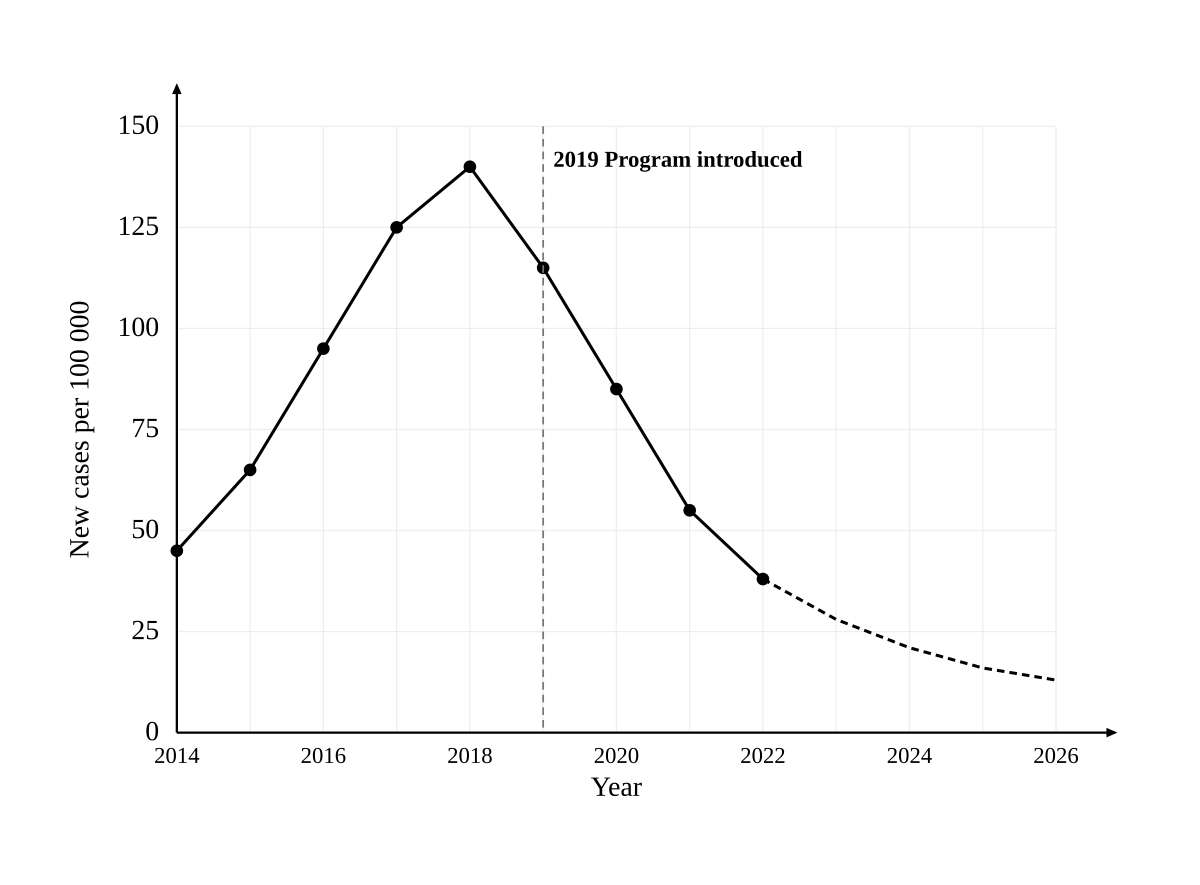
(b) Assess the effectiveness of the booster program in controlling whooping cough. In your answer, use data from the table and explain how a coverage of 94% protects individuals who are NOT vaccinated. (4)
A species of lizard lives on the mainland and on a small island 40 km offshore. The two populations have been isolated from each other for many years. In 2016, a cyclone reduced the island population from about 1500 lizards to 38 survivors. The table shows the frequency of allele B in each population.
table — Frequency of allele B. Mainland population (approx. 60 000 lizards): 2010: 0.61; 2014: 0.60; 2018: 0.59; 2022: 0.61; 2024: 0.60. Island population: 2010: 0.61; 2014: 0.60; 2018: 0.22; 2022: 0.18; 2024: 0.19. Survivors of the cyclone were no better adapted than the lizards that died.
(a) Explain the difference between the island and mainland allele frequencies after 2016. In your answer, name the process responsible, justify your choice using the data, and explain why the same change did NOT occur on the mainland. (4)
(b) A tourism operator begins ferrying lizards accidentally between the mainland and the island. Predict, with reasons, how this is expected to change the island population's gene pool. (2)
Chronic obstructive pulmonary disease (COPD) is a non-infectious lung disease.
(a) A town has a population of 50 000. During 2025 there were 150 newly diagnosed cases of COPD, and at the end of 2025 a total of 1200 residents were living with the disease.
Calculate the incidence of COPD in the town for 2025 (per 100 000 population) and the prevalence of COPD at the end of 2025 (as a percentage). (2)
(b) Researchers investigated whether long-term exposure to fine airborne particles from a nearby quarry causes COPD. They recruited 350 adults living in the suburb closest to the quarry, asked them to self-report their breathing symptoms in an online survey over 8 months, and compared the results with state-wide COPD rates. No information was collected about participants' smoking or occupations.
Evaluate the method of this study. In your answer, assess its validity and reliability, and make a judgement about whether its results could establish that quarry dust causes COPD. (5)
Panama disease is a fungal disease that kills Cavendish banana plants. A wild banana species carries a gene that provides resistance to the fungus. Scientists have produced a transgenic Cavendish banana that carries the wild species' resistance gene.
(a) Describe the process used to produce this transgenic banana plant, from the isolation of the resistance gene to a whole plant whose cells all carry the gene. Include the names of the enzymes and the vector involved. (4)
(b) The table shows three reproductive technologies used by a cattle breeding enterprise.
table — Technology 1: artificial insemination of the entire herd using semen from one champion bull. Technology 2: cloning of the enterprise's single highest-yielding cow, with the clones replacing other breeding cows. Technology 3: a cross-breeding program that introduces bulls of a different breed from another region.
Evaluate the effect of EACH technology on the genetic diversity of the herd, and make an overall judgement about the herd's long-term vulnerability if Technologies 1 and 2 are used together. (4)
| Q | Answer | Note |
|---|---|---|
| 1 | B | Prions are infectious misfolded proteins with no DNA or RNA |
| 2 | C | Ovulation → fertilisation (in the fallopian tube) → implantation → placenta |
| 3 | B | Complement of CTAGGT with U replacing T: GAUCCA (option A is the DNA complement — the classic trap) |
| 4 | A | A = T = 30%, so G + C = 40% and G = C = 20% |
| 5 | A | I^A i and I^B i offspring only: groups A or B; group O (ii) is impossible — the AB parent has no i allele |
| 6 | A | Crossing over between homologues in meiosis I recombines linked alleles |
| 7 | D | Only germ-line (gamete-producing) mutations are heritable |
| 8 | C | Random survival + small population = genetic drift (bottleneck); selection is excluded by the stem |
| 9 | B | One enzyme, one recognition site ⇒ matching complementary sticky ends; ligase (not the restriction enzyme) joins them |
| 10 | A | Nuclear DNA comes from the somatic-cell donor X |
| 11 | A | Protozoan pathogen, insect vector, indirect (vector-borne) transmission |
| 12 | C | Memory cells are antigen-specific and adaptive; A, B, D are innate first/second line |
| 13 | D | Pre-formed antibodies given medically = artificial passive; no memory is formed |
| 14 | B | Plants have no phagocytes or antibodies; programmed cell death (with wall thickening, antimicrobial compounds) is an active response — the cuticle is passive |
| 15 | C | Correlation only; causation needs controlled evidence |
| 16 | B | New cases unchanged ⇒ incidence unchanged; longer survival ⇒ more people living with it ⇒ prevalence rises |
| 17 | C | Vasodilation increases heat loss by radiation; A, B, D conserve or generate heat |
| 18 | B | Conductive blockage with intact cochlea ⇒ bypass the outer/middle ear via bone conduction; a cochlear implant is for a damaged cochlea |
| 19 | B | Myopia: focal point in front of retina ⇒ diverging lens moves it back; increasing corneal curvature worsens it |
| 20 | B | Urea diffuses down its concentration gradient (28 → 0); glucose has no gradient |
Q21 (a). X = virus (non-cellular, has nucleic acid); Y = prion (non-cellular, no nucleic acid); Z = fungus (cellular, membrane-bound nucleus). 2 marks for all three; 1 mark for two. (b). The toxin causes profuse watery diarrhoea, which expels enormous numbers of V. cholerae into the environment/water supply, contaminating water that new hosts drink — the symptom itself spreads the pathogen between hosts (transmission, not entry or survival).
Q22 (a). Mutation 1. It arose in the germ line (ovary lineage) before gamete formation, so it can be present in gametes and passed to the zygote; Mutation 2 is somatic — skin cells do not form gametes, so it dies with the individual. Both the identification and the gamete reasoning required for 2 marks. (b). Any one: the mutation is copied into the descendants of that skin cell (a clone of mutant cells); if it disrupts control of the cell cycle it may lead to a cancer such as melanoma; or it may have no effect if the affected gene is not expressed in skin.
Q23 (a). Incomplete dominance: the heterozygote's phenotype (blue-grey) is intermediate between the two homozygotes, shown by the first cross producing ONLY blue-grey offspring from black × white parents (neither parental phenotype reappears in F1, so neither allele is completely dominant). (b). Key: F^B = black allele, F^W = white allele; black = F^B F^B, blue-grey = F^B F^W, white = F^W F^W. Punnett square F^B F^W × F^B F^W → 1 F^B F^B : 2 F^B F^W : 1 F^W F^W = 1 black : 2 blue-grey : 1 white. Marks: key (1), correct square (1), phenotypic ratio stated (1). A genotypic ratio alone, or indistinguishable allele symbols (e.g. B and b, which imply dominance), loses the ratio mark.
Q24 (a). Autosomal recessive. Justification citing individuals: II-3 is affected although her parents I-1 and I-2 are both unaffected, so the allele is recessive (both parents are carriers). It cannot be X-linked recessive: an affected female (II-3, or III-2) must be homozygous and must therefore have received an affected X from her father, but her father (I-1, or II-4 respectively) is unaffected. Marks: recessive with individuals cited (1), autosomal exclusion argument with individuals cited (1), correct mode stated (1). "Somatic" for "autosomal" scores zero for that mark. (b). Key: A = normal allele, a = disorder allele. II-3 is aa (affected); II-4 is Aa (his father I-3 is affected aa, so II-4 must carry a; he is unaffected so he is Aa — also required by the affected child III-2). Punnett: aa × Aa → ½ Aa (unaffected) : ½ aa (affected). Probability = ½ (50%). Marks: keyed square with justified parental genotypes (1), probability (1).
Q25. A comparison on shared criteria (a table is ideal): Enzyme — DNA polymerase (replication) vs RNA polymerase (transcription); helicase unwinds in both/replication. Template — both strands of the entire DNA molecule (replication) vs one strand (template strand) of a single gene (transcription). Product — two identical double-stranded DNA molecules, each half original and half new (semi-conservative) vs a single-stranded mRNA molecule. Base pairing — A–T (replication) vs A–U (transcription); both use C–G. Marks: one per correct compared criterion up to 4; two separate descriptions that never align the criteria cap at 2 (2024 Q30(a) feedback).
Q26 (a). mRNA from the normal template: AUG CCU AAA UGU UAA; amino acids: methionine (start) – proline – lysine – cysteine – (stop). 1 mark mRNA (U not T; complementary), 1 mark amino acid chain read from the supplied table. (b). A substitution (point) mutation: the seventh template base T→A changes the third codon from AAA (lysine) to UAA (STOP) — a nonsense mutation. Translation terminates early, producing a truncated polypeptide of only two amino acids after methionine instead of the full chain; the shortened polypeptide cannot fold into its functional tertiary shape, so the protein loses its function. Marks: substitution identified (1), premature stop/truncation from the chart (1), link to folding/function (1). Note the frameshift trap: only one base is REPLACED, not inserted or deleted, so the reading frame is unchanged.
Q27 (a). Trisomy 21 (three copies of chromosome 21; Down syndrome) — 47 chromosomes. (b). During meiosis in one parent, the two homologous copies of chromosome 21 failed to separate at anaphase I (or sister chromatids failed to separate at anaphase II) — non-disjunction. This produced a gamete containing two copies of chromosome 21 (24 chromosomes) instead of one. Fertilisation of this gamete by a normal gamete (23 chromosomes, one copy of 21) produced a zygote with three copies of chromosome 21 and 47 chromosomes in every body cell. Marks: non-disjunction named (1), meiosis I/II mechanics of failed separation (1), abnormal gamete with 24 chromosomes (1), fertilisation step completing the trisomy (1). "Error in mitosis" scores at most 1.
Q28 (a). Stimulus: blood glucose rising above the set point — from 5.0 to 7.6 mmol L⁻¹ at 30 min. Response: insulin secretion rises (40 → 280 pmol L⁻¹, peaking at 45 min, just after the glucose peak) while glucagon falls (90 → 55 ng L⁻¹). Data values required. (b). Beta cells of the pancreatic islets detect the raised glucose and secrete insulin; insulin causes the liver (and muscle) to take up glucose and convert it to glycogen, and body cells to increase glucose uptake, so blood glucose falls (7.6 → 5.2 by 120 min). Alpha cells reduce glucagon secretion, so glycogen breakdown slows. As glucose returns to the set point, the stimulus for insulin release is removed and insulin falls back toward 40–60 pmol L⁻¹ — the response counteracts the original change and switches itself off, which is negative feedback. Marks: beta cells as detector (1), liver/glycogen effector action (1), the counteracting direction of change referenced to the graphs (1), the feedback loop closed (falling glucose removes the stimulus) (1). Naming insulin without glucagon-suppression or without the loop closing caps at 3.
Q29 (a). The plant detects the INTERNAL change — falling water content/turgor of its cells (not the hot weather itself). Abscisic acid (ABA) is produced and signals the guard cells; guard cells lose turgor and the stomata close, reducing transpiration so water loss no longer exceeds uptake and internal water is kept within tolerance limits. Marks: internal detection (1), ABA/guard-cell mechanism (1), stomatal closure reducing transpiration linked back to water balance (1). Structural adaptations (sunken stomata, thick cuticle) are not responses to a change and score zero here — the 2019 Q29 trap. (b). In negative feedback the response counteracts the stimulus and returns the variable to a set point. Here the response (contractions) INCREASES the stimulus (pressure on the cervix), which increases oxytocin release, which strengthens contractions — the loop amplifies the original change rather than opposing it, escalating until an endpoint (birth) removes the stimulus entirely. Marks: negative feedback defined by counteraction (1), amplification loop traced in the stimulus (1), endpoint/contrast completed (1).
Q30 (a). Urea diffuses from the blood (28 mmol L⁻¹) across the semi-permeable dialyser membrane into the dialysate (0 mmol L⁻¹) down its concentration gradient; constant replacement of dialysate maintains the gradient, so urea keeps leaving (28 → 9). Glucose shows no net movement because its concentration is equal (5.0 mmol L⁻¹) on both sides — no gradient. Plasma proteins and red blood cells are too large to cross the membrane's pores, so they are retained. Marks: urea gradient + diffusion (1), glucose equal concentrations (1), size exclusion of proteins/cells (1). "The machine cleans the blood" or "urea moves by osmosis" scores zero for that mark — the 2020 Q24(c) traps. (b). If the dialysate contained no glucose, glucose would diffuse out of the blood down a gradient; matching the dialysate glucose to normal blood concentration prevents the loss of this useful solute.
Q31 (a). Sample answer: Collect equal-volume water samples from several sites along the creek using sterile containers. Spread a fixed volume of each sample onto separate sterile nutrient agar plates. Controls: one plate spread with sterile distilled water, and one unopened sterile plate, to show any growth comes from the creek water and not the equipment or air. Controlled variables: volume of water per plate, type/depth of agar, incubation temperature (about 25–30 °C) and time (48 h), same sealing (tape, not fully airtight). Reliability: at least three plates per site, count colonies and compare with the controls. Marks: valid method with sterile technique (1), control treatment(s) (1), at least two controlled variables (1), repetition/replication for reliability (1). Confusing reliability (repeats agree) with validity (only the tested variable differs) loses a mark — flagged 2022 and 2024. (b). Incubation may have multiplied harmful (pathogenic) microorganisms to enormous numbers; opening the plate would expose students to them. Plates are sealed, examined through the lid, and sterilised before disposal. (c). The same bacterium must be found in all sufferers (and not in healthy people); it must be isolated from a sufferer and grown in pure culture; the cultured bacterium must cause the same disease when introduced into a healthy host; and it must be re-isolated from that host and shown to be identical. Any two postulate steps applied to this scenario for 2 marks.
Q32 (a). Points plotted accurately with axes labelled (1); a single smooth line/curve of best fit — NOT dot-to-dot — rising to the 2018 peak (138) then falling after 2019 (1); a dashed extrapolation beyond 2024 shown ON the graph, reading off a 2026 prediction of roughly 10–20 cases per 100 000 (1). The even-year graphing fixture: dot-to-dot and unshown extrapolation were the flagged errors in 2020, 2022 and 2024. (b). Judgement plus data: the program is effective — incidence rose steadily to 138 per 100 000 in 2018 but fell every year after the 2019 introduction, to 31 in 2024, a fall of about 78% while coverage rose from 74% to 94% (2). Herd immunity: at 94% coverage, so few susceptible hosts remain that chains of transmission are broken; an infected person is unlikely to contact an unvaccinated susceptible person, so even the ~6% unvaccinated are rarely exposed (2). Restating numbers without an explicit judgement caps at 2 — the 2021/2023 Q30 trap.
Q33 (a). Genetic drift (a bottleneck). Justification from data: the island frequency of B was stable (0.60–0.61) until the 2016 cyclone cut the population from ~1500 to 38; among the few random survivors the allele frequencies differed by chance from the original population (0.60 → 0.22), and the stem states survivors were no better adapted, ruling out natural selection. The mainland population (~60 000) is large, so chance deaths cannot appreciably shift its frequencies (0.59–0.61 throughout), and isolation means no gene flow between the populations. Marks: drift named (1), bottleneck/small-sample chance reasoning with data cited (1), selection excluded using the stem (1), population-size contrast for the mainland (1). Gene flow vs drift confusion is the most-flagged error in this topic (2022, 2025). (b). This introduces gene flow: alleles carried by migrating lizards enter the island gene pool, so the island's allele frequencies are expected to move back toward the mainland's (B rising from ~0.19 toward ~0.60) and the island population's genetic diversity increases. Process named (1), predicted direction/effect justified (1).
Q34 (a). Incidence 2025 = 150/50 000 = 0.3% = 300 per 100 000 per year. Prevalence = 1200/50 000 = 2.4%. One mark each; incidence counts NEW cases, prevalence counts all existing cases. (b). Weaknesses: self-reported symptoms in an online survey are subjective and unverified (measurement validity); no directly measured dust exposure; no matched control group of similar adults away from the quarry — state-wide rates differ in age, smoking and occupation; confounders (smoking, occupational dust) not recorded although smoking is the leading cause of COPD; 8 months is far too short for a chronic disease that develops over decades; 350 people from one suburb is a small, localised sample (any three, 3 marks). Reliability vs validity distinguished: repetition/consistency of results was not addressed, and reliability cannot rescue an invalid design (1). Judgement: the study can at best show a correlation; it cannot establish that quarry dust causes COPD — a longitudinal cohort with measured exposure, spirometry diagnosis, a matched unexposed control group and smoking data would be needed (1). No explicit judgement caps the response — flagged 2021, 2023, 2025.
Q35 (a). The resistance gene is cut out of the wild banana's DNA using a restriction enzyme, producing fragments with sticky ends; the same restriction enzyme cuts open a plasmid vector so its sticky ends are complementary; DNA ligase joins the gene into the plasmid (recombinant plasmid); the plasmid is inserted into bacteria (e.g. Agrobacterium), which are cultured to amplify the gene and then used to deliver it into Cavendish banana cells; transformed cells are grown by tissue culture into whole plants, so every cell of the regenerated plant — including its reproductive cells — carries the resistance gene. Marks: restriction enzyme/sticky ends (1), ligase + plasmid vector (1), amplification and delivery into plant cells (1), regeneration so ALL cells carry the gene, making the trait heritable (1). "Place the gene into the banana" without process terminology caps at 1 — the 2025 Q30(a) trap. (b). Technology 1: one bull fathers every calf, so the variety of paternal alleles collapses — genetic diversity falls sharply. Technology 2: clones are genetically identical to one cow, so diversity among breeding females falls to near zero for those animals. Technology 3: introduces alleles from a different breed's gene pool — diversity increases (gene flow). Overall judgement: used together, Technologies 1 and 2 leave the herd genetically uniform; a new disease or environmental change to which the champion genotypes are susceptible could affect almost every animal at once, so long-term vulnerability is high. Marks: one per technology judged on DIVERSITY (not on productivity) (3), explicit overall judgement linking uniformity to vulnerability (1). Effects on the organism instead of on the gene pool score zero per row — the 2023 Q34 trap.
| Paper item | Prediction | Agreement |
|---|---|---|
|
Section I Q1 ↑ Q1 |
topic-level consensus | 0.56 cluster · 6 (all) |
|
Section I Q2 ↑ Q2 |
topic-level consensus | rested: P(substantial) 0.51 · 3 models rest it |
|
Section I Q3 ↑ Q3 |
topic-level consensus | 0.70 (grok) · 2 (grok, fable) |
|
Section I Q4 ↑ Q4 |
topic-level consensus | 0.45 (fable) · 2 (fable, grok) |
|
Section I Q5 ↑ Q5 |
topic-level consensus | 0.55–0.58 · 2 (grok, opus) |
|
Section I Q7 ↑ Q7 |
topic-level consensus | 0.49 (gpt-5.6-sol) · 2 (gpt-5.6-sol, deepseek) |
|
Section I Q8 ↑ Q8 |
topic-level consensus | 0.50 (grok) · 2 (grok, opus) |
|
Section I Q9 ↑ Q9 |
topic-level consensus | 0.45 (grok) · 1 (grok) |
|
Section I Q11 ↑ Q11 |
topic-level consensus | 0.45 (grok) · 1 (grok) |
|
Section I Q12 ↑ Q12 |
watch list | 0.85 (fable) · 4 (fable, opus, grok, deepseek) |
|
Section I Q13 ↑ Q13 |
watch list | 0.50 (grok) · 2 (grok, opus) |
|
Section I Q14 ↑ Q14 |
watch list | 0.30 (opus) · 2 (opus, fable) |
|
Section I Q15 ↑ Q15 |
topic-level consensus | 0.55 (fable) · 2 (fable, gpt-5.6-sol) |
|
Section I Q16 ↑ Q16 |
watch list | 0.60 (fable) · 4 (fable, opus, grok, deepseek) |
|
Section I Q17 ↑ Q17 |
topic-level consensus | 0.40 (grok) · 1 (grok) |
|
Section I Q18 ↑ Q18 |
bio-q14-hearing-technologies | 0.52 cluster · 6 (all) |
|
Section I Q19 ↑ Q19 |
topic-level consensus | 0.38 (grok) · 3 (grok, gemini-3.1-pro, opus) |
|
Section I Q20 ↑ Q20 |
topic-level consensus | 0.53 cluster · 5 |
|
Q21 ↑ Q21 |
bio-q10-pathogen-classification-adaptation | 0.56 · 6 (all) |
|
Q22 ↑ Q22 |
bio-q4-somatic-vs-germline | 0.59 · 5 (fable, opus, gpt-5.6-sol, gemini-3.1-pro, deepseek) |
|
Q23 ↑ Q23 |
bio-q12-non-mendelian-cross | 0.55 · 4 (fable, opus, grok, deepseek) |
|
Q24 ↑ Q24 |
bio-q1-pedigree-mode-of-inheritance | 0.71 · 6 (all) |
|
Q25 ↑ Q25 |
bio-q9-dna-replication-written-return | 0.57 · 6 (all) |
|
Q26 ↑ Q26 |
bio-q3-codon-chart-mutation | 0.64 · 5 (fable, opus, gpt-5.6-sol, gemini-3.1-pro, deepseek; grok contrarian) |
|
Q27 ↑ Q27 |
watch list | 0.75 / 0.55 / 0.60 · 3 (gemini-3.1-pro, grok, deepseek) |
|
Q28 ↑ Q28 |
bio-q7-glucose-negative-feedback | 0.57 · 5 (fable, opus, gpt-5.6-sol, grok, deepseek) |
|
Q29 ↑ Q29 |
watch list | 0.45–0.75 / 0.32–0.55 · 5 / 3 |
|
Q30 ↑ Q30 |
bio-q13-kidney-dialysis | 0.53 · 5 (fable, opus, gpt-5.6-sol, grok, deepseek) |
|
Q31 ↑ Q31 |
watch list | 0.42–0.58 / 0.45–0.50 · 5 / 3 |
|
Q32 ↑ Q32 |
bio-q5-vaccination-program-analysis | 0.60 / 0.60 (fable) · 5 / 2 |
|
Q33 ↑ Q33 |
bio-q8-gene-pool-processes | 0.57 · 5 (fable, opus, gpt-5.6-sol, gemini-3.1-pro, grok) |
|
Q34 ↑ Q34 |
bio-q2-epidemiology-study-evaluation | 0.67 · 6 (all) |
|
Q35 ↑ Q35 |
bio-q6-transgenic-production-process | 0.57 / 0.55 · 6 / 5 |
Exam Success Program
Our 2027 program offers Biology practice exams under real conditions, with marking and personal feedback. See the ESP page for the program start and enquire about exam session availability.
2027 session times to be confirmed
Intu AI
Intu AI builds unlimited practice questions for Biology in these styles, marks your working, and explains what you missed — aligned to your syllabus.
Published Aug 2026, before the exams. In November 2026 we score these predictions publicly against the real paper — per-model calibration and question-level hit rates, the same harness as the 2025 backtest. How we did it.